

The Importance of Peptide Storage Temperature in Oman
The optimal peptide storage temperature in Oman dictates that lyophilised peptides require deep-freezing between -20°C and -80°C for long-term stability. Once reconstituted, liquid compounds must be strictly refrigerated at 2°C to 8°C. Protecting these fragile materials from extreme GCC heat prevents rapid molecular degradation.
Key Takeaways: Laboratory Handling in the GCC
- Lyophilised Storage: Keep unmixed freeze-dried powders in a manual-defrost freezer at -20°C or below for long-term preservation.
- Reconstituted Storage: Store liquid formulations strictly between 2°C and 8°C.
- Never Freeze Liquids: Freezing a reconstituted peptide will destroy its molecular structure.
- Thawing Protocols: Always allow cold vials to equilibrate to room temperature inside an airtight desiccator before opening to prevent condensation.
- Logistics: Demand vacuum-insulated cold-chain transit to protect shipments from Muscat’s extreme summer temperatures.
Sourcing and maintaining research materials in the Gulf Cooperation Council (GCC) presents specific logistical hurdles. Summer temperatures in Muscat, Salalah, and across the Sultanate routinely exceed 45°C. For procurement staff and laboratory technicians, understanding precise temperature tolerances is non-negotiable. Standard, non-refrigerated courier transport poses a severe risk to the structural integrity of these sensitive compounds, often rendering them biologically inactive before testing even begins.
When evaluating suppliers and planning laboratory protocols, buyers must account for the distinct physical states of their compounds: lyophilised (freeze-dried) and reconstituted (liquid). Each state has entirely different thermal thresholds. Failing to maintain these thresholds accelerates chemical degradation. This comprehensive guide outlines how to manage temperature controls, navigate local customs clearance, evaluate third-party testing, and select a supplier capable of surviving the intense Omani climate.
The Chemistry of Degradation: Heat, Moisture, and Light
To understand why strict temperature adherence is necessary, researchers must understand the specific degradation pathways accelerated by the GCC environment. High temperatures, humidity, and light exposure are the primary enemies of peptide purity.
Hydrolysis and the Danger of Ambient Moisture
Peptides are highly hygroscopic, meaning they rapidly absorb moisture from the surrounding air. When a cold vial is removed from the freezer or refrigerator and immediately opened in a humid, warm environment—such as a naturally ventilated laboratory area during an Omani summer—condensation instantly forms on the powder inside.
This trapped moisture initiates hydrolysis, a chemical reaction where water molecules cleave the peptide bonds, breaking the chain into smaller, inactive fragments. To prevent condensation, standard laboratory protocol dictates that researchers must always allow cold vials to fully equilibrate to ambient room temperature inside an airtight desiccator before removing the seal.
Oxidation of Sensitive Amino Acids
Certain amino acid residues—specifically Cysteine (Cys), Methionine (Met), and Tryptophan (Trp)—are highly susceptible to oxidation. Ambient heat significantly accelerates this process. When exposed to oxygen at elevated temperatures, these residues degrade, altering the compound’s structure and behavior. Premium suppliers mitigate this risk during manufacturing by purging vials with inert gases like nitrogen or argon, creating an anaerobic environment inside the sealed vial. However, once that seal is broken, temperature control becomes the primary defense against rapid oxidation.
Deamidation and Photosensitivity
Deamidation is another common degradation pathway, particularly for sequences containing Asparagine (Asn) or Glutamine (Gln). This reaction is accelerated by both heat and shifts in pH. Furthermore, many experimental compounds are photosensitive. Prolonged exposure to ultraviolet (UV) light can induce photo-degradation. Research materials should always be stored in dark, opaque containers or amber glass vials, kept strictly away from direct sunlight and harsh laboratory lighting.
Lyophilised vs. Reconstituted: Adapting Lab Protocols
The physical state of your research material dictates its environmental resilience. Implementing state-specific handling procedures is the foundation of any robust laboratory storage strategy.
Preserving Lyophilised Peptides
Most premium research peptides arrive in a lyophilised state. Freeze-drying removes the water content, leaving behind a stable, solid powder. Because moisture is the primary catalyst for rapid chemical degradation, lyophilised vials are significantly more resilient to ambient temperatures than their liquid counterparts.
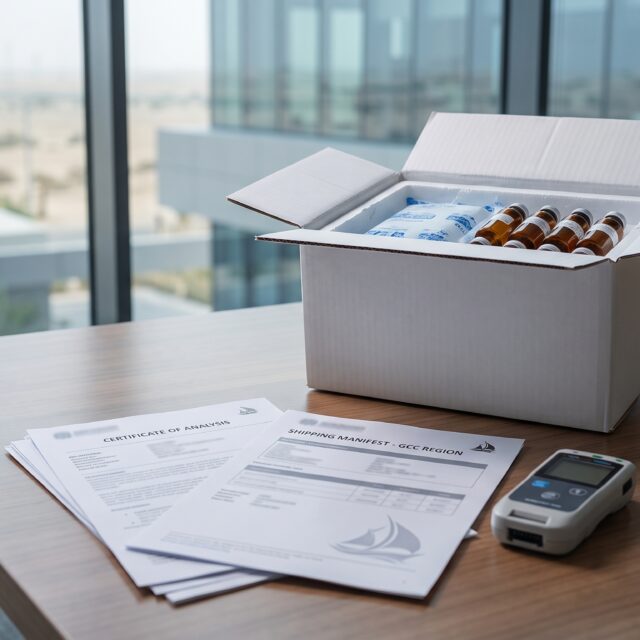
For short-term transit, lyophilised compounds can withstand ambient room temperatures for brief periods without measurable loss of purity. However, ambient room temperature in a controlled laboratory differs vastly from the interior of a Muscat delivery van. Competent suppliers therefore utilize phase-change cool packs and vacuum-insulated packaging to buffer against extreme heat spikes during local transit.
Once lyophilised vials arrive at your facility, long-term storage protocols must begin immediately. To preserve the molecular structure for months or years, store these vials in a deep freezer at temperatures ranging from -20°C to -80°C. Researchers should prioritize a manual-defrost freezer over standard commercial auto-defrost units. Auto-defrost freezers regularly cycle temperatures above freezing to melt ice buildup, and these continuous thermal fluctuations will gradually degrade the peptide structure over time.
Refrigerating Reconstituted Peptides
Once a lyophilised powder is reconstituted with bacteriostatic water or sterile saline, the compound becomes highly fragile. The reintroduction of moisture immediately creates the potential for bacterial growth and rapid structural breakdown.
Reconstituted liquid peptides must be transferred to a refrigerator immediately. The strict temperature window for liquid formulations is 2°C to 8°C. Under these refrigerated conditions, most common research peptides remain stable for 14 to 30 days, depending on their specific amino acid sequence and the sterility of the reconstitution environment.
Crucially, never freeze a reconstituted peptide. Freezing a liquid peptide causes the formation of ice crystals. As these crystals expand, they physically shear and destroy the delicate molecular bonds of the compound, completely ruining the material for laboratory use.
Navigating Cold-Chain Transit and Bayan Customs Clearance
Sourcing high-purity materials is only half the challenge; getting them safely through local logistics networks is the other. Importing research chemicals into Oman requires navigating the Royal Oman Police Bayan customs portal. Unregistered research materials must be declared accurately using correct Harmonized System (HS) codes (such as 3824.99.99 for specific laboratory chemicals) to avoid extended delays at the border.
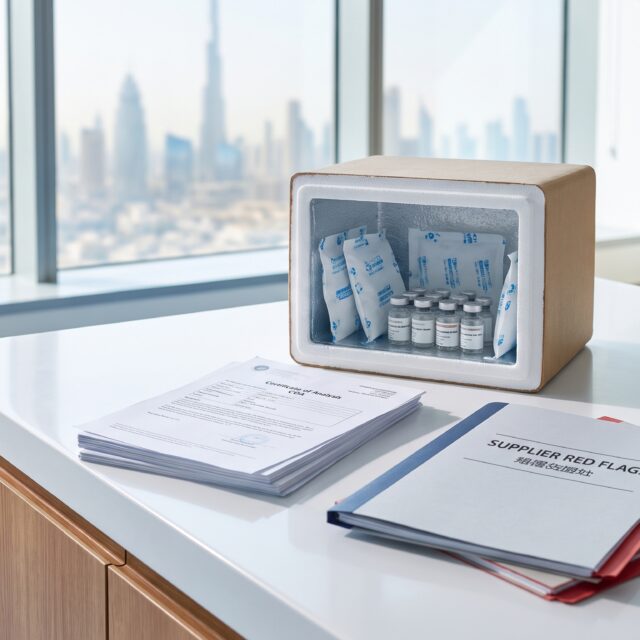
A delay at customs during the peak of an Omani summer can easily destroy a shipment if the supplier has not utilized adequate cold-chain packaging. When evaluating a supplier, inquire about their logistics infrastructure. Do they use vacuum-insulated panels? Are they incorporating phase-change cooling materials designed to hold strict temperature thresholds for 48 to 72 hours?
If you operate within the GCC, partnering with a supplier that understands these regional hurdles is vital. You can review rapid GCC delivery protocols to see how modern cold-chain fulfillment operates directly from regional hubs, bypassing international transit delays and ensuring materials arrive within their required thermal thresholds.
Supplier Checklist: Verifying Quality Before Ordering
Verifying the optimal storage temperature is just one part of maintaining lab standards. Informed buyers must rely on concrete, verifiable proof of quality and operational competence rather than marketing claims alone. Before procuring compounds for your facility in Oman, run through this rigorous checklist:
- Third-Party Testing (COA/HPLC): Does the supplier provide a recent, batch-specific Certificate of Analysis (COA)? You must be able to view High-Performance Liquid Chromatography (HPLC) and Mass Spectrometry (MS) reports proving a purity level of 99% or higher. Without a COA, you cannot verify the structural integrity of your baseline materials.
- Regional Fulfillment: Do they ship from a regional hub (such as Dubai) to minimize transit time to Oman, or are you risking a two-week international journey through multiple non-refrigerated customs warehouses?
- Proper Packaging: Do they explicitly detail their cold-chain shipping methods for GCC deliveries?
- Responsive Support: Do they offer direct communication channels, such as WhatsApp or dedicated enterprise support, to assist with customs documentation, Bayan portal queries, or delivery coordination?
- Payment Flexibility: Do they offer secure institutional payment gateways, crypto, or regional payment options tailored to GCC research buyers?
Securing Your Research Investment
Maintaining the correct peptide storage temperature in Oman is essential for securing the integrity of your research investment. The extreme GCC climate leaves absolutely no room for error. Store lyophilised powders in a manual-defrost freezer at -20°C or below, strictly refrigerate reconstituted liquids between 2°C and 8°C, never refreeze liquid compounds, and always allow vials to reach room temperature in a desiccator before opening to prevent moisture damage.
By partnering with a regionally competent supplier providing transparent COA documentation, advanced cold-chain transit, and dedicated GCC logistics support, researchers can confidently bypass the environmental risks of the local climate. To source verified, purity-tested materials backed by robust regional logistics, browse verified research peptides designed to meet rigorous laboratory standards.
Disclaimer: The products mentioned in this article are for in-vitro research and laboratory purposes only. They are strictly not intended for human consumption, therapeutic use, or diagnostic applications.
References
- Bachem. (2021). General Guidelines for Peptide Storage and Handling.
- Royal Oman Police (ROP) Directorate General of Customs. Bayan System Regulations for Chemical Imports.
- D’Hondt, M., et al. (2014). Related impurities in peptide medicines. Journal of Pharmaceutical and Biomedical Analysis.
- Al Barrak Group. Cold Chain Logistics for GCC’s Food and Pharma Supply Chains.
- Swiss Pharma. Why Cold-Chain Matters for Peptide Stability in Extreme Heat environments.
Disclaimer: The products mentioned in this article are for research purposes only and are not intended for human consumption.
- Oman Cold Chain Peptide Delivery Guide | Transport & – NOVA Labs
- How to Store Peptides: Fridge, Freezer & Shelf Life Guide
- Peptide Storage Temperature Bahrain: Lab & Handling Guide – NOVA Labs
- How to Store Research Peptides: Complete UK Guide to Stability and Shelf Life (2026)
- UAE Shipping Information | UAE Core Peptides
- Why Cold-Chain Matters for Peptide Stability, Especially in UAE Heat – Swiss Pharma
- Buying Research Peptides UAE — the 2026 buyer-evaluation guide – Wellness Labs
- Cold Chain Logistics for GCC’s Food and Pharma Supply Chains – Al Barrak Group
Frequently asked questions
What is the optimal peptide storage temperature in Oman?
For optimal stability, lyophilised (powdered) peptides should be stored in a manual-defrost freezer between -20°C and -80°C. Reconstituted (liquid) peptides must be kept in a refrigerator strictly between 2°C and 8°C.
Can lyophilised peptides survive the summer heat in Oman during delivery?
Yes, short-term transit is safe provided the supplier uses proper cold-chain packaging, such as vacuum-insulated panels and phase-change cool packs, to buffer the extreme ambient GCC temperatures.
Why shouldn't I freeze reconstituted research peptides?
Freezing liquid peptides causes the formation of ice crystals. As these crystals expand, they physically shear and destroy the delicate molecular structure of the compound, rendering it biologically inactive for research purposes.
How do I prevent moisture damage when opening cold peptide vials?
Peptides are highly hygroscopic. Always allow cold vials to fully equilibrate to ambient room temperature inside an airtight desiccator before opening to prevent condensation and subsequent hydrolysis.
How long do reconstituted peptides remain stable in the refrigerator?
When properly mixed with bacteriostatic water or sterile saline and stored between 2°C and 8°C, most reconstituted research peptides remain chemically stable and viable for 14 to 30 days, depending on the sequence.
Nova Labs buyer tools
Ready to verify stock, testing and delivery?
Use the product page and lab report section to check availability, documentation, delivery timing and support before placing an order.
- COA / test-report checks
- Oman delivery context
- Cold-chain handling
- COD and card payment options
- WhatsApp support