
Sourcing Analytical-Grade Peptides in the GCC
Procuring high-purity laboratory reagents in the Gulf Cooperation Council (GCC) presents a unique set of logistical and regulatory challenges. For procurement officers and laboratory professionals looking to buy GHK-Cu in Oman, the process involves far more than simply placing an order and waiting for delivery. Sourcing verifiable, analytical-grade compounds requires navigating strict regional customs frameworks, mitigating the severe risks of thermal degradation during transit, and meticulously verifying third-party documentation.
As the demand for this copper-binding peptide grows across analytical, biochemical, and material science sectors, the market has become saturated with varying grades of the compound. Institutional buyers in Muscat and beyond must be able to confidently differentiate between consumer-grade formulations and pure lyophilized research materials to ensure the integrity of their laboratory work.
Quick Answer: How to Buy GHK-Cu in Oman
To successfully buy GHK-Cu in Oman for research, buyers must source lyophilized powder backed by verifiable HPLC/MS Certificates of Analysis. Ordering from regional GCC suppliers ensures faster transit, bypasses lengthy international ROP Bayan customs holds, and prevents thermal degradation in Oman’s +45°C heat. Always declare shipments as laboratory reagents.
Differentiating Cosmetic Serums from Lyophilized Research Powder
When evaluating a GHK-Cu supplier in Oman, procurement teams must immediately distinguish between retail cosmetics and analytical-grade peptides. The market primarily caters to two entirely different end-users.
The Consumer Retail Market
On popular e-commerce platforms like Noon and Ubuy Oman, buyers frequently encounter GHK-Cu integrated into topical serums and creams. These formulations typically contain a very low concentration of the peptide—often between 1% and 4%—blended with various excipients, preservatives, and carrier oils. While these pre-mixed solutions serve the general consumer skincare market, they are entirely useless for quantitative laboratory analysis, structural research, or controlled in-vitro studies. Clinical environments in Muscat also utilize completely different, specific clinical-grade preparations for mesotherapy under strict medical supervision.
The Institutional Research Requirement
In contrast, independent researchers and procurement staff require pure, unadulterated GHK-Cu peptide. This means procuring the compound in a lyophilized (freeze-dried) powder format without any added binders or cosmetic carriers. Lyophilized powder allows researchers to reconstitute the peptide using specific solvents (like bacteriostatic water or sterile saline) at the exact concentrations required for their unique experimental protocols. When you order GHK-Cu in Oman for a laboratory setting, ensuring you are receiving raw, high-purity powder is the foundational step in supplier evaluation.
Navigating Oman’s Customs and MoH Import Regulations
Importing chemical reagents into the Sultanate of Oman requires strict adherence to local regulatory frameworks. For institutional buyers, the primary hurdle is clearing the Royal Oman Police (ROP) Bayan single-window customs system. This integrated electronic system links various government ministries to monitor imports and enforce national safety standards.
The Role of MoH and MoCIIP
The Ministry of Health (MoH) Drug Safety Center and the Ministry of Commerce, Industry and Investment Promotion (MoCIIP) closely monitor the importation of biochemicals. When bringing research peptides across the border, documentation must be flawless.
If a shipment of GHK-Cu is improperly labeled or misconstrued as a finished pharmaceutical drug or cosmetic product, it will be flagged for medical registration. This leads to immediate customs holds. The compound must be explicitly declared and labeled as a “research-use laboratory reagent.”
The Cost of Documentation Errors
Minor discrepancies in commercial invoices, missing Material Safety Data Sheets (MSDS), or ambiguous product descriptions can trigger secondary laboratory testing by Omani customs authorities. This delays the arrival of time-sensitive research materials and can incur severe demurrage fees. Buyers must partner with suppliers who understand GCC customs nuances and provide exact, compliant documentation to facilitate smooth transit through the Bayan system.
The Impact of GCC Temperatures on Peptide Stability
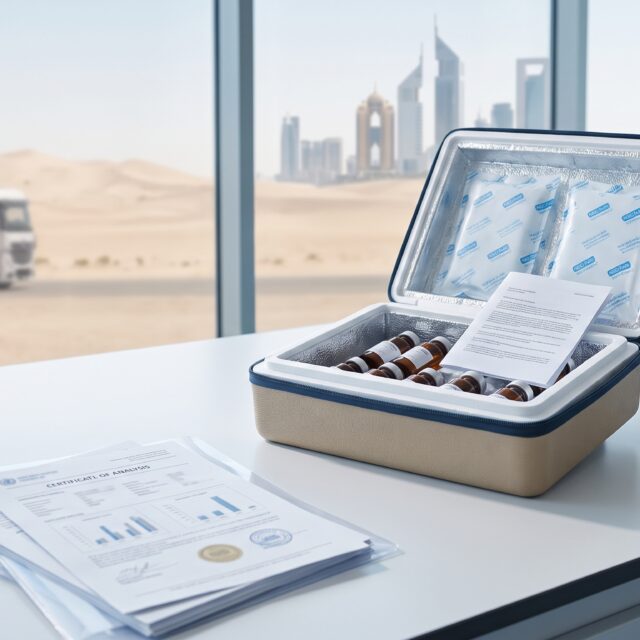
One of the most critical factors to consider when purchasing laboratory peptides in the Middle East is the region’s climate. Oman experiences intense heat, with summer transit temperatures frequently exceeding +45°C (113°F). Peptides, particularly when in an aqueous state, are highly susceptible to thermal degradation. Heat exposure breaks down the molecular bonds of the peptide, altering its structural integrity and rendering it useless for precise analytical research.
Why Lyophilization is Non-Negotiable
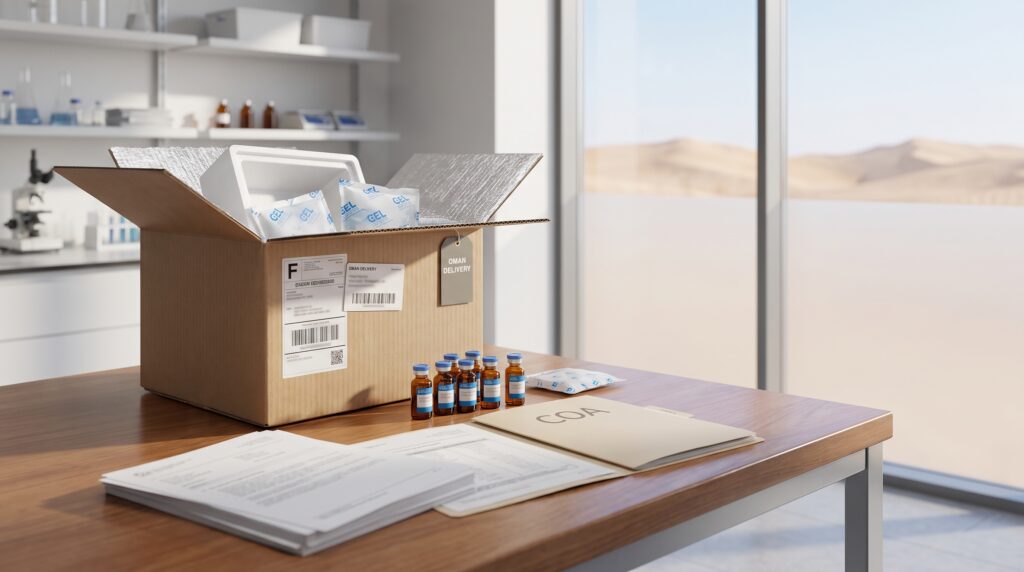
To survive extreme transit conditions, GHK-Cu must be shipped as a lyophilized powder. The freeze-drying process removes moisture, placing the peptide in a dormant, stable state that is significantly more resilient to temperature fluctuations than pre-mixed liquid solutions. However, even lyophilized peptides have thermal limits, and prolonged exposure to high heat during a lengthy international shipping route can still compromise purity.
The Advantage of Regional Logistics Hubs
Sourcing from a regional supplier within the GCC is a massive logistical advantage. Relying on international drop-shipping from overseas manufacturers often means the package will sit in unconditioned transit facilities or face multi-week customs delays. Leveraging regional UAE next-day dispatch and GCC logistics capabilities ensures that the peptide spends the absolute minimum time in transit, preserving its molecular integrity and arriving at your Omani laboratory ready for precise reconstitution.
Evaluating the COA: What Omani Buyers Must Check
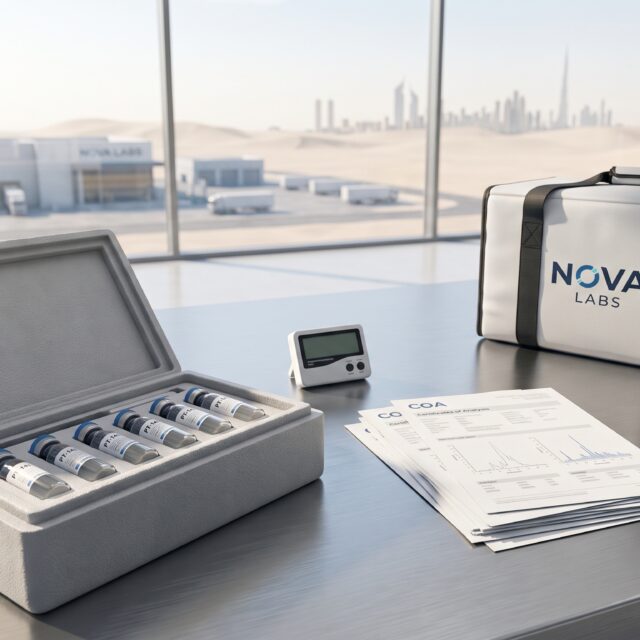
The cornerstone of confidence in any chemical supplier is their approach to third-party testing and documentation. High-purity pricing and institutional acceptance rely entirely on batch-specific Certificates of Analysis (COA). A trustworthy supplier will not merely claim high purity; they will provide transparent, verifiable data.
High-Performance Liquid Chromatography (HPLC)
HPLC is the standard method for determining the purity of a peptide. The HPLC report separates the components of the sample, providing a clear visualization of the primary compound versus any residual impurities or byproducts left over from the synthesis process. For robust research applications, buyers should expect an HPLC purity rating of 99% or higher.
Mass Spectrometry (MS)
While HPLC confirms purity, Mass Spectrometry (MS) confirms identity. The MS report verifies the molecular weight of the compound, ensuring that the synthesized powder is exactly the sequence of GHK-Cu (Glycyl-L-Histidyl-L-Lysine complexed with copper).
When evaluating a supplier, buyers should ensure that the COA matches the specific batch being purchased. At NOVA Labs, we prioritize institutional transparency. Researchers can access batch-verified documentation when they evaluate our pure lyophilized GHK-Cu, ensuring that the materials they receive meet the rigorous analytical standards required for reproducible science.
The Bottom Line for Omani Researchers
Procuring GHK-Cu in Oman requires a strategic approach to bypass the pitfalls of retail formulations, international shipping delays, and thermal degradation. By insisting on lyophilized powder, verifying batch-specific HPLC and MS reports, and leveraging regional GCC logistics to navigate the ROP Bayan customs system, researchers can secure the high-purity compounds necessary for their work.
When you are ready to source verified, research-grade materials with transparent documentation and optimized regional delivery, choose a supplier built for the specific demands of the Middle Eastern market.
*
Disclaimer: The products mentioned in this article are strictly for in-vitro research and laboratory use only. They are not intended for human consumption, therapeutic use, or medical treatment.
References
- Oman Customs (Royal Oman Police). Bayan Customs System Guidelines and Clearance Procedures.
- Ministry of Commerce, Industry and Investment Promotion (MoCIIP) Oman. Import Regulations for Chemical and Laboratory Reagents.
- Global logistics reports on thermal degradation of lyophilized biologicals in high-temperature environments (+45°C GCC summer transit profiles).
Disclaimer: The products mentioned in this article are for research purposes only and are not intended for human consumption.
- Buy GHK-Cu Oman: Purity, COAs & Fast Delivery Guide – NOVA Labs
- Peptide Supplier Checklist Oman: Buyer Guide & Import – NOVA Labs
- Peptides Treatment in Muscat | Anti-Ageing Peptide Therapy – Enfield Royal Clinics Oman
- Customs Clearance Services in Oman – Arabital Shipping LLC
- Cold Chain Logistics Oman for Pharmaceutical Distribution – Clarion Shipping
- Copper Peptide GHK-Cu Bulk Wholesale Supplier | Factory Price Oman
Frequently asked questions
How do I clear GHK-Cu through Oman customs?
GHK-Cu and other research peptides must be cleared through the ROP Bayan single-window system. The shipment must be clearly labeled as a research-use laboratory reagent, backed by proper MSDS and commercial invoices, to avoid delays with the Ministry of Health (MoH).
Is GHK-Cu stable during shipping to Oman in the summer?
Aqueous peptide solutions are highly susceptible to thermal degradation in Oman's +45°C heat. To ensure stability, researchers must purchase GHK-Cu strictly as a lyophilized (freeze-dried) powder and utilize fast, regional GCC shipping routes to minimize transit time.
What documentation should I request from a GHK-Cu supplier in Oman?
Institutional buyers should demand a batch-specific Certificate of Analysis (COA) that includes both High-Performance Liquid Chromatography (HPLC) for purity percentage and Mass Spectrometry (MS) to verify the precise molecular weight of the peptide.
Can I use cosmetic GHK-Cu serums for laboratory research?
No. Retail cosmetic serums typically contain low peptide concentrations (1% to 4%) mixed with carrier oils, binders, and preservatives. Quantitative laboratory research requires 99% pure, unadulterated lyophilized GHK-Cu powder.
Nova Labs buyer tools
Ready to verify stock, testing and delivery?
Use the product page and lab report section to check availability, documentation, delivery timing and support before placing an order.
- COA / test-report checks
- Oman delivery context
- Cold-chain handling
- COD and card payment options
- WhatsApp support