



The Critical Need for Cold Chain Peptide Delivery UAE
Quick answer: Cold chain peptide delivery in the UAE relies on advanced thermal packaging and localized fulfillment to protect sensitive lyophilized compounds from thermal degradation. Using Expanded Polystyrene insulation, phase-change cooling packs, and domestic next-day dispatch, researchers avoid international customs delays and ensure strict temperature control.
For researchers, laboratory managers, and procurement specialists operating in the Gulf, the environment poses a unique and relentless threat to biological compounds. Sourcing high-purity research materials is only half the challenge; ensuring they survive transit is the other. Extreme ambient temperatures can rapidly compromise molecular stability, making cold chain peptide delivery UAE logistics the most critical factor in securing viable compounds.
Without an unbroken thermal control system, even the highest-grade compounds will arrive at the laboratory degraded and practically useless. For buyers evaluating local and international suppliers, understanding the mechanics of thermal packaging, the severe risks of cross-border customs delays, and the specific stability requirements of lyophilized formats is essential for protecting research investments and maintaining assay reproducibility.
The Science of Thermal Degradation in 45°C Heat
Peptides are structurally delicate chains of amino acids that require specific, controlled handling to maintain their molecular integrity. When exposed to the severe heat typical of the UAE and the broader GCC region—frequently exceeding 40°C in ambient air and much hotter inside transport vehicles—chemical reaction rates accelerate dramatically.
Research indicates that for many sensitive biological compounds, the rate of chemical degradation essentially doubles for every 10°C increase in temperature. The primary vectors of thermal degradation include:
- Hydrolysis: The cleavage of peptide bonds by water molecules, a reaction accelerated by elevated temperatures.
- Oxidation: Exposure to oxygen and light, combined with heat, leading to the alteration of specific amino acid residues (such as methionine and tryptophan).
- Deamidation: A common degradation pathway in asparagine and glutamine residues that is highly temperature-dependent.
During the peak of summer, uncooled last-mile delivery vans in Dubai, Abu Dhabi, or Sharjah can routinely exceed 60°C. If a shipment is left unprotected in these conditions, the molecular bonds can denature almost immediately, rendering the compound useless for in vitro research.
Lyophilized vs. Pre-Mixed Liquid Formulations
Understanding the physical state of the compound is the very first step in mitigating heat risk. Reputable suppliers exclusively ship peptides in a lyophilized (freeze-dried) format. Lyophilization is a specialized process that removes the water content under a vacuum, creating a stable, crystalline powder (often called a ‘puck’). This state is significantly more resilient to temperature fluctuations than its liquid counterpart.
Conversely, pre-mixed liquid or pre-reconstituted peptides are highly unstable. Without uninterrupted, active refrigeration (strictly maintained between 2°C to 8°C at all times), liquid formulations degrade rapidly in regional heat. Purchasing pre-mixed liquid formulations from vendors is widely considered a major procurement red flag by laboratory managers, as their survival in local transit without active, motorized cold-chain logistics is highly improbable.
The Customs Trap: Local UAE Fulfillment vs. Importation
Historically, independent researchers and institutions in the Middle East have relied on importing materials from the United States, the UK, or Europe. However, international shipping exposes sensitive biologicals to severe logistical bottlenecks and environmental threats.
When a package arrives at international transit hubs in Dubai (DXB) or Abu Dhabi (AUH), it must undergo customs and regulatory clearance. This process is highly unpredictable. Standard international couriers frequently hold packages in unconditioned airport warehouses or, worse, directly on the tarmac waiting for processing. A single 24-hour delay in a non-climate-controlled environment can completely compromise the shelf life of the enclosed research materials, even if they were packed with dry ice (which typically sublimates within 48 to 72 hours).
This is why true cold chain peptide delivery for research peptides UAE necessitates a localized approach. Sourcing from a domestic supplier with local UAE stock eliminates cross-border customs declarations entirely. It reduces the entire transit window to under 24 hours. Because the items are already in-country, they can go straight from a climate-controlled freezer facility into protective packaging and out for delivery, ensuring the passive cooling materials inside do not expire before the package reaches your lab bench.
Packaging Logistics: Anatomy of a Gulf-Safe Shipment
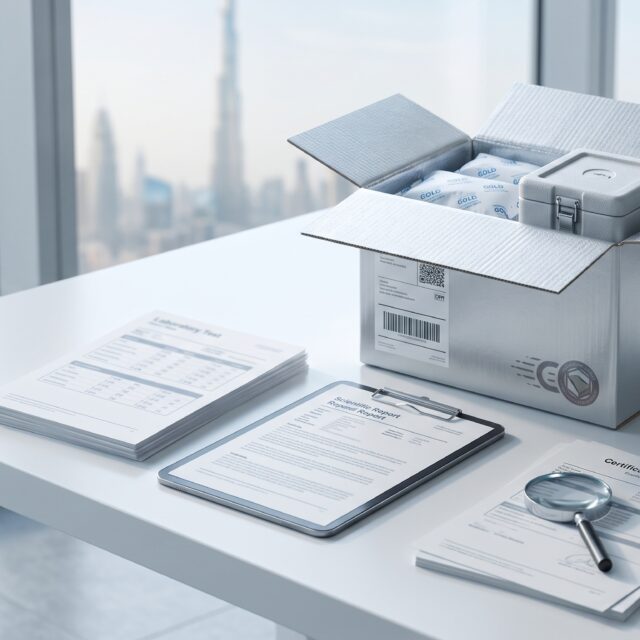
When evaluating a supplier’s logistics, it is vital to know exactly how the materials are protected during transit. Active cold-chain delivery in the Gulf region relies on sophisticated passive thermal packaging designed to buy maximum time against ambient heat.
If you are ordering research compounds locally, your delivery must incorporate the following protective measures:
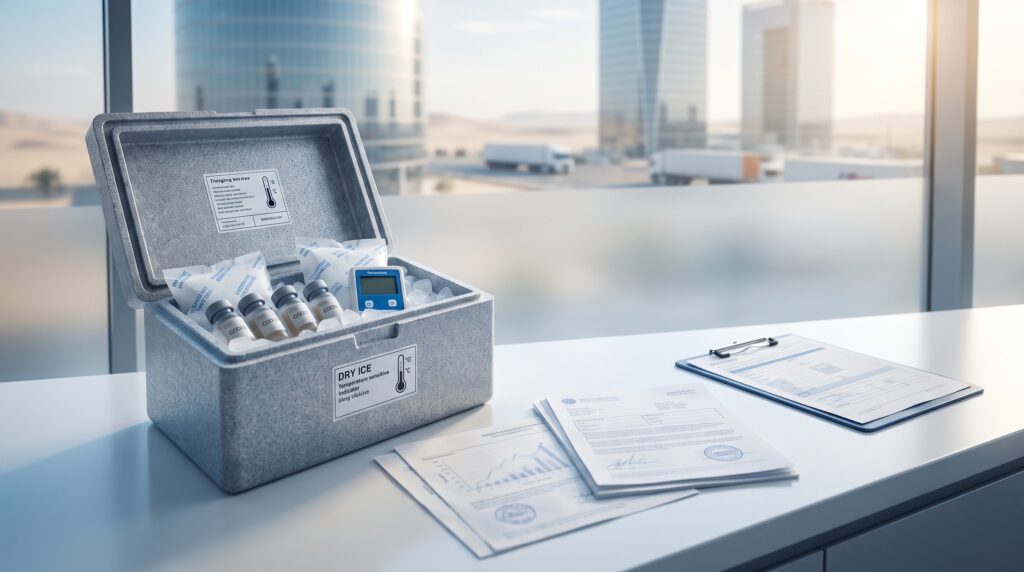
- Expanded Polystyrene (EPS) Insulation: Standard corrugated cardboard boxes are entirely insufficient. The vials must be encased in multi-layered EPS or dense polyurethane foam coolers. This creates a thick thermal barrier against external heat transfer.
- Phase-Change Cooling Packs: Standard water-based ice melts far too quickly. Reliable logistics require cryogenic cooling gel packs or specialized phase-change materials that absorb heat and maintain a consistent low temperature within the insulated box for up to 48 hours.
- Light Protection: Amber vials or opaque secondary packaging should be used to protect light-sensitive amino acid chains from UV degradation during handling and storage.
If a supplier simply drops unprotected vials into a standard plastic courier flyer for a mid-day Dubai delivery, the structural viability of those compounds is highly suspect.
Purchasing, Procurement, and Support Checks
Procuring specialized compounds in the UAE is not just about the shipping box; it is about the broader vendor ecosystem. Laboratory procurement requires efficiency, transparency, and accessible support. When vetting a localized supplier, look for these critical service pillars:
- Rapid Dispatch Times: To minimize transit exposure, orders should be dispatched the same or next business day. You should expect transparent cutoff times for next-day dispatch.
- Accessible Customer Support: Given the time-sensitive nature of biological deliveries, suppliers offering dedicated WhatsApp support or responsive local ticketing systems provide a major advantage for managing delivery windows and bulk orders.
- Secure Payment Gateways: Reputable local vendors offer robust and familiar payment options, ensuring institutional purchases can be processed smoothly via credit card or secure localized gateways without relying on opaque, high-risk wire transfers.
By leveraging localized support and streamlined payment systems, procurement teams can operate with the same confidence they expect from global scientific supply chains, but with localized speed.
Evaluating Supplier Trust and Quality Control
Even the most advanced EPS thermal packaging is irrelevant if the underlying compound is impure from the start. As the UAE research market matures, the standard for supplier transparency has shifted. Buyers must verify both the logistical competence and the analytical documentation of a vendor before placing an order.
Cryptographic HPLC/MS Documentation
Do not accept static PDF certificates of analysis (COAs) provided in an email, as these are easily fabricated or outdated. Reputable regional vendors provide batch-specific High-Performance Liquid Chromatography (HPLC) and Mass-Spectrometry (MS) testing.
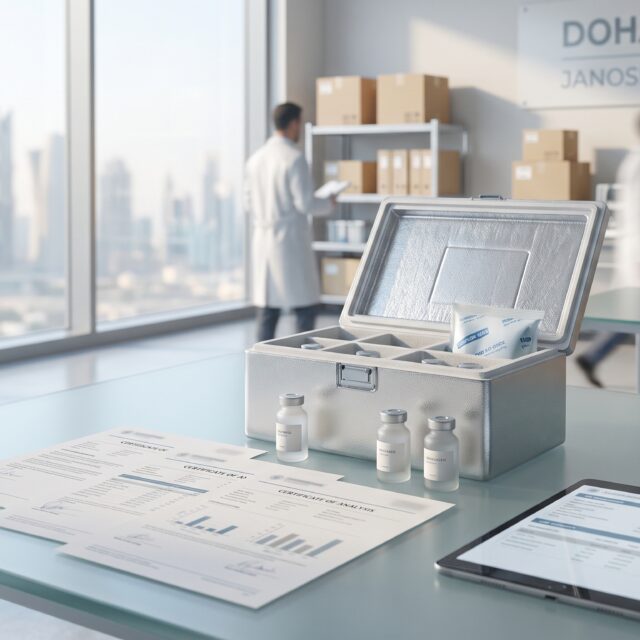
Crucially, this testing should be verified via independent cryptographic platforms, such as Janoshik Analytical. These laboratories provide a unique verification key and QR code on the document. This allows the buyer to go to the third-party tester’s website, enter the key, and independently confirm the purity (ideally 99%+) directly with the testing laboratory, completely bypassing the vendor’s claims.
Post-Delivery Handling: The Equilibration Rule
Securing cold chain peptide delivery in the UAE is only successful if proper protocols are followed once the package physically arrives. A common, yet catastrophic, mistake made by laboratory staff is opening cold vials immediately upon receiving them.
This triggers a mandatory handling step known as the Equilibration Rule. When a refrigerated or frozen vial is exposed to humid, room-temperature air (which is very common in coastal UAE cities like Dubai), condensation instantly forms on and inside the cold glass. This introduction of moisture causes immediate hydrolytic degradation of the lyophilized powder.
To prevent this, buyers must allow the sealed vials to sit in a climate-controlled room for 10 to 15 minutes upon removal from the thermal shipping box. Allowing the vials to naturally warm to room temperature before removing the protective caps or unsealing the stoppers ensures that no destructive condensation is introduced to the freeze-dried puck.
Secure Procurement with NOVA Labs
For researchers seeking absolute confidence in both product purity and logistical execution, sourcing through a dedicated local supplier is paramount. NOVA Labs bridges the gap between rigorous analytical testing and optimized regional fulfillment.
By maintaining local stock within the UAE, we bypass the customs delays that routinely destroy internationally imported compounds. Researchers can rely on our advanced logistics to ensure secure, fast cold-chain delivery that keeps time-in-transit to an absolute minimum. Every dispatch utilizes proper EPS thermal insulation and phase-change cooling packs, guaranteeing that the ambient Gulf heat does not penetrate the core of the shipment.
Furthermore, all available inventory is backed by verifiable, third-party cryptographic HPLC and MS testing. When it is time to restock your laboratory or research facility, explore our complete product catalog to review the exact purity documentation linked to the current batch, ensuring your next study is built on a foundation of uncompromised quality.
Conclusion & Final Checklist
Navigating the procurement of sensitive biologicals in a high-heat environment leaves no room for logistical errors. The viability of your research depends directly on how those compounds are treated between the supplier’s freezer and your laboratory bench.
Prioritizing true cold chain peptide delivery in the UAE ensures that your investment is protected by specialized thermal packaging, rapid local dispatch, and rigorous handling protocols. Always demand lyophilized formulations, verify cryptographic third-party COAs, and ensure your supplier utilizes proper EPS insulation and cooling packs for last-mile transit.
By taking control of the supply chain and sourcing domestically, researchers can eliminate the variables of extreme heat and unpredictable customs delays, ensuring every compound arrives exactly as it left the manufacturing laboratory.
*
Disclaimer: The products and compounds mentioned in this article are strictly for in vitro laboratory research purposes only and are not intended for human consumption, medical treatment, or diagnostic use. Strict adherence to institutional safety and handling guidelines is required.
References
- World Health Organization (WHO). (2015). Model guidance for the storage and transport of time- and temperature-sensitive pharmaceutical products.
- International Safe Transit Association (ISTA). (2023). Temperature-Controlled Transport Packaging Guidelines.
- United States Pharmacopeia (USP). <1079> Good Storage and Distribution Practices for Drug Products.
- Manning, M. C., Chou, D. K., Murphy, B. M., Payne, R. W., & Ruth, K. (2010). Stability of Protein Pharmaceuticals: An Update. Pharmaceutical Research.
- Sharjah Cold Chain Peptide Delivery | Next-Day Local – NOVA Labs
- UAE Peptides: Dubai Buying Guide and Nova Labs Review (2026)
- Lyophilized Peptide Shelf Life: Storage Guide for UAE – NOVA Labs
- Nova Biolabs vs Peptide Tech UAE: Abu Dhabi Buyer Comparison (2026)
- Technical resource hub | VaultLabs UAE
- Cold-Chain Peptide Delivery and Stability in the UAE
- What Happens If You Don’t Refrigerate Peptides? Stability Research – NorthPeptide
Frequently asked questions
Why do research peptides need cold chain delivery in the UAE?
Research peptides require cold chain delivery because extreme ambient UAE temperatures rapidly accelerate chemical degradation, including hydrolysis and oxidation. Passive thermal packaging ensures structural integrity is maintained during transit.
Can pre-mixed liquid peptides survive shipping in Dubai?
Pre-mixed liquid formulations are highly unstable and degrade rapidly in Gulf heat unless maintained continuously between 2°C and 8°C. Lyophilized (freeze-dried) formats are significantly more resilient and are the standard for regional delivery.
How long does a locally fulfilled peptide delivery take in the GCC?
When sourcing from a domestic UAE supplier with local stock, delivery typically takes under 24 hours. Local fulfillment bypasses international customs holds, ensuring the thermal packaging remains effective until arrival at the laboratory.
What is the equilibration rule for handling lyophilized peptides?
The equilibration rule requires cold, sealed vials to sit at room temperature for 10 to 15 minutes before opening. This prevents condensation from forming inside the vial, which can instantly introduce moisture and ruin the lyophilized powder.
How can I verify the purity of locally delivered research peptides?
Always require third-party, batch-specific HPLC and MS testing from your supplier. Reputable vendors use cryptographic verification services like Janoshik, providing a QR code or key that allows you to independently confirm test results directly with the analytical lab.
Nova Labs buyer tools
Ready to verify stock, testing and delivery?
Use the product page and lab report section to check availability, documentation, delivery timing and support before placing an order.
- COA / test-report checks
- UAE delivery context
- Cold-chain handling
- COD and card payment options
- WhatsApp support