

Sourcing research compounds in the Middle East is fundamentally different from buying in North America or Europe. If you are operating a laboratory, an academic institution, or conducting independent studies in the GCC, a standard international buying guide is insufficient. The ultimate peptide supplier checklist Kuwait researchers need must account for a unique combination of extreme climate conditions, rigorous customs regulations, and specific analytical documentation requirements.
When summer tarmac temperatures at Kuwait International Airport routinely exceed 50°C, the stability of delicate peptide structures is immediately put at risk. A supplier might boast 99% purity at their manufacturing facility overseas, but without specialized cold-chain logistics and regional infrastructure, that compound can degrade significantly before it ever reaches your laboratory door. Navigating these regional hurdles requires a strict vetting process to protect your research budget and the integrity of your studies.
Quick Answer: What is the most important peptide supplier checklist in Kuwait?
To fulfill a complete peptide supplier checklist in Kuwait, buyers must verify batch-specific Certificates of Analysis (COA) showing ≥98% HPLC purity, confirm unbroken cold-chain shipping to survive extreme desert heat, and ensure strict “Research Use Only” (RUO) documentation is included to clear customs smoothly without regulatory delays.
The 50°C Desert-Proof Logistics Test
One of the most critical factors for any peptide supplier checklist guide in Kuwait is thermal stability and transit logistics. Unopened lyophilized (freeze-dried) powder is generally stable at room temperature, but it is not invincible against the extremes of a GCC summer.
Prolonged exposure to temperatures above 30°C to 37°C accelerates chemical degradation. Sensitive residues within the peptide structure—such as cysteine, methionine, and tryptophan—are particularly vulnerable to oxidation and hydrolysis when heated. During the peak of a Kuwaiti summer, ambient temperatures can surpass 50°C, meaning the inside of a delivery vehicle or an air cargo holding area can easily reach temperatures that destroy a compound’s structural integrity.
Validating Cold-Chain Capabilities
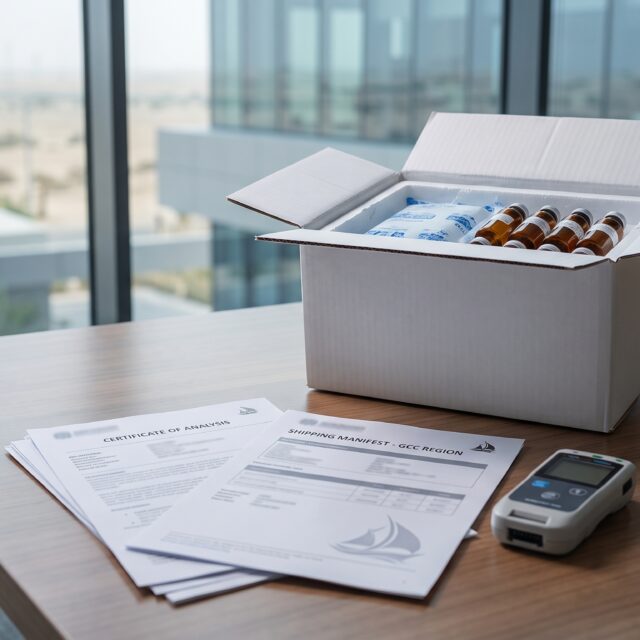
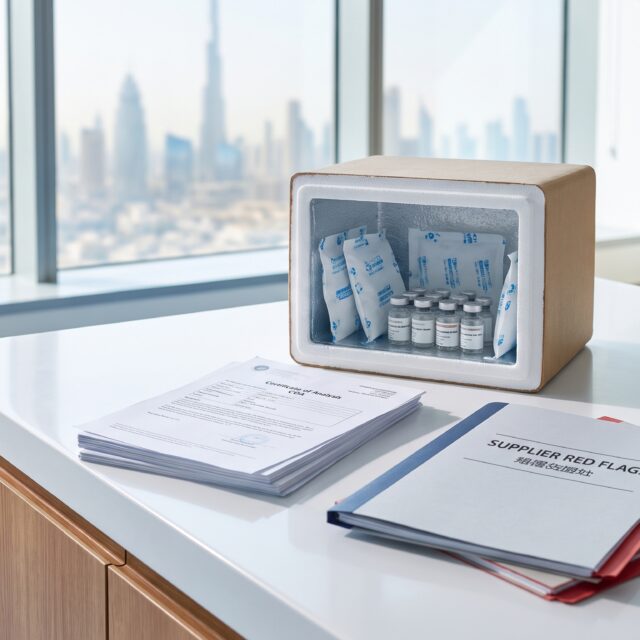
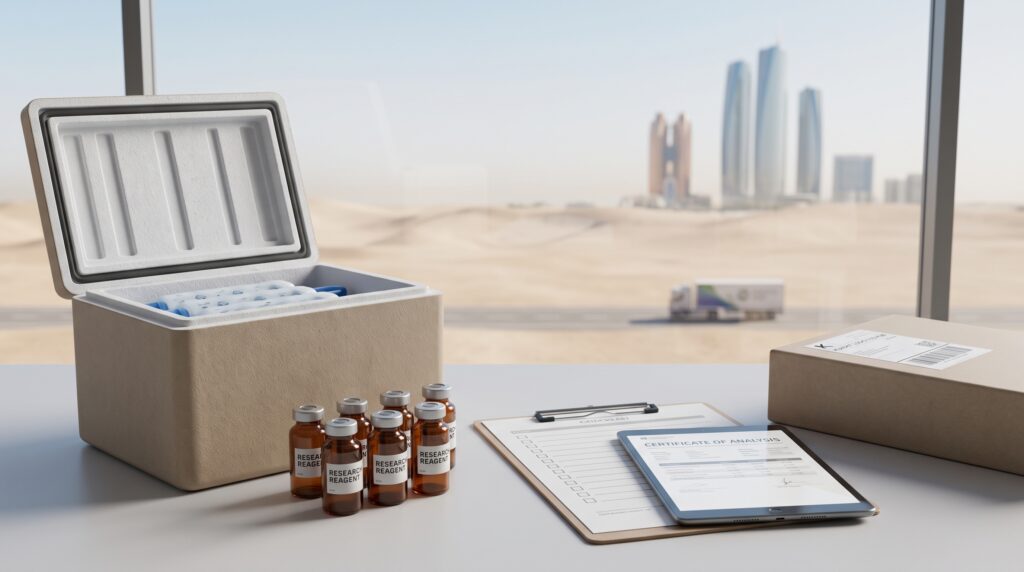
When evaluating a supplier, you must investigate their shipping protocols. A major competitor weakness in the global research compound market is the lack of temperature-monitoring transparency and inadequate packaging. Safe transit into Kuwait requires:
- Phase Change Materials (PCMs): Beyond standard ice packs, elite suppliers utilize advanced PCMs that maintain specific temperature ranges during prolonged transit, ensuring the internal temperature remains stable even if the external environment fluctuates wildly.
- Insulated EPS Packaging: The use of high-density Expanded Polystyrene (EPS) coolers or specialized vacuum-insulated panels (VIPs) is mandatory for GCC shipping to block external heat transfer.
- Expedited Regional Dispatch: Time is the enemy of stability. Working with a regional partner drastically reduces transit holding times. For instance, holding stock in the UAE allows for expedited dispatch to Kuwait, minimizing the critical window where thermal degradation can occur.
Verifying Analytical Quality Control and COAs
The foundation of any legitimate peptide supplier checklist in Kuwait remains analytical quality control. Never accept a generic, undated, or unbranded Certificate of Analysis (COA). A genuine COA provides a comprehensive, verifiable snapshot of the exact batch of lyophilized powder you are purchasing.
Essential COA Metrics to Check
Generic resellers often post single-page documents that lack scientific rigor. Your checklist must require a supplier to demonstrate mastery across several analytical testing methods:
- HPLC Purity (High-Performance Liquid Chromatography): This is the industry gold standard for measuring the percentage of the target peptide versus impurities. You should demand a minimum purity of 98% for high-precision in-vitro research applications.
- Mass Spectrometry (MS): While HPLC shows purity, Mass Spectrometry confirms the identity of the compound. It ensures the molecular weight of the synthesized compound exactly matches the theoretical weight of the target peptide sequence.
- TFA (Trifluoroacetic Acid) Removal: TFA is a toxic byproduct of the peptide synthesis process. High-tier synthesis laboratories perform counter-ion exchange (usually to acetate salts) to reduce TFA content to trace amounts, protecting delicate cellular assays from toxicity.
- Sterility and Endotoxin (LAL) Testing: Because endotoxins can cause severe false positives in cellular research and biological assays, verifiable sterility data via Limulus Amebocyte Lysate (LAL) testing is a strong indicator of a sterile, clinical-grade laboratory environment.
If a supplier cannot provide a batch-specific COA upon request, or if the documentation looks like a recycled JPEG template from another company, that is a severe red flag. Total transparency in third-party analytical testing separates professional operations from amateur resellers.
Navigating Kuwait Customs and RUO Documentation
Purity and logistics are entirely meaningless if your shipment is seized at the border by customs officials. Kuwaiti import regulations require strict adherence to specific documentation protocols, making customs expertise a mandatory item on your vetting checklist.
The Cost, Insurance, and Freight (CIF) Threshold
For independent researchers, academic labs, and personal importations, shipments with a Cost, Insurance, and Freight (CIF) value under USD 1,000 (approximately KWD 305) may qualify for duty-free entry. However, “duty-free” does not mean “inspection-free.” All imported packages are subject to strict regulatory scrutiny by the Kuwait Ministry of Commerce and Industry and the Directorate General of Customs.
Research Use Only (RUO) Framing
Therapeutic, medical, or clinical labeling is heavily restricted in the GCC without explicit clearance from the local Ministry of Health. To avoid immediate customs rejection, successful suppliers ensure that all documentation is flawless. The commercial invoice, Air Waybill (AWB), packing list, and the actual product vials must be explicitly labeled as “Research Use Only” (RUO) or “Not For Human Consumption.”
Any implication of human application, medical treatment, dietary supplementation, or clinical dosage guidelines on the packaging or the supplier’s website can trigger an immediate shipment seizure and potential flagging of your delivery address. Ensure your supplier understands these exact GCC nuances before you initiate an order.
Local GCC Support vs. International Resellers
The GCC sourcing debate often comes down to choosing between global suppliers with long transit times and localized regional suppliers. The danger of unverified local Middle East resellers is that they may store bulk stock in non-climate-controlled warehouses in industrial zones, exposing the peptides to the very thermal degradation you are trying to avoid before they even ship it to you.
The optimal solution is partnering with an established, transparent regional supplier with proven infrastructure. For example, NOVA Labs operates with strict cold-chain protocols and holds verifiable stock in climate-controlled UAE facilities. By doing so, we can offer fast UAE and GCC shipping including next-day regional dispatch that completely bypasses the prolonged tarmac holding times associated with transcontinental shipments from North America or East Asia.
Verifying Stock, Payment, and After-Sales Support
Before finalizing your supplier choice, check the reality of their operational infrastructure:
- Real-Time Stock Checks: Do they actually hold the inventory locally, or are they quietly drop-shipping from overseas? Drop-shipping introduces unacceptable customs delays, lack of quality control oversight, and massive temperature risks.
- Secure and Flexible Payments: Do they offer secure corporate credit card processing, cryptocurrency options for privacy, or Cash on Delivery (COD) where regionally applicable? Flexible, modern payment infrastructure indicates a legitimate, established business entity.
- Responsive, Localized Communication: Do they offer direct WhatsApp support or prompt email contact operating within the GST/AST timezone? If a customs issue arises at Kuwait International Airport, or a courier is unexpectedly delayed, you need a supplier who responds in hours to provide supplemental documentation, not days.
Bottom Line
Successfully procuring delicate research compounds in the GCC requires specialized knowledge and vetted partnerships. The ideal peptide supplier checklist in Kuwait demands verified third-party HPLC and Mass Spectrometry documentation, rigid adherence to RUO customs framing to prevent seizures, and a desert-proof cold-chain logistics network capable of defeating the relentless summer heat.
By carefully vetting your supply partners against these strict criteria, you protect your laboratory’s budget, safeguard your research and testing timelines, and most importantly, ensure the structural integrity of your compounds.
Ready to source high-purity, laboratory-tested compounds with reliable GCC shipping? Browse our full catalogue of research compounds to view our batch-specific COA documentation and review our cold-chain transit commitments.
Disclaimer: All products and compounds mentioned in this article are strictly for in-vitro laboratory research purposes only and are not intended for human consumption, medical application, or therapeutic use.
References
- International Trade Administration (ITA). Kuwait – Import Requirements and Documentation.
- AXP.life — Peptide Research & Education Hub. Supplier Vetting Checklist & QA Standards.
- Ascend Labs. How to Choose a Research Peptide Supplier: GCC Stability Metrics.
- SWISTECH. Protecting Cold Chain Logistics in Kuwait with Advanced IoT Fleet Management Solutions.
- Supplier Vetting Checklist – AXP.life — Peptide Research & Education Hub
- How to choose a research peptide supplier (2026 checklist) – Ascend Labs
- How to Store Research Peptides: Complete UK Guide to Stability and Shelf Life (2026)
- Kuwait – Import Requirements and Documentation – International Trade Administration
- Protecting Cold Chain Logistics in Kuwait with Advanced IoT fleet management solutions Operational Reality of Kuwait’s Desert Climate on Temperature-Sensitive Cargo Operating a temperature | SWISTECH
Frequently asked questions
How long do research peptides stay stable in Kuwait's summer heat?
Unopened lyophilized peptides can degrade rapidly if exposed to temperatures above 30°C to 37°C for prolonged periods. In Kuwait's 50°C summer heat, active cold-chain packaging utilizing insulated EPS mailers and phase-change cooling agents is strictly required to prevent chemical degradation during transit.
What is the customs duty-free limit for research shipments in Kuwait?
Under standard Kuwaiti customs regulations, independent research shipments with a Cost, Insurance, and Freight (CIF) value under USD 1,000 (roughly KWD 305) may qualify for duty-free entry. However, all packages remain subject to standard Ministry of Commerce inspections.
Why do peptide suppliers use "Research Use Only" labels for Kuwait shipments?
Strict 'Research Use Only' (RUO) labeling is a mandatory compliance requirement for customs clearance. Labeling compounds for medical, therapeutic, or human use without the proper Ministry of Health clinical import licenses will result in an immediate shipment seizure.
What should I look for on a peptide Certificate of Analysis (COA)?
A reliable COA for laboratory research must be batch-specific. It should feature High-Performance Liquid Chromatography (HPLC) results demonstrating at least 98% purity, alongside Mass Spectrometry (MS) data to verify the correct molecular weight and identity of the compound.
Nova Labs buyer tools
Ready to verify stock, testing and delivery?
Use the product page and lab report section to check availability, documentation, delivery timing and support before placing an order.
- COA / test-report checks
- Kuwait delivery context
- Cold-chain handling
- COD and card payment options
- WhatsApp support