


Sourcing Wholesale Peptides in Kuwait: The Procurement Challenge
Quick Answer: When sourcing wholesale peptides in Kuwait, procurement officers must partner with regional suppliers providing robust cold-chain shipping. Successful bulk imports require strict “For Research Purposes Only” (RUO) commercial invoicing, accurate laboratory reagent HS codes, and detailed MSDS documentation to bypass local holds and prevent Ardiya customs delays.
For institutional researchers, procurement officers, and private scientific facilities, sourcing high-purity biochemicals in the Gulf region presents a unique set of logistical and regulatory challenges. Finding a reliable source for wholesale peptides kuwait requires looking beyond domestic retail options. While local retail chains and domestic pharmacies in Kuwait—such as Al Mutawa and Pharmazone—provide excellent consumer access to cosmetic peptide serums and oral collagens, they do not stock high-purity, lyophilised research peptides.
This gap in the domestic market leaves scientific and institutional buyers dependent on specialised regional GCC or international wholesalers. However, importing bulk peptides into Kuwait is not as simple as placing an order online. Navigating the Kuwait Ministry of Health (MOH) import mandates, managing extreme ambient temperatures, and ensuring correct documentation are critical steps to prevent costly delays. This guide details the essential requirements for B2B buyers looking to secure a reliable, compliant, and thermally protected supply chain.
Navigating Kuwait Customs and the MOH ‘Health Release’
The most significant hurdle for any B2B buyer or institution importing biochemicals into Kuwait is the regulatory framework governed by the Kuwait Ministry of Health (MOH) and the General Administration of Customs. Recently, regulatory overhauls—such as Ministerial Decision No. 303/2025—have tightened controls on the importation of health-related materials, chemical precursors, and biochemical compounds.
The ‘Health Release’ Mandate
Historically, the MOH applies strict scrutiny to incoming chemical and biological imports. Any compound flagged incorrectly as a pharmaceutical or medical product is subjected to a mandatory ‘Health Release’ (الافراج الصحي). For unapproved or unregistered research chemicals, obtaining this clearance is often impossible, resulting in the shipment being permanently held or rejected at the port of entry.
Correct Documentation and HS Codes
To bypass these pharmaceutical-centric bottlenecks, a professional peptide wholesale supplier in Kuwait must structure their export documentation meticulously. Bulk peptide shipments must be explicitly invoiced with “For Research Purposes Only” (RUO) labelling. Furthermore, accurate classification using Harmonised System (HS) codes for laboratory reagents—rather than pharmaceutical goods—is vital. Providing complete Material Safety Data Sheets (MSDS) alongside the commercial invoice ensures that customs inspectors can quickly verify the non-clinical nature of the import, facilitating smoother clearance.
The Ardiya Bottleneck: Preventing Costly Warehouse Holds
When a shipment lacks the correct RUO documentation or accurate HS codes, it is inevitably delayed and routed to the Ardiya customs warehouses. For researchers and B2B buyers, an Ardiya hold presents two massive risks: financial penalties and total product degradation.
Understanding ‘Ardeya’ Charges
Shipments held in the Ardiya customs facilities quickly accrue daily storage fees, commonly referred to by local logistics teams as ‘Ardeya’ charges. These fees can escalate rapidly, significantly inflating the landed cost of bulk peptides kuwait. Procurement teams must ensure their supplier understands local customs nuances to avoid these administrative traps.
The Threat of Extreme Temperatures
Kuwait’s summer temperatures frequently exceed 50°C (122°F). When shipments are held in unconditioned or poorly insulated sections of customs warehouses, the ambient heat poses a catastrophic risk to peptide stability. Lyophilised (freeze-dried) peptides require stable, cool environments to maintain their molecular integrity. Prolonged exposure to intense heat breaks down fragile peptide bonds, rendering the batch biologically inactive and useless for laboratory research.
Surviving 50°C Heat: The Necessity of Cold-Chain Logistics
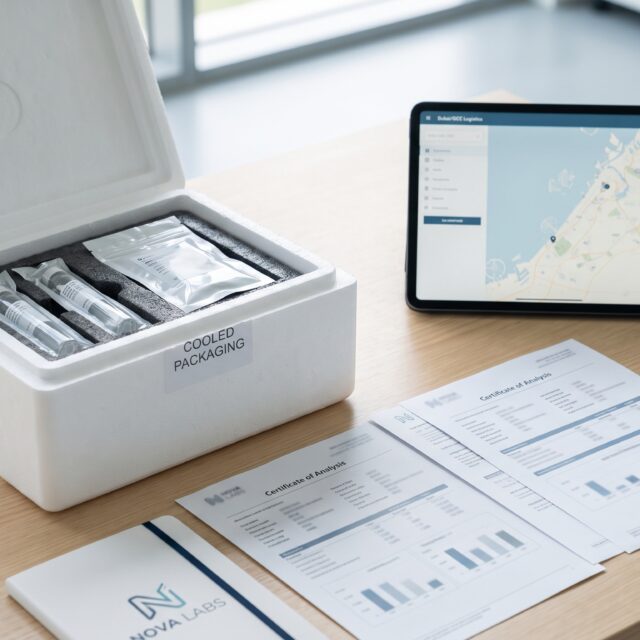
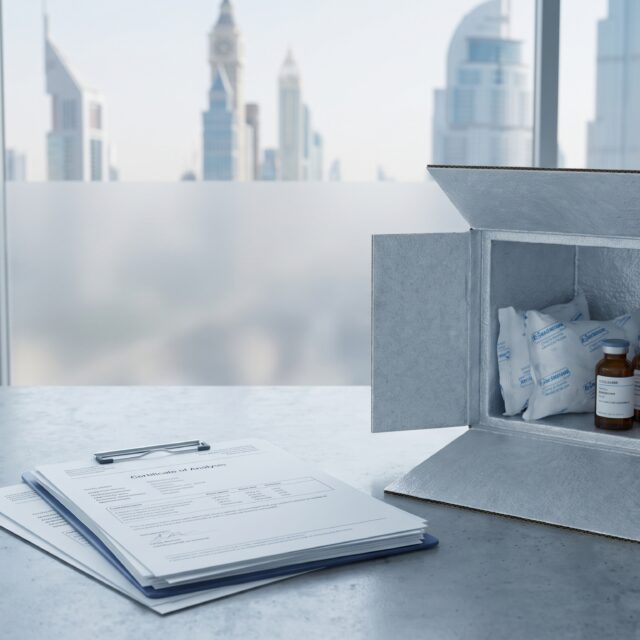
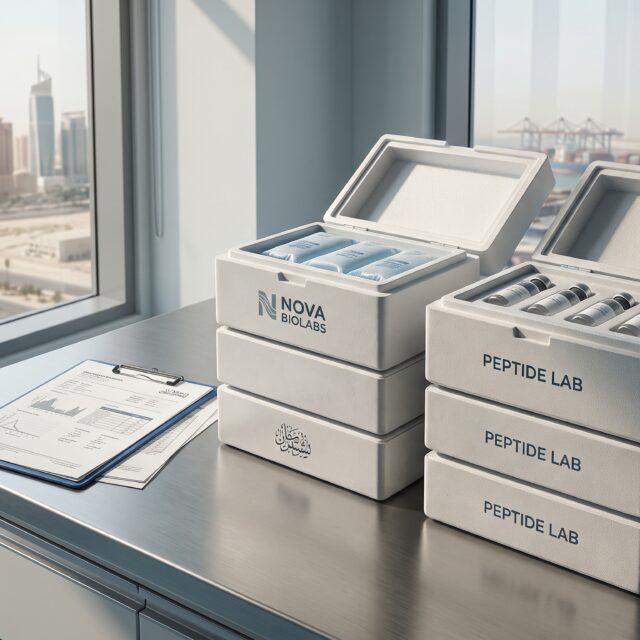
Given the extreme climate, standard courier shipping is insufficient for regional biochemical transport. A premium peptide wholesale supplier kuwait must offer dedicated cold-chain logistics to protect the shipment from origin to the final laboratory destination.
Cold-chain shipping involves more than just adding an ice pack to a cardboard box. For bulk and wholesale orders, the logistics framework must include:
- Phase-Change Materials (PCMs): High-grade PCMs are engineered to maintain a strict internal temperature environment of 2–8°C for extended periods, far outlasting traditional gel packs.
- Insulated Thermal Packaging: EPS (Expanded Polystyrene) or VIP (Vacuum Insulated Panel) shippers are required to block external radiant heat.
- Expedited Regional Routing: Utilizing direct GCC air freight and prioritised local delivery minimises transit times, ensuring the cold chain is never broken during the critical final mile.
Procurement officers must explicitly verify a supplier’s cold-chain capabilities before approving any large-scale purchase order. A failure in temperature control compromises the entire research investment.
Evaluating a B2B Peptide Supplier: Purity and Proof
Beyond logistics, the core value of any biochemical supply lies in its verifiable purity. B2B wholesale buyers expect rigorous documentation for every batch produced. When comparing suppliers, procurement teams must insist on visibility into the manufacturing and testing process.
Certificates of Analysis (COA) and HPLC Testing
A reliable supplier will freely provide a Certificate of Analysis (COA) for their compounds. This document must be backed by independent High-Performance Liquid Chromatography (HPLC) and Mass Spectrometry (MS) testing. The industry standard for high-level research requires a purity threshold of ≥98%. The COA verifies the sequence, molecular weight, and the absence of impurities, salts, or synthesis by-products.
Regional Support and Communication
International suppliers located in North America or East Asia often struggle with GCC logistics and operate on vastly different time zones, making real-time customs troubleshooting difficult. A regionally based supplier offers a distinct advantage. Active, responsive communication—often facilitated via direct WhatsApp support—allows procurement managers to coordinate delivery windows, address local payment preferences, and resolve documentation queries instantly.
Stock Availability and Streamlining Your Bulk Order
Consistency in supply is just as important as purity. Research protocols require reliable, uninterrupted access to specific compounds. Institutional buyers need a partner who holds sufficient regional inventory to fulfill large-scale orders without extensive backorder delays.
At NOVA Labs, we understand the exact operational hurdles that GCC researchers face. We merge rigorous batch testing with optimised local logistics to ensure your facility receives pure, stable compounds without the typical customs friction. If your facility requires a reliable, documented supply chain, we invite you to explore our dedicated wholesale portal to submit a bulk inquiry, or simply browse our complete research compound catalogue to view our current inventory and testing documentation.
Conclusion: Securing Your Supply Chain
Procuring bulk peptides in Kuwait demands more than finding the lowest unit price; it requires a strategic approach to logistics, documentation, and thermal protection. Local retail pharmacies cannot meet the demands of rigorous scientific research, making regional B2B partnerships essential. By ensuring strict RUO invoicing, correct HS categorisation, and uncompromising cold-chain handling, institutional buyers can bypass Ardiya customs holds and protect their compounds from the severe Kuwaiti heat. Prioritising suppliers who provide transparent COAs and responsive regional support is the key to maintaining a successful, uninterrupted research programme.
Disclaimer: The products mentioned in this article are for research purposes only and are not intended for human consumption.
References:
- New decisions issued in Kuwait under the Ministry of Health, HFW Legal Insights.
- Kuwait – Import Requirements and Documentation, International Trade Administration.
- Best Peptide Shop Kuwait: Supplier Guide & Customs Tips, NOVA Labs Research.
References
- Best Peptide Shop Kuwait: Supplier Guide & Customs Tips – NOVA Labs
- Cold Chain Peptide Delivery in Kuwait: Logistics & Customs – NOVA Labs
- New decisions issued in Kuwait under the Ministry of Health – HFW
- Kuwait – Import Requirements and Documentation – International Trade Administration
Frequently asked questions
Can I buy wholesale research peptides from local pharmacies in Kuwait?
No. Local Kuwaiti pharmacies only stock cosmetic peptide serums and commercial health products. High-purity, lyophilised research peptides must be sourced through specialised B2B wholesale suppliers.
How do wholesale peptide shipments clear Kuwait customs without being held?
Successful clearance requires the supplier to use explicit 'For Research Purposes Only' (RUO) commercial invoicing, correct laboratory reagent HS codes, and complete MSDS documentation to avoid the MOH 'Health Release' mandate.
What are Ardeya charges in Kuwait?
Ardeya charges are expensive daily warehousing and storage fees applied to shipments that are delayed or held by customs at the Ardiya port of entry, typically due to incorrect documentation or unapproved regulatory status.
Why is cold-chain shipping necessary for bulk peptides in Kuwait?
Kuwait's summer temperatures frequently exceed 50°C. Cold-chain shipping using phase-change materials (PCMs) ensures the peptides remain at 2–8°C, preventing severe thermal degradation of the sensitive biochemical bonds.
What documentation should a B2B peptide supplier provide?
A reliable wholesale supplier must provide a Certificate of Analysis (COA), independent HPLC/MS test results verifying ≥98% purity, and comprehensive Material Safety Data Sheets (MSDS) to facilitate customs clearance.
Nova Labs buyer tools
Ready to verify stock, testing and delivery?
Use the product page and lab report section to check availability, documentation, delivery timing and support before placing an order.
- COA / test-report checks
- Kuwait delivery context
- Cold-chain handling
- COD and card payment options
- WhatsApp support