
Procuring high-quality biochemicals in the Arabian Gulf involves more than simply checking out on a generic supplier’s website. For laboratory researchers and procurement officers looking to source peptides locally, the primary challenges are ensuring chemical purity and preventing compound degradation in the region’s intense heat during transit. Sourcing BPC-157 in Bahrain requires navigating strict regulatory frameworks, international shipping risks, and the need for rigorous, independent laboratory testing.
Because standard aggregator marketplaces often dropship unverified products without temperature controls, buyers are increasingly pivoting toward specialized regional suppliers. This comprehensive guide breaks down exactly what informed researchers in Bahrain should look for when evaluating sources, interpreting testing documentation, and selecting appropriate delivery methods to ensure the integrity of their research materials.
Where to Buy BPC-157 in Bahrain Safely
Quick Answer: To safely buy BPC-157 in Bahrain, procurement officers must prioritize regional GCC suppliers offering independent HPLC testing, verifiable Certificates of Analysis (COAs), and temperature-controlled logistics. Avoid international aggregators to prevent thermal degradation during transit and ensure seamless NHRA customs clearance for research materials.
While search results are frequently flooded with international supplement platforms offering unverified formulations, evaluating a supplier based on scientific rigor rather than marketing claims is essential. Authentic, research-grade BPC-157 is evaluated on transparent batch testing, secure handling, and rapid regional delivery to prevent degradation. International dropshipping often exposes fragile peptides to extreme temperatures, while local sourcing ensures structural integrity, verifiable purity, and streamlined customs clearance.
Understanding BPC-157 in Bahrain’s Regulatory Landscape
When you order BPC-157 in Bahrain, it is critical to understand its classification. The National Health Regulatory Authority (NHRA) maintains strict oversight over pharmaceutical and chemical imports, classifying BPC-157 exclusively as an experimental research chemical. It is not registered as a dietary supplement or a medical product, meaning it cannot legally be sold for human consumption in local physical pharmacies.
The Impact of Global Customs Enforcement
Bahrain actively participates in global regulatory enforcement campaigns, such as INTERPOL’s Operation Pangea, which aggressively monitors and targets unlicensed pharmaceutical imports. If an overseas supplier attempts to ship BPC-157 into Bahrain mislabelled as a “dietary supplement” or “vitamin,” it faces a high risk of customs seizure.
Transparent, specialized suppliers prevent this friction by correctly declaring the contents as research-use-only chemicals. Proper documentation ensures that laboratories, universities, and qualified buyers do not face unnecessary delays, extensive administrative holds, or confiscated shipments at the border.
WADA and Professional Sports Compliance
It is also vital for procurement teams tied to athletic institutions to be aware of the World Anti-Doping Agency (WADA) guidelines. BPC-157 is strictly prohibited by WADA under the S0 (Non-approved substances) and S2 (Peptide hormones, growth factors, related substances, and mimetics) categories. Tested athletes in Bahrain must strictly avoid the presence of this compound to prevent long-term competitive bans. Its legitimate presence in the country remains strictly confined to controlled laboratory environments and in vitro analysis.
The Thermal Integrity Dilemma: GCC Heat vs. Dropshipping
One of the most overlooked factors when evaluating a BPC-157 supplier in Bahrain is the physical logistics of the Arabian Gulf. Peptides are complex chains of amino acids. In their lyophilised (freeze-dried) state, they are relatively stable compared to liquid formats, but they are not immune to severe thermal degradation.
The Failure of Aggregator Marketplaces
Retail platforms like Ubuy, Desertcart, and various general merchandise sites capture broad search intent by offering various peptide capsules and sprays dropshipped from the United States or East Asia. However, these aggregator marketplaces do not utilise specialized, temperature-monitored cold-chain logistics tailored for biochemicals.
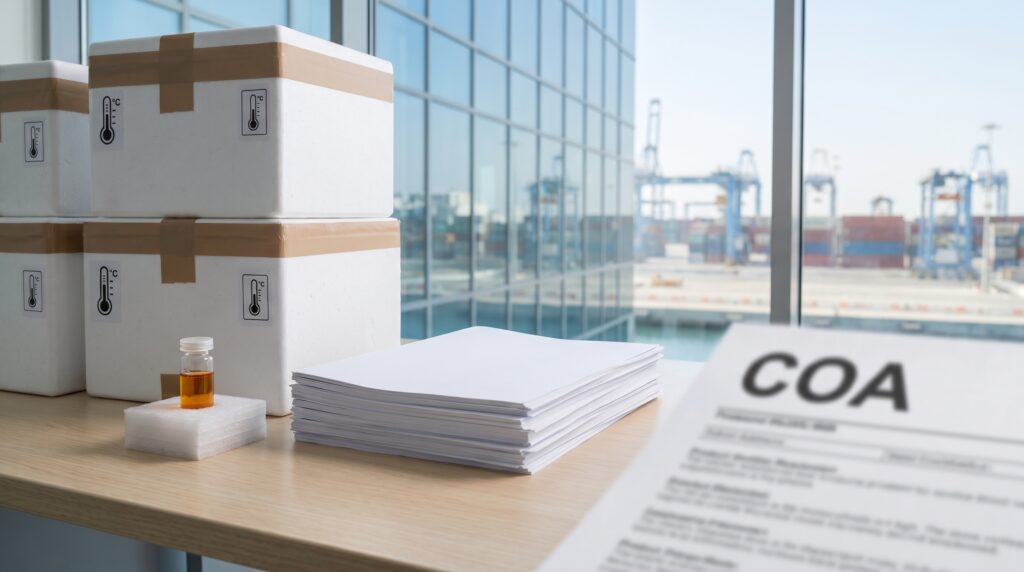
A parcel shipped via standard international freight can sit in a customs warehouse or on an airport tarmac where temperatures frequently exceed 45°C in the Gulf summer. Prolonged exposure to these extremes can denature the peptide bonds and cause irreversible chemical cleavage, rendering the research material completely useless before it even reaches your laboratory workbench.
The Case for Regional GCC Fulfilment
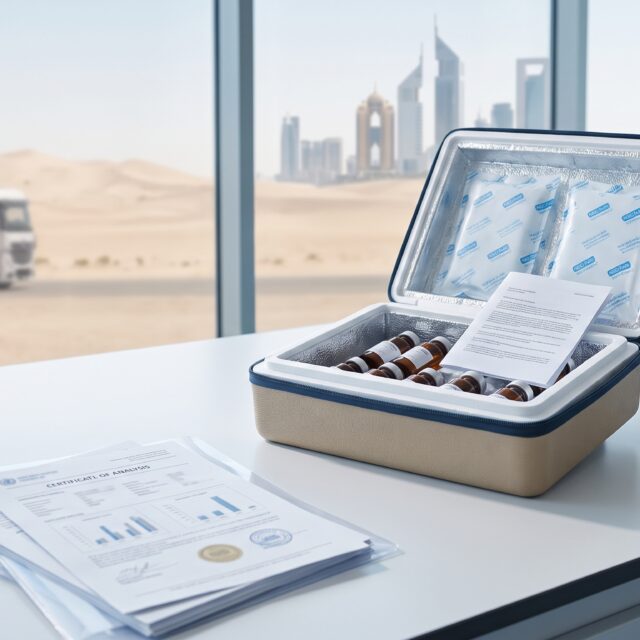
To preserve the fragile structural integrity of lyophilised powders, regional warehousing is essential. Sourcing from a supplier based within the Gulf means significantly shorter transit times and minimal exposure to the elements. By leveraging regional GCC logistics out of hubs like Dubai, specialized suppliers can bypass the lengthy international transit delays that compromise chemical stability, ensuring materials arrive intact, stable, and ready for scientific reconstitution.
Comprehensive Buyer’s Checklist: Evaluating a BPC-157 Supplier in Bahrain
Marketing claims about purity mean absolutely nothing without verifiable data. Whether you are a dedicated procurement specialist or an informed researcher comparing brands, you must evaluate the hard evidence backing the product. Here are the key signals of a trustworthy BPC-157 source:
1. Independent Certificate of Analysis (COA)
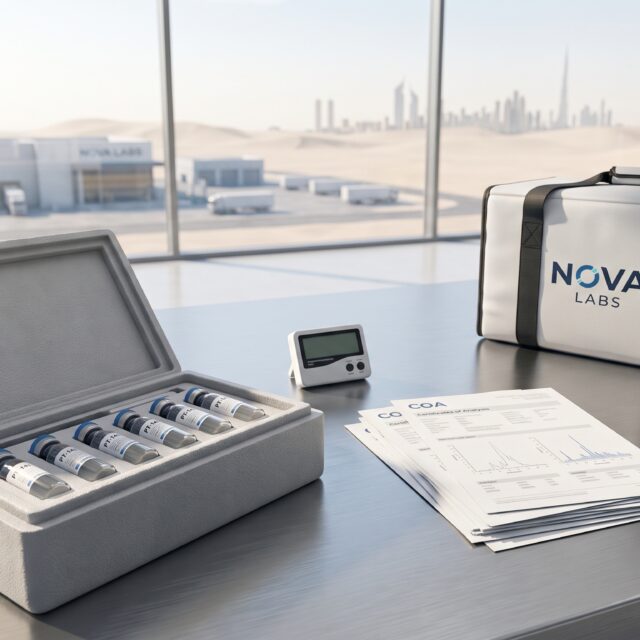
The gold standard for verifying chemical authenticity in the GCC is the Certificate of Analysis (COA). A legitimate supplier will always provide a COA from a reputable third-party analytical laboratory, not just a self-published, unverified in-house document. Procurement teams should review the date of the COA to ensure it corresponds with current inventory rather than being recycled from years prior.
2. High-Performance Liquid Chromatography (HPLC) and Mass Spectrometry (MS)
Look specifically for testing conducted via HPLC (High-Performance Liquid Chromatography) and MS (Mass Spectrometry).
- HPLC measures the precise purity percentage of the batch by separating the compound’s individual components. You should expect a purity yield of >99% for reliable research applications.
- MS verifies the molecular weight, ensuring that the chemical composition in the vial is authentically BPC-157 and not a cheaper, similar-looking substitute.
3. Clear Batch Numbering and Transparency
Testing documentation should clearly match the specific batch number printed on the vial you receive. A supplier committed to scientific rigor will maintain an easily accessible archive of batch records, allowing buyers to verify exactly what they are receiving.
4. Regional Support and Secure Payment Gateways
Responsive support is critical for handling GCC logistics. A supplier that offers direct communication channels (such as dedicated local WhatsApp support), manages customs documentation proactively, and provides clear, realistic shipping timelines is vastly superior to a faceless dropshipping aggregator. Furthermore, robust platforms offer secure, encrypted payment gateways that protect institutional procurement data.
Format Selection: Lyophilised Powders vs. Consumer Blends
As you search for BPC-157 in Bahrain, you will likely encounter fundamentally different product formats. Understanding this distinction is absolutely paramount for proper laboratory procurement.
Consumer Blends (Capsules/Sprays): Commonly found on international retail sites, these formulations are heavily marketed toward general consumers. However, they lack stability data, rarely come with independent HPLC testing, and often contain proprietary blends where the exact peptide yield is obscured. These formats are wholly unsuitable for precision scientific research.
Lyophilised Vials: This is the standard, accepted format for in vitro and laboratory research. Freeze-dried BPC-157 powder securely contained in sterile glass vials offers precise measurement capability, maximum stability during regional transit, and mathematically verified purity. Researchers reconstitute this powder using bacteriostatic water immediately prior to analysis, ensuring the compound remains active, stable, and uncontaminated.
Handling and Storage Post-Delivery in Bahrain
Procuring high-quality BPC-157 is only the first step; maintaining its viability upon arrival in Bahrain is equally critical. Upon receiving lyophilised peptides, researchers should immediately transfer the vials to a secure, temperature-controlled environment. Unreconstituted vials should ideally be stored at -20°C in a laboratory freezer to maintain long-term stability (up to 24-36 months). If freezer storage is unavailable, standard refrigeration at 2°C to 8°C will suffice for short-to-medium-term holding. Once the peptide is reconstituted with bacteriostatic water, it must be kept refrigerated at all times and utilized within standard laboratory timeframes to prevent bacterial contamination and peptide degradation.
Sourcing with Confidence from NOVA Labs
For buyers seeking verifiable purity and rapid regional logistics, NOVA Labs provides a streamlined procurement channel specifically tailored to the rigorous demands of the Middle East. By operating within the GCC, we entirely eliminate the thermal risks associated with international dropshipping and extensive customs holds.
Every batch of our BPC-157 undergoes stringent, third-party HPLC and MS testing to guarantee >99% purity, with transparent COAs readily available for buyer verification prior to purchase. We combine rigorous scientific standards with practical local support, offering responsive customer service, transparent research-only documentation, and rapid dispatch across the Gulf to ensure your materials arrive safely, promptly, and ready for immediate laboratory deployment.
Bottom Line
Ordering BPC-157 in Bahrain requires careful attention to the region’s unique logistical and regulatory environment. By deliberately avoiding international dropshippers, insisting on verifiable HPLC/MS testing, and prioritizing regional suppliers who deeply understand the critical nature of temperature control and customs compliance, researchers can secure high-quality materials without the guesswork.
Prioritise operational transparency, independently verify the analytical data, and build your supply chain around vendors who handle biochemical procurement with the exact precision your research demands. For secure, laboratory-grade sourcing, explore the verified catalog at NOVA Labs today.
Disclaimer: The products mentioned in this article are exclusively for laboratory research and in vitro analysis purposes only. They are explicitly not intended for human consumption, clinical use, or self-administration.
References
- World Anti-Doping Agency (WADA). (2024). The Prohibited List.
- INTERPOL. (2021). Record 769 arrests and USD 65 million in illicit pharmaceuticals seized in global bust (Operation Pangea).
- National Health Regulatory Authority (NHRA) Bahrain. Guidelines on the import of experimental chemicals for laboratory use.
- World Health Organization (WHO). Good Distribution Practices for Pharmaceutical and Biochemical Products.
Disclaimer: The products mentioned in this article are for research purposes only and are not intended for human consumption.
- Buy BPC-157 Bahrain: Purity, COA & GCC Delivery Guide – NOVA Labs
- Are SARMs Legal in Bahrain? (2026 Guide) – NutriMax PES Limited
- Legal & regulatory framework | Best US Peptide Supplier Guide
- Record 769 arrests and USD 65 million in illicit pharmaceuticals seized in global bust
Frequently asked questions
Is BPC-157 legal to buy in Bahrain?
As an experimental research chemical, BPC-157 is not registered by the NHRA for human consumption, but it can be legally procured by institutions and individuals for strict scientific laboratory research purposes with appropriate compliance documentation.
Why shouldn't I order BPC-157 from international aggregator sites?
General marketplace sites rarely utilize specialized, temperature-controlled logistics, meaning fragile peptide chains can quickly denature and degrade when exposed to extreme Arabian Gulf heat during extended international shipping timelines.
How can I verify the purity of a BPC-157 supplier in Bahrain?
You should request an independent, batch-specific Certificate of Analysis (COA) that relies on High-Performance Liquid Chromatography (HPLC) and Mass Spectrometry testing to mathematically confirm the peptide's purity is above 99%.
Does WADA ban BPC-157?
Yes, WADA strictly prohibits BPC-157 under classes S0 and S2. Tested athletes operating in Bahrain must avoid its presence entirely to prevent anti-doping violations, emphasizing its classification strictly for laboratory research.
What is the proper way to store BPC-157 in Bahrain?
Upon delivery, lyophilized BPC-157 powder should be stored in a laboratory freezer at -20°C for long-term stability. Once reconstituted for analysis, it must be kept refrigerated between 2°C and 8°C.
Nova Labs buyer tools
Ready to verify stock, testing and delivery?
Use the product page and lab report section to check availability, documentation, delivery timing and support before placing an order.
- COA / test-report checks
- Bahrain delivery context
- Cold-chain handling
- COD and card payment options
- WhatsApp support