
What You Need to Know Before You Buy BPC-157 in the UAE
Sourcing investigative compounds requires rigorous attention to regulatory shifts, quality control, and local logistics. For research teams and procurement staff preparing to buy BPC-157 in the UAE, the landscape has fundamentally changed. Recent legislative updates and stricter oversight have marginalized unauthorized imports, making verifiable domestic sourcing the only viable route for maintaining laboratory operations and securing high-purity materials.
Quick answer: When looking to buy BPC-157 in the UAE, researchers must source from domestic suppliers providing an independent Certificate of Analysis (COA) confirming 99%+ purity. Compliant procurement requires purchasing this compound strictly as an in-vitro reference material and utilizing local vendors for rapid dispatch to prevent thermal degradation.
This guide breaks down exactly what informed researchers must evaluate before placing an order, from deciphering High-Performance Liquid Chromatography (HPLC) reports to understanding the critical necessity of local stock availability.
Navigating UAE Regulatory Compliance and the EDE
The procurement of any peptide in the Middle East requires strict adherence to federal laws governing pharmaceutical and laboratory materials. Under the UAE’s Federal Decree-Law No. 38 of 2024, the Emirates Drug Establishment (EDE) assumed expanded oversight over medical products and commercial distribution.
This shift brought immediate consequences for the unregulated market. Recently, UAE authorities initiated enforcement actions cracking down on illegal sources and penalized social media influencers promoting unapproved compounds. The era of quietly importing mislabeled “supplements” from overseas is over. Customs officials routinely inspect international shipments, leading to significant delays and financial losses for buyers relying on foreign shipping models.
For procurement staff, legally compliant sourcing means acquiring BPC-157 strictly as an in-vitro reference material or research-grade compound intended solely for laboratory use, not for human consumption. Furthermore, researchers operating in sports science or athletic testing should note that under World Anti-Doping Agency (WADA) guidelines, BPC-157 is classified under Section S0 (Non-Approved Substances) and is strictly banned at all times for competitive athletes.
Deciphering the Lab Report: The COA Checklist
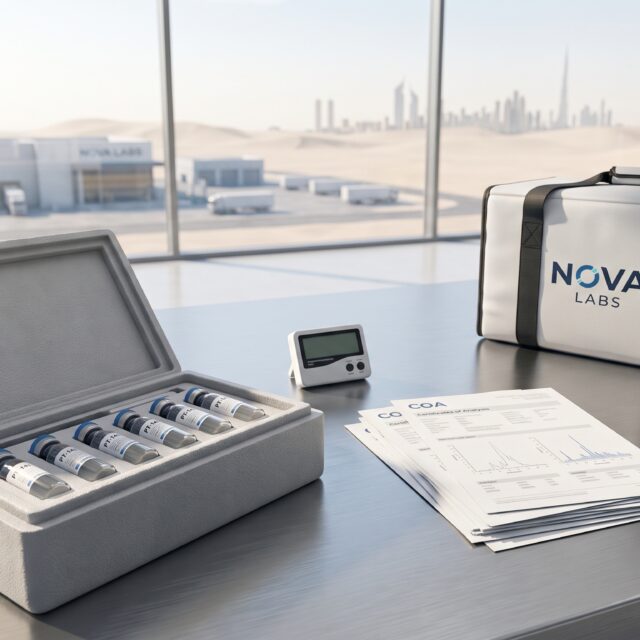
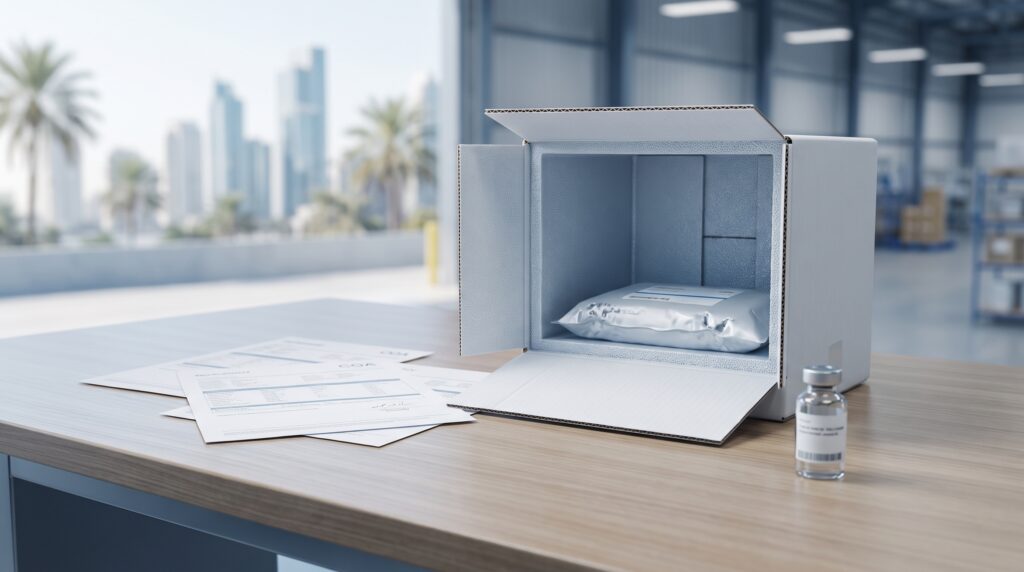
When you set out to order BPC-157, UAE market conditions demand that you never take a supplier’s purity claims at face value. A legitimate BPC-157 supplier will always provide a batch-specific Certificate of Analysis (COA) from an independent, third-party laboratory. If a supplier hides this documentation or provides an outdated report, it is a definitive red flag.
Here is what you must verify on any COA before committing to a purchase:
- HPLC Purity Percentage: High-Performance Liquid Chromatography (HPLC) separates the compound into its individual components. You should look for a purity level of 99% or higher. Top-tier research providers routinely supply documentation proving purity levels around 99.8%.
- Mass Spectrometry (MS): This test confirms the molecular weight and structural identity of the BPC-157 peptide, ensuring you are receiving the exact sequence required for your research protocols rather than a degraded or substituted filler.
- Sterility Verification: Because research compounds are often utilized in sensitive in-vitro cellular assays, the vial must be demonstrably free from bacterial and fungal contamination.
- Endotoxin Levels: High endotoxin levels can ruin sensitive cellular research. The COA must show negligible endotoxin presence.
- Heavy Metals: Testing for lead, arsenic, mercury, and cadmium ensures the compound was synthesized in a controlled, pharmaceutical-grade environment rather than a low-quality industrial facility.
When evaluating regional sellers, prioritizing transparency is non-negotiable. NOVA Labs, for example, strictly provides comprehensive, batch-specific testing documentation to guarantee researchers have the quantitative data required for their experimental controls.
Surviving the GCC Heat: Storage and Logistics
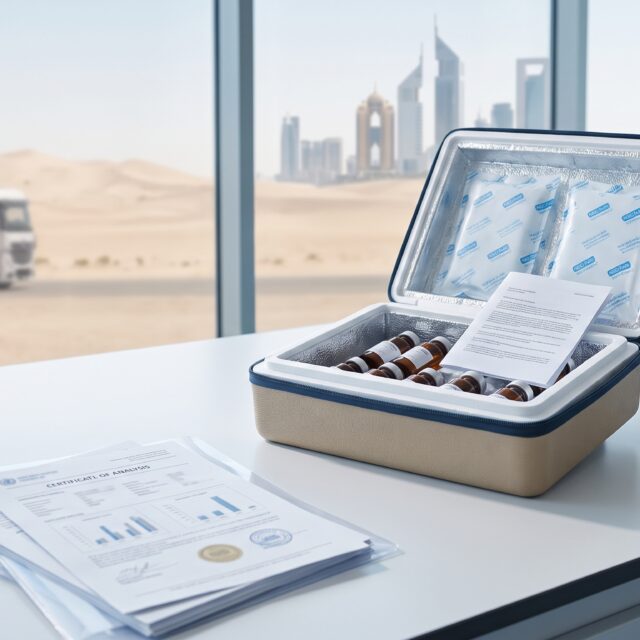
One of the most overlooked aspects of evaluating a BPC-157 peptide vendor is logistics. The extreme climate of the Gulf region poses a severe threat to peptide stability. While BPC-157 in its freeze-dried (lyophilized) powder format is relatively stable and can endure short transit times at room temperature, it is highly susceptible to rapid degradation if left sitting in a 45°C non-air-conditioned warehouse or a delayed customs facility.
This is why relying on international suppliers has become an operational liability for UAE researchers. A package delayed for three days at the border is often a compromised package.
To ensure material integrity, domestic fulfillment is required. Once the package is delivered, buyers must immediately transition the vials to proper storage. Unreconstituted lyophilized powder should be stored in a refrigerator at 2 to 8 degrees Celsius. If long-term storage is required (several months or more), freezing the vials is recommended.
Because transit time is the enemy of peptide stability, utilizing a supplier that guarantees UAE next day delivery is a critical procurement safeguard. Domestic dispatch ensures the compound moves rapidly from a climate-controlled facility directly to your laboratory, avoiding thermal stress entirely.
Payment Friction and Customer Support Expectations
Procuring high-grade reference materials represents a significant budget allocation for independent researchers and private labs. The best suppliers have adapted to the regional preference for flexibility and immediate communication.
Buy Now, Pay Later (BNPL) Integrations
To alleviate budget friction, leading regional platforms have integrated BNPL solutions like Tabby and Tamara. This allows buyers to split their orders into interest-free monthly payments, smoothing out procurement budgets without delaying time-sensitive research schedules.
Rapid-Response WhatsApp Support
In the GCC, email support tickets that take 48 hours to resolve are increasingly viewed as unacceptable. A premium supplier will offer dedicated WhatsApp support channels. Whether you need to verify a batch number on a COA, inquire about bulk stock availability, or confirm a delivery window in Sharjah, response times should ideally be under a few minutes.
Cash on Delivery (COD)
Despite the rise of digital payments, a segment of the UAE market still prefers the trust and finality of Cash on Delivery (COD). Suppliers offering this option demonstrate a high degree of confidence in their fulfillment networks and provide buyers with ultimate peace of mind.
Conclusion: A More Informed Approach to Procurement
Deciding to buy BPC-157 requires more than simply finding the lowest price. It demands a strategic approach to regulatory compliance, independent laboratory verification, and localized logistics. By demanding batch-specific COAs, refusing to compromise on fast delivery protocols, and utilizing modern procurement channels, researchers can secure the high-purity compounds their work requires.
Ensure your laboratory is equipped with verifiable, stable, and compliant materials. For researchers ready to source premium-grade lyophilized compounds backed by rigorous independent testing, explore our reliable inventory of BPC-157 10mg lyophilized powder to keep your projects on track without logistical delays.
Disclaimer: The products mentioned in this article are for research purposes only and are not intended for human consumption or therapeutic use.
References
- Gulf News. (2024). UAE Cracks Down on Unapproved Peptide Weight-Loss Drugs: Sources and Influencers Face Action.
- UAE Ministry of Health and Prevention. (2024). Federal Decree-Law No. 38 of 2024 on Medical Products and Pharmacy Profession.
- World Anti-Doping Agency (WADA). Prohibited List: Section S0 (Non-Approved Substances).
- Independent Third-Party Laboratory Testing Guidelines for In-Vitro Reference Materials.
- UAE Cracks Down on Unapproved Peptide Weight-Loss Drugs: 71 Sources and 14 Influencers Face Action – Gulf News
- The UAE’s new pharmaceutical law: 10 things businesses should know
- is peptide legal in dubai rules – FIBAV
- BPC-157 UAE Research Guide (2026): Evidence, Safety & FDA Vote – Emirates Peptides
- BPC-157 – NOVA Labs
- BPC-157 5 mg — Research Compound | Wellness Labs UAE
- BPC-157 10mg Research Peptide UAE – VaultLabs
- Buy BPC 157 UAE For Lab Research
Frequently asked questions
Is BPC-157 legal to buy in the UAE?
Yes, BPC-157 is legally permitted for procurement in the UAE strictly when purchased as an in-vitro reference material or research-grade compound intended solely for laboratory research, not for human consumption.
How should BPC-157 be stored in the UAE climate?
Due to the extreme GCC heat, unmixed lyophilized BPC-157 powder should be stored in a refrigerator at 2°C to 8°C immediately upon delivery to prevent degradation. For long-term storage, freezing the vials is recommended.
What is the best way to ensure BPC-157 purity?
Buyers must verify purity by requesting a batch-specific Certificate of Analysis (COA) from an independent laboratory, checking specifically for HPLC purity levels of 99% or higher, as well as the absence of endotoxins and heavy metals.
Why is local UAE delivery important for research peptides?
Local delivery is critical because international shipments are frequently subjected to customs delays and high ambient temperatures. This thermal stress can rapidly degrade the structural integrity of the peptide before it reaches your laboratory.
Do UAE peptide suppliers offer Cash on Delivery (COD)?
Yes, reputable domestic suppliers in the UAE typically offer modern payment options including Cash on Delivery (COD) as well as Buy Now, Pay Later (BNPL) services like Tabby and Tamara for authorized laboratory buyers.
Nova Labs buyer tools
Ready to verify stock, testing and delivery?
Use the product page and lab report section to check availability, documentation, delivery timing and support before placing an order.
- COA / test-report checks
- UAE delivery context
- Cold-chain handling
- COD and card payment options
- WhatsApp support