



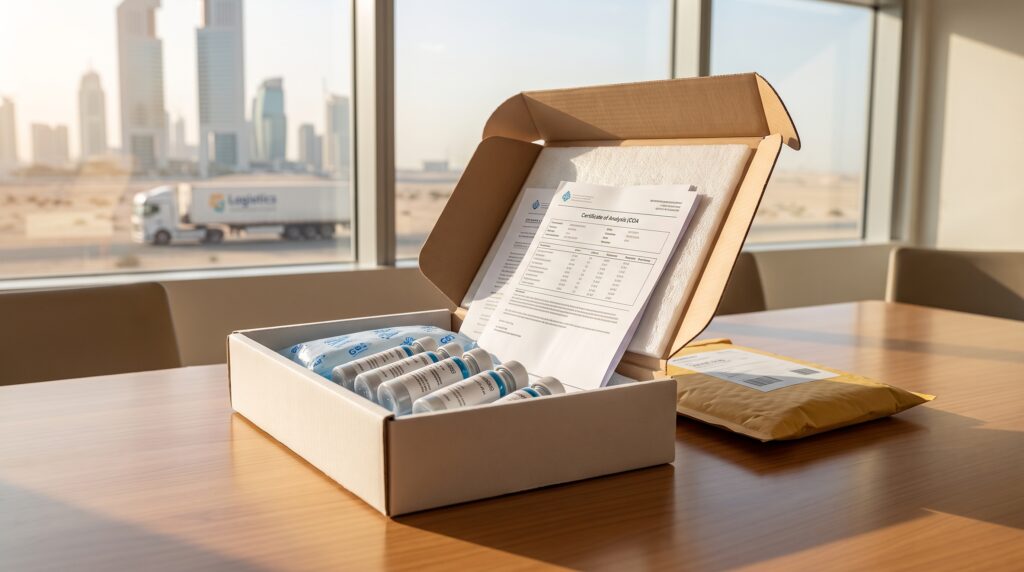
Procuring high-quality research materials in the Gulf Cooperation Council (GCC) presents a unique set of logistical and regulatory challenges. For laboratories and informed buyers looking to buy CJC-1295 No DAC in Oman, the decision extends far beyond simply finding an available supplier. Success in this procurement process requires strict attention to third-party purity testing, navigating extreme local climates that threaten peptide stability, and understanding local customs clearance at ports like Muscat International Airport.
This guide explores the critical steps for evaluating suppliers, verifying documentation, and ensuring that temperature-sensitive compounds arrive at your facility intact, compliant, and ready for advanced in vitro analysis.
Where to Buy CJC-1295 No DAC in Oman
To buy CJC-1295 No DAC in Oman, researchers should source from specialized regional suppliers offering third-party HPLC and Mass Spectrometry validation. Ensure the vendor utilizes active cold-chain logistics directly to Muscat and provides clear, research-only commercial invoices to ensure rapid, frictionless customs clearance.
Buyer Checklist: Sourcing Peptides in the GCC
Before finalizing an order for CJC-1295 No DAC or any other synthetic peptide in Oman, review this essential criteria:
- Third-Party COAs: Demand recent, batch-specific Certificates of Analysis confirming >99% purity via HPLC.
- GCC-Specific Logistics: Verify the supplier uses thermal packaging and phase-change materials to combat Omani heat.
- Customs Compliance: Ensure the vendor includes proper Material Safety Data Sheets (MSDS) and explicit “For Research Use Only” declarations.
- Responsive Regional Support: Look for suppliers offering immediate communication channels (e.g., WhatsApp) in a compatible time zone for tracking and troubleshooting.
When ordering CJC-1295 No DAC for Oman-bound shipments, buyers often navigate a market flooded with international drop-shippers. Many of these entities lack the infrastructure to maintain the integrity of fragile peptides during transit across the Middle East. Furthermore, some vendors compromise their legal standing by attaching inappropriate therapeutic claims to strictly research-based chemicals. To secure authentic, uncompromised materials, laboratories must rely on suppliers who prioritize rigorous laboratory validation, transparent documentation, and specialized GCC logistics.
Why “No DAC” Matters: Understanding the Research Profile
Before evaluating a CJC-1295 No DAC supplier in Oman, it is essential to understand the exact biochemical nature of the compound being sourced. CJC-1295 No DAC, frequently referred to in scientific literature as Modified GRF 1-29, is a synthetic 29-amino acid analogue of Growth Hormone Releasing Hormone (GHRH). It was engineered for laboratory research to stimulate pulsatile growth hormone release in experimental in vitro cellular models.
Pharmacokinetics: No DAC vs. With DAC
The crucial distinction for researchers lies in the pharmacokinetics. The standard CJC-1295 compound includes a Drug Affinity Complex (DAC) designed to bind to endogenous albumin, extending the half-life to approximately 6 to 8 days in biological models. While this offers sustained activity, it can lead to continuous, non-pulsatile pituitary stimulation in research settings, which may not align with certain study objectives.
Conversely, CJC-1295 No DAC lacks this binding complex, resulting in a much shorter half-life of approximately 30 minutes. This abbreviated window mimics natural, physiological pulsatile endocrine secretions far more accurately. Researchers often seek the No DAC variant when studying precise, episodic hormonal fluctuations rather than sustained elevation. In various in vitro models, this compound is studied alongside selective ghrelin receptor agonists (like GHRP-2 or GHRP-6) to observe synergistic secretory patterns.
Oman Buyer’s Checklist: How to Verify Your Peptide Supplier
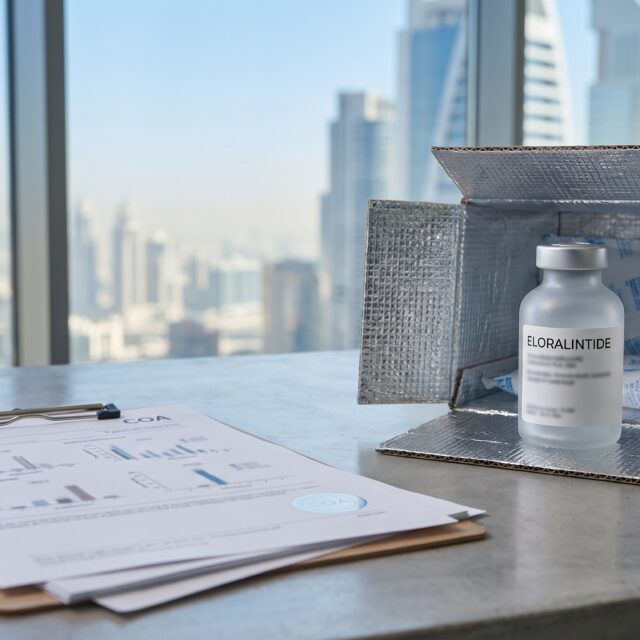
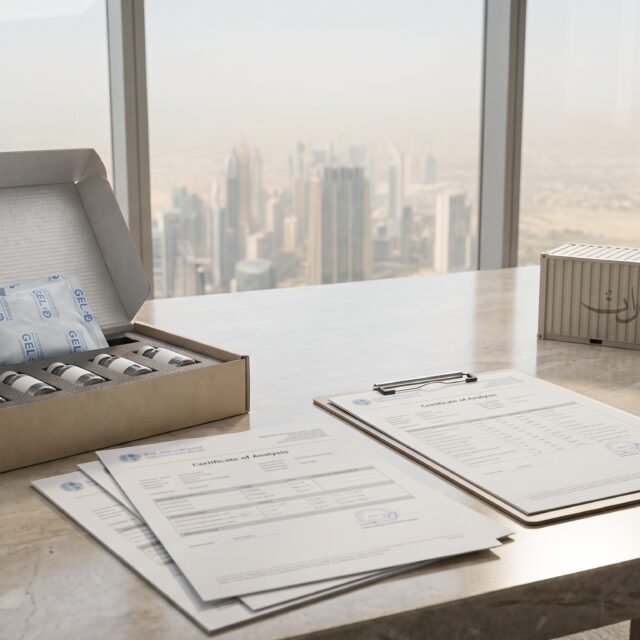
The cornerstone of reliable peptide procurement is the Certificate of Analysis (COA). When sourcing a CJC-1295 No DAC peptide, Omani researchers must demand independent, third-party laboratory verification. Internal, self-published testing holds little weight in serious scientific environments.
Deciphering the Documentation
A legitimate COA should provide two critical pieces of data: High-Performance Liquid Chromatography (HPLC) results and Mass Spectrometry (MS) data.
- HPLC Chromatogram: This tests for purity. The resulting graph should display a single, sharp, dominant peak representing the target peptide, with minimal baseline noise or secondary peaks (which indicate impurities or degradation fragments). Reputable suppliers mandate a purity threshold of at least 99%.
- Mass Spectrometry: This tests for identity. The MS report confirms that the molecular weight of the powder in the vial exactly matches the theoretical molecular weight of CJC-1295 No DAC (approximately 3367.9 g/mol).
- Batch Specificity: The COA must match the batch number printed directly on the vial you receive. A generic, outdated COA provides zero assurance about the current inventory.
If a supplier cannot produce this documentation upon request, or if the dates on the COA are several years old, buyers should immediately source their materials elsewhere to protect the integrity of their research.
Payment Security and Local Support in the GCC
Procurement managers in Oman frequently run into hurdles regarding payment processing and vendor communication when dealing with overseas suppliers. International wire transfers can be slow, expensive, and subject to holds, delaying critical research timelines.
Premium suppliers catering to the GCC region address this by offering secure, varied payment gateways. This includes encrypted credit card processing, bank transfers with clear local routing, and increasingly, cryptocurrency options which provide rapid, secure settlements for institutional buyers.
Equally important is post-purchase support. Time zone differences between Oman and Western suppliers can result in 24-to-48-hour communication delays. Sourcing from a provider with a regional presence ensures access to real-time support, such as WhatsApp updates for delivery tracking or immediate assistance if customs requires additional clarification.
Beating the Heat: Logistics and Cold-Chain Delivery in Muscat
Perhaps the most significant hurdle when importing research materials into the GCC is the extreme local climate. Lyophilized (freeze-dried) peptides are inherently sensitive to thermal degradation. While they are more stable in powder form than when reconstituted, prolonged exposure to the blistering summer temperatures of Muscat or Salalah can irreversibly damage the delicate peptide bonds, rendering the research chemical inert.
Legitimate suppliers servicing Oman utilize validated active and passive cold-chain transit protocols. This involves dispatching vials in specialized thermal packaging equipped with phase-change materials or cold packs designed to maintain a stable, cool environment for the duration of the transit window.
Speed is equally critical to minimizing thermal exposure. NOVA Labs mitigates environmental risks by operating directly within the GCC. By utilizing our fast regional logistics and reliable GCC and UAE delivery protocols, we minimize the time your temperature-sensitive materials spend in transit, ensuring they bypass long international layovers and arrive at your Omani facility ready for immediate, uncompromised analysis.
Navigating Customs and Documentation in Oman
When importing chemical compounds, compliance with local regulatory bodies is non-negotiable. The Royal Oman Police Directorate General of Customs, working alongside relevant ministries such as the Ministry of Health or Environment, closely monitors the importation of synthetic biologicals.
Shipments must be accurately declared using the correct Harmonized System (HS) codes for laboratory reagents. Attempting to obscure the nature of the package or mislabeling it to bypass scrutiny often results in severe delays or permanent seizure. Authentic suppliers ensure that shipments include all necessary paperwork, particularly a detailed commercial invoice and the Material Safety Data Sheet (MSDS).
Crucially, all documentation must explicitly state that the contents are for “In Vitro Laboratory Research Only.” Omani authorities flag and block shipments from companies that market these chemicals with direct therapeutic claims, human-use instructions, or medical branding. By strictly maintaining research-only protocols, buyers protect themselves and their institutions from customs friction.
Storage and Reconstitution Requirements
Once the CJC-1295 No DAC arrives in Oman, the responsibility for maintaining compound integrity shifts to the receiving laboratory. Upon delivery, the thermal packaging should be unpacked immediately, and the lyophilized vials must be transferred to a stable environment.
For long-term storage, unmixed vials should be kept in a dedicated laboratory freezer at -20 degrees Celsius, protected from light and ambient moisture. At this temperature, high-quality lyophilized peptides can remain stable for up to 24 months.
When researchers are ready to begin their studies, the peptide must be reconstituted. This process is typically performed inside a sterile fume hood or cleanroom environment using bacteriostatic water or sterile saline. Once reconstituted, the peptide becomes highly fragile. It must be refrigerated at 2 to 8 degrees Celsius and handled gently, as vigorous shaking can break the delicate amino acid chains. Reconstituted peptides should generally be utilized within 14 to 30 days to ensure maximum efficacy in experimental models.
Securing Your Order with NOVA Labs
Procuring high-purity peptides in the GCC requires a partner who understands both the strict scientific rigor of laboratory research and the precise logistical realities of the Middle East. Whether you are conducting baseline cellular endocrine evaluations or complex in vitro studies, your experimental outcomes are only as reliable as your starting materials.
By prioritizing transparent, batch-specific COA visibility, maintaining strictly compliant research-only documentation, and leveraging advanced passive cold-chain logistics, we provide Omani researchers with unparalleled peace of mind. Eliminate the guesswork from your supply chain and equip your laboratory with verified, ultra-pure synthetic compounds.
We invite procurement managers and independent researchers in Oman to browse our inventory and review our stringent quality control standards. Secure your next batch of materials by exploring our CJC-1295 No DAC peptide vials today.
*
Disclaimer: The products mentioned in this article are strictly for in vitro laboratory research purposes only and are not intended for human consumption, animal testing, diagnostic, or therapeutic use. Buyers must comply with all local Omani regulations regarding the import and handling of synthetic peptides.
References
- National Center for Biotechnology Information. “PubChem Compound Summary for Modified GRF (1-29).” PubChem Database.
- Jetté, L., et al. (2005). “hGRF1-29-albumin bioconjugates demonstrate enhanced half-life and stimulate pulsatile GH release in vitro.” Endocrinology, 146(7), 3052-3058.
- Royal Oman Police Directorate General of Customs. “Customs Procedures for Chemical and Biological Imports.”
- Alba, M., et al. (2006). “Once-daily administration of CJC-1295, a long-acting growth hormone-releasing hormone (GHRH) analog, normalizes growth in the dwarf rat.” American Journal of Physiology-Endocrinology and Metabolism, 291(6), E1290-E1294.
- Buy CJC-1295 No DAC in Oman: COA & Delivery Guide – NOVA Labs
- CJC-1295 No DAC: Pulsatile GH, GHRP Synergy (2026) – The Peptide Catalog
- CJC-1295 With DAC vs CJC-1295 No DAC: Key Differences in Laboratory Research Applications | Palmetto Peptides
- CJC-1295: The Modified GHRH for Sustained Growth Hormone Release | Peptidepedia
- Directorate General of Customs – Permit to Import Chemical and Cosmetic Products
Frequently asked questions
What is the difference between CJC-1295 with and without DAC?
The primary difference lies in their pharmacokinetics. CJC-1295 with DAC binds to albumin for a prolonged half-life of 6 to 8 days, while the No DAC version (Modified GRF 1-29) has a short half-life of approximately 30 minutes, better mimicking natural pulsatile hormonal release in research models.
How should CJC-1295 No DAC be stored upon arrival in Oman?
Unreconstituted lyophilized vials should be immediately stored in a laboratory freezer at -20 degrees Celsius, away from light and moisture. Once reconstituted with bacteriostatic water or sterile saline, the solution must be kept refrigerated at 2 to 8 degrees Celsius and handled gently.
Do Omani customs allow the import of research peptides?
Yes, provided they are strictly declared for in vitro laboratory research purposes only. The shipment must include accurate commercial documentation, such as an MSDS, and the supplier must not make any medical, diagnostic, or human-use claims that conflict with Omani import regulations.
How can I verify the purity of my CJC-1295 No DAC order?
Buyers should request a batch-specific Certificate of Analysis (COA) from their supplier prior to ordering. This document must feature independent third-party High-Performance Liquid Chromatography (HPLC) and Mass Spectrometry (MS) testing showing a purity level of 99% or higher.
Why is cold-chain shipping important for peptides in Oman?
Lyophilized peptides are susceptible to thermal degradation. The extreme heat in Oman during transit can break down the peptide bonds. Cold-chain shipping using thermal packaging and phase-change materials ensures the compounds remain stable and viable for laboratory use.
Nova Labs buyer tools
Ready to verify stock, testing and delivery?
Use the product page and lab report section to check availability, documentation, delivery timing and support before placing an order.
- COA / test-report checks
- Oman delivery context
- Cold-chain handling
- COD and card payment options
- WhatsApp support