




Procuring mitochondrial-derived compounds for laboratory study in the Middle East requires strict attention to product stability and supplier documentation. When laboratories and independent researchers seek to secure high-grade reagents in the UAE, they often encounter a highly fragmented market. Sourcing options range from clinical facilities to direct-to-buyer suppliers with varying logistical capabilities.
For those studying metabolic pathways and cellular function, MOTS-c (Mitochondrial Derived Peptide) is frequently evaluated for its role in cellular stress responses. However, securing stable, uncontaminated compounds in a region known for extreme summer temperatures demands rigorous vetting. This guide breaks down exactly what informed researchers should expect regarding testing transparency, cold-chain handling, and seamless procurement.
Quick Answer: Buy MOTS-c Dubai Buyer Checklist
To securely buy MOTS-c in Dubai, researchers must verify third-party HPLC testing (≥99% purity), ensure the supplier uses lyophilized powder formats, and demand strict cold-chain logistics. Avoiding international transit delays by utilizing locally stocked vendors protects sensitive peptide bonds from degrading in extreme UAE temperatures.
The Dubai Market: Clinical Facilities vs. Direct Sourcing
The local landscape for peptide procurement is heavily split. On one end, premium wellness centers across Dubai handle direct administration but offer very little transparency into the base cost or primary sourcing of the compounds they utilize. On the other end, independent researchers and lab procurement staff look for direct suppliers to acquire unadulterated reagents for in vitro studies.
Many online suppliers serving the GCC struggle with logistical vulnerabilities or explicitly violate compliance by pushing human dosing protocols. Reliable direct sourcing shifts the focus entirely to material quality and transparent pricing. Dedicated suppliers structure pricing to support ongoing research, allowing laboratories to scale their studies predictably without unverified claims.
Understanding MOTS-c and Peptide Stability
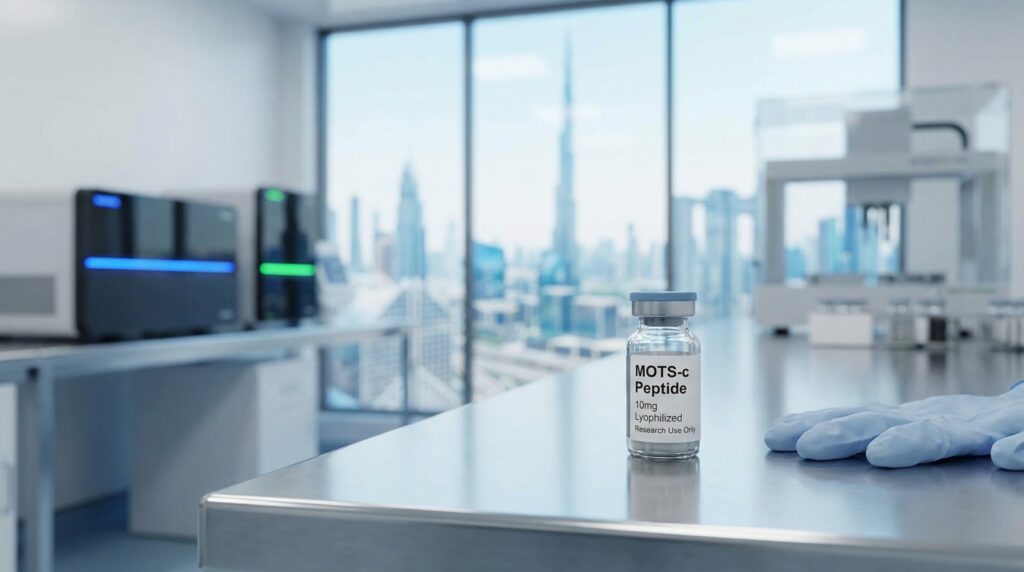
MOTS-c is a 16-amino acid peptide naturally expressed within the mitochondrial genome. In laboratory settings, it is studied for its regulatory effects on cellular metabolism and insulin sensitivity in vitro. Due to its specific molecular sequence, it is highly susceptible to environmental degradation if not manufactured, stored, and transported under exact conditions.
Researchers evaluating MOTS-c must recognize that physical stability is just as important as chemical purity. A degraded peptide, even one that was originally 99% pure, will yield inconsistent or completely invalid experimental data.
The Heat Factor: Formulations and Cold-Chain Logistics
The most critical factor when procuring sensitive biological compounds in the Middle East is the extreme climate. Dubai summer temperatures frequently exceed 45°C. When peptide chains are exposed to severe heat—even for just a few hours—they face rapid degradation through hydrolysis, oxidation, and aggregation.
Lyophilized Powder vs. Liquid Formulations
A major differentiator between compliant, research-focused suppliers and vulnerable vendors is the physical formulation. Pre-reconstituted liquid formats are highly unstable and require absolute, uninterrupted refrigeration. In the event of a slight delay in transit, these liquid formulations can rapidly degrade, rendering them useless for precise scientific study.
Conversely, lyophilized (freeze-dried) powder is significantly more stable. By removing the moisture content in a controlled laboratory environment, the peptide’s structural integrity is preserved. Lyophilized MOTS-c can withstand brief temperature fluctuations during transit much better than its liquid counterpart, making it the required format for the Gulf climate.
Essential Cold-Chain Delivery Infrastructure
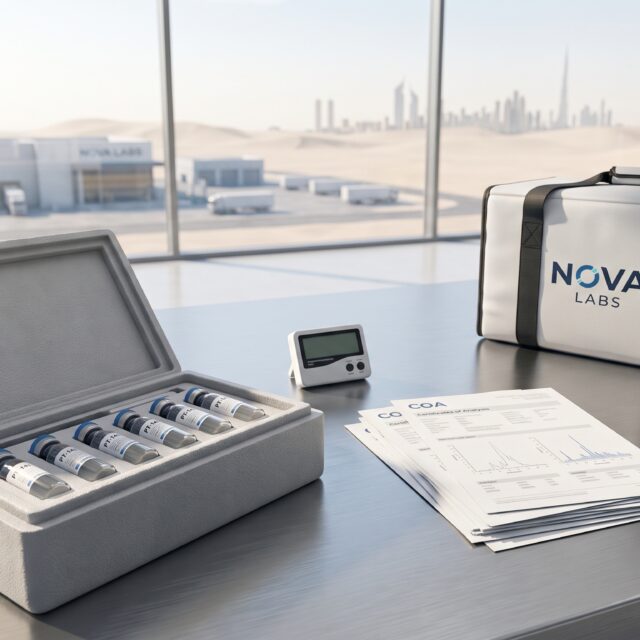
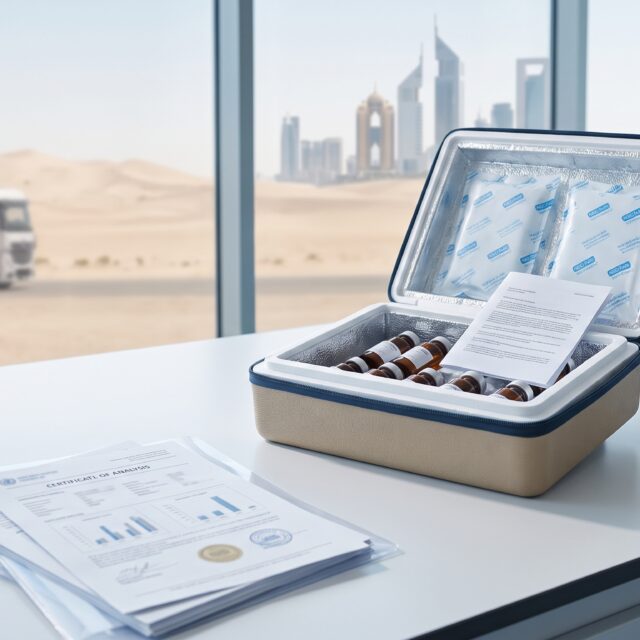
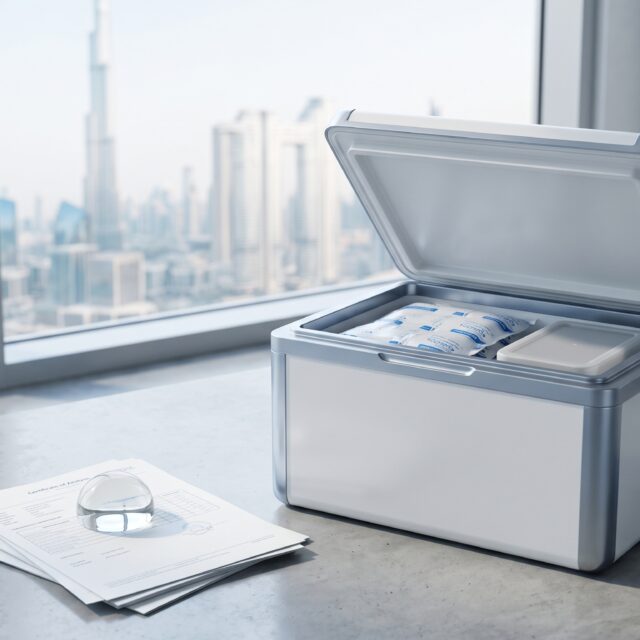
Even with lyophilized formulations, reputable suppliers do not leave transit to chance. Secure delivery relies on advanced cold-chain logistics. This includes utilizing passive thermal insulated packaging, climate-shield mailers, and phase-change materials (PCMs) engineered to absorb ambient heat.
Local operational efficiency is a massive advantage here. Bypassing international transit delays by using a locally stocked supplier minimizes thermal exposure. For researchers in the UAE, utilizing expedited local services like peptides Dubai same-day delivery ensures that compounds spend minimal time outside of controlled storage. Optimized logistics typically involve cooled, priority delivery protocols and strict daily fulfillment cutoffs.
Verifying Your MOTS-c Supplier: The COA Breakdown
A professional procurement strategy relies heavily on objective data. Trust in a chemical supplier is built entirely on their willingness to provide independent, third-party validation for every batch of product distributed.
Before ordering, always request the Certificate of Analysis (COA). If a supplier produces their own COAs in-house, the data presents a conflict of interest. Reputable suppliers partner with renowned analytical laboratories, such as Janoshik Analytical, to conduct rigorous testing.
When reviewing a COA, verify the following metrics:
- HPLC (High-Performance Liquid Chromatography): This test measures the purity of the compound. For rigorous research applications, an HPLC purity rating of ≥99% is the standard baseline. The chromatogram should show one distinct peak without significant background noise.
- Mass Spectrometry (MS): While HPLC shows purity, Mass Spectrometry confirms the exact molecular weight and identity of the peptide. It ensures the vial contains the precise 16-amino acid sequence of MOTS-c rather than a cheaper, unverified substitute.
- Batch Matching: Ensure that the batch number on the independent COA perfectly matches the batch number printed on the vial you receive in the lab.
Suppliers that fail to provide easily accessible, highly visible third-party COAs should be strictly avoided.
Best Practices for Lab Storage Post-Delivery
Procurement does not end when the package arrives; handling at the facility is equally critical. Upon receiving lyophilized MOTS-c, researchers should immediately transfer the vials to a controlled freezer environment, ideally at -20°C for long-term storage.
When preparing the compound for in vitro application, reconstitution should be performed using sterile laboratory water or bacteriostatic water, depending on the duration of the experiment. Once reconstituted, the liquid MOTS-c must be kept refrigerated at 2°C to 8°C and utilized within an appropriate timeframe to prevent biological degradation.
Seamless GCC Procurement: Payment and Support
Alongside chemical verification and logistics, the purchasing process in the GCC often introduces unnecessary friction. International vendors frequently suffer from declined transactions or complex cryptocurrency requirements.
Localizing the transaction is a strong signal of a supplier’s commitment to the UAE market. Top-tier suppliers resolve these hurdles by offering region-specific payment and communication options:
- Responsive Local Support: The ability to communicate directly during UAE business hours allows buyers to verify stock availability, confirm shipping timelines, or clarify analytical testing details before finalizing a requisition.
- Flexible Payment Structures: Trust is often reinforced by offering secure credit card processing and localized options like Buy Now, Pay Later (BNPL) platforms (such as Tamara). This provides financial flexibility for laboratories procuring larger bundle quantities for ongoing studies.
Confident Procurement for Your Laboratory
Sourcing peptides in a high-temperature, fast-paced environment like Dubai requires a strategic, uncompromising approach. It is about ensuring the compound arrives in a chemically sound state, verified by independent testing, and supported by a seamless local infrastructure.
By demanding lyophilized formulations, strict cold-chain handling, independent COAs, and reliable local support, you protect the integrity of your experimental data. To ensure your laboratory studies rely on verified, heat-stable compounds, explore our localized inventory and secure MOTS-c for your research. Selecting a supplier that prioritizes analytical transparency and robust logistics is the first step in successful cellular research.
Disclaimer: The products and compounds mentioned in this article are strictly for in vitro laboratory research purposes only. They are not intended for human or animal consumption, diagnostic, therapeutic, or clinical use.
References
- D’Hondt, M., et al. (2014). “Related impurities in peptide medicines.” Journal of Pharmaceutical and Biomedical Analysis.
- Lee, C., et al. (2015). “The mitochondrial-derived peptide MOTS-c promotes metabolic homeostasis and reduces diet-induced obesity.” Cell Metabolism.
- Janoshik Analytical. (2023). Standardized Testing Protocols for Peptide Synthetics: HPLC and Mass Spectrometry.
- UAE Ministry of Climate Change and Environment (MOCCAE) logistics frameworks for temperature-sensitive compounds.
- MOTS-c – NOVA Labs
- Shipping Policy – NOVA Labs
- Refund Policy – NOVA Labs
- Contact Us – NOVA Labs
- Nova Biolabs vs BodyPharm GCC: 2026 Peptide Buyer Comparison – NOVA Labs
- Cold Chain Peptide Delivery Bahrain: Heat, Timing and Packaging – NOVA Labs
- Nova Biolabs vs Peptide Tech UAE: Oman Buyer Comparison
Frequently asked questions
Why is cold-chain shipping important for MOTS-c in Dubai?
Dubai's extreme summer temperatures frequently exceed 45°C, which can rapidly degrade delicate peptide bonds through hydrolysis and oxidation. Cold-chain shipping utilizing insulated mailers and phase-change materials ensures the compound remains stable during transit to the laboratory.
How can I verify the purity of MOTS-c before ordering?
You should always review the batch-specific Certificate of Analysis (COA) from an independent third-party laboratory. Look for High-Performance Liquid Chromatography (HPLC) results showing ≥99% purity and Mass Spectrometry confirming the compound's precise molecular weight.
What is the difference between lyophilized powder and liquid MOTS-c?
Lyophilized (freeze-dried) powder has its moisture removed, making it highly resilient to temperature fluctuations during transit. Pre-reconstituted liquid MOTS-c is highly unstable and can rapidly degrade if strict refrigeration is interrupted.
How should MOTS-c be stored in a laboratory setting after delivery?
Upon arrival, lyophilized MOTS-c should be immediately stored in a freezer at -20°C to preserve long-term stability. Once reconstituted for in vitro use, the solution must be kept refrigerated between 2°C and 8°C.
Nova Labs buyer tools
Ready to verify stock, testing and delivery?
Use the product page and lab report section to check availability, documentation, delivery timing and support before placing an order.
- COA / test-report checks
- Dubai delivery context
- Cold-chain handling
- COD and card payment options
- WhatsApp support