



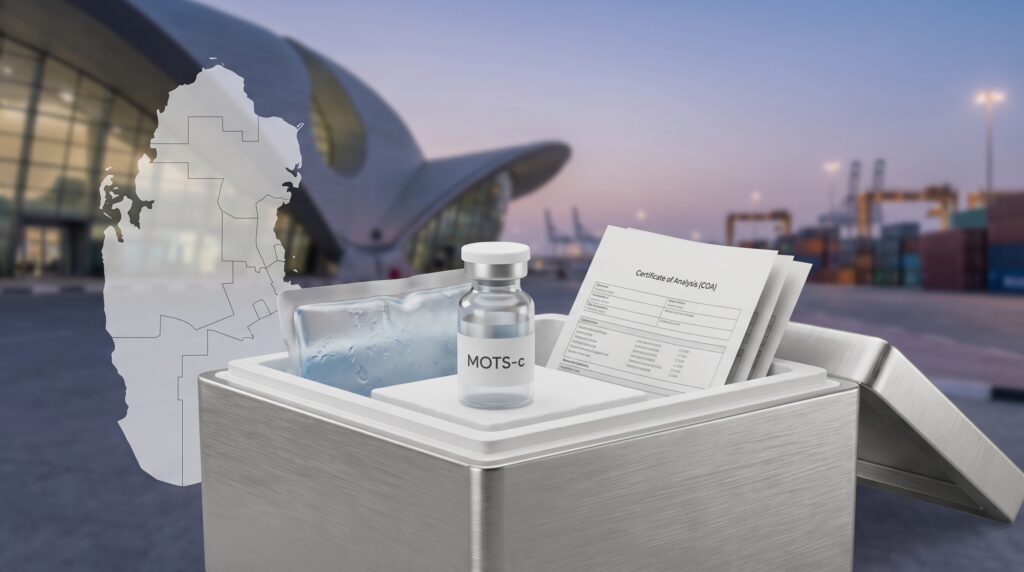
The landscape for sourcing laboratory peptides in the GCC has undergone a significant transformation. For procurement staff looking to buy MOTS-c in Qatar, acquiring verifiable, research-grade compounds now requires strict adherence to updated government protocols and advanced logistical planning. As the regulatory environment tightening around unverified chemical shipments increases, understanding exactly how to evaluate a vendor’s documentation, marketing, and logistics is essential for maintaining institutional compliance and research integrity.
Quick Answer: Buying MOTS-c in Qatar
To safely buy MOTS-c in Qatar for research, procurement teams must select suppliers that provide verifiable third-party Certificates of Analysis (COAs), utilise insulated regional cold-chain logistics, and adhere strictly to Ministry of Public Health (MoPH) regulations by marketing compounds exclusively for in vitro laboratory applications.
Navigating Qatar MoPH Regulations
In recent years, Qatar’s Ministry of Public Health (MoPH) Pharmacy and Drug Control Department has enacted sweeping directives that fundamentally alter how biological compounds are imported and handled within the nation. The rules strictly prohibit the import, trade, promotion, and use of unlicensed peptides when marketed, sold, or intended for human consumption. This increasing scrutiny makes procurement a highly delicate process for legitimate research facilities and private laboratories.
For institutional buyers, the most critical takeaway from these circulars is the standard of intent. The MoPH clarifies that simply affixing a “for research purposes only” label on a product is entirely insufficient if the vendor concurrently promotes the compound for non-laboratory applications via social media or their primary website. Undocumented or improperly marketed peptide shipments face immediate interception at Hamad International Airport, where the General Authority of Customs and the Qatar National Anti-Doping Commission (QNADC) scrutinize incoming packages for any signs of direct-to-consumer marketing.
The Importance of Clean Supplier Boundaries
When looking for a reliable MOTS-c supplier Qatar laboratories can trust, evaluating the vendor’s marketing practices is just as vital as checking their product catalogue. Legitimate suppliers of research-grade MOTS-c must strictly market their compounds for in vitro and laboratory research. They will actively avoid any association with telehealth platforms, cosmetic claims, or consumer dosing guides.
If a supplier implies that their products are intended for physiological alteration, metabolic management, or human consumption, they are in direct violation of MoPH guidelines. Shipping items from such vendors puts the receiving laboratory at severe risk of customs confiscation, financial loss, and institutional auditing. The Qatari government has heavily reinforced this stance through dedicated reporting channels to monitor the distribution of unverified compounds. Maintaining strict boundaries between research sourcing and consumer trends is the only way to ensure unhindered institutional procurement.
Product Fit: Why MOTS-c Requires Stringent Purity
Before evaluating logistics, it is important to understand why the molecular integrity of this specific compound is paramount. MOTS-c (Mitochondrial Open Reading Frame of the 12S rRNA-c) is a 16-amino acid peptide derived from the mitochondrial genome. In laboratory settings, it is heavily studied in cellular assays to observe mitochondrial function, metabolic signalling pathways, and cellular stress responses strictly within in vitro environments.
Because the peptide acts on delicate mitochondrial structures in cell cultures, any synthetic impurities, heavy metals, or residual solvents left over from the manufacturing process can drastically skew experimental data, lead to cellular toxicity, and invalidate expensive research studies.
COA Verification: Spotting Authentic Lab Reports
True research-grade MOTS-c peptide Qatar procurement teams demand must be backed by a stringent, third-party Certificate of Analysis (COA). A valid COA for MOTS-c should confirm two crucial analytical metrics:
- Purity via HPLC: High-Performance Liquid Chromatography (HPLC) testing should confirm a molecular purity of 99% or greater. This ensures that synthetic byproducts have been successfully cleaved and removed during the synthesis phase.
- Identity via Mass Spectrometry (MS): The molecular identity of synthetic MOTS-c must be confirmed by matching its exact theoretical molecular weight of 2174.6 g/mol.
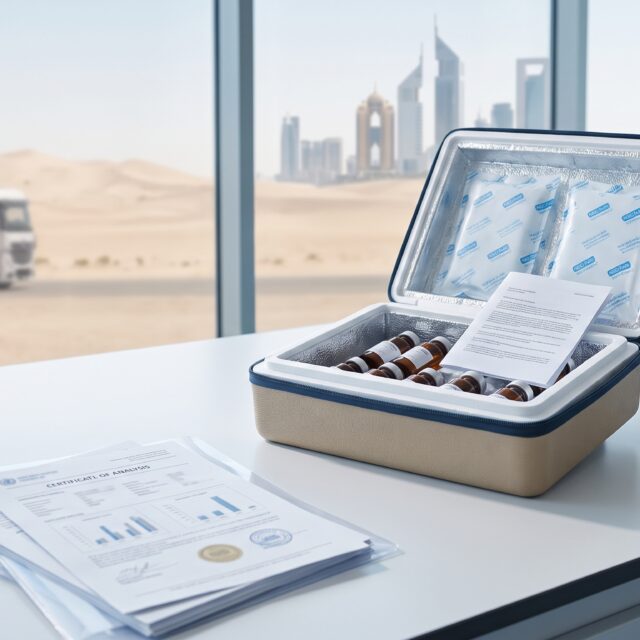
Unfortunately, the global research supply market is saturated with vendors utilising tampered or generic static PDF reports. These static documents are easily manipulated using basic photo-editing software, posing a severe risk to research integrity. To combat this, premier suppliers use independent, verifiable testing services such as Janoshik. A Janoshik COA contains cryptographically secure, unique keys that allow the buyer to pull the original test results directly from the independent testing laboratory’s server. This guarantees that the purity data has not been altered by the vendor prior to sale, providing absolute assurance to your finance and quality control departments.
Mitigating Extreme GCC Heat: The Cold-Chain Imperative
Once a legitimate, COA-verified supplier is identified, the next major hurdle is physical logistics. Peptides are highly sensitive to thermal degradation. Given that Middle Eastern summer temperatures routinely exceed 45 degrees Celsius, shipping these fragile molecular structures without proper thermal protection is a recipe for complete compound spoilage.
When you order MOTS-c Qatar customs processing times can vary based on shipment volume and documentation clarity. Sourcing from international suppliers often means long tarmac hold times at transit hubs where uncooled shipments rapidly degrade. Due to high customs friction and complex import guidelines, several well-known international suppliers have officially ceased shipping to Qatar and Bahrain entirely, unable to guarantee compound survival across long, unmanaged international supply chains.
This highlights the absolute necessity of regional logistical expertise. Sourcing from regional Middle East hubs, such as UAE-based fulfilment networks, provides insulated, cold-chain delivery. By utilising secure, temperature-controlled transit maintained between 2 to 8 degrees Celsius, regional suppliers bypass catastrophic long-haul tarmac delays. This rapid, climate-controlled relay ensures the peptide maintains its structural integrity from the dispatch facility directly to your laboratory bench.
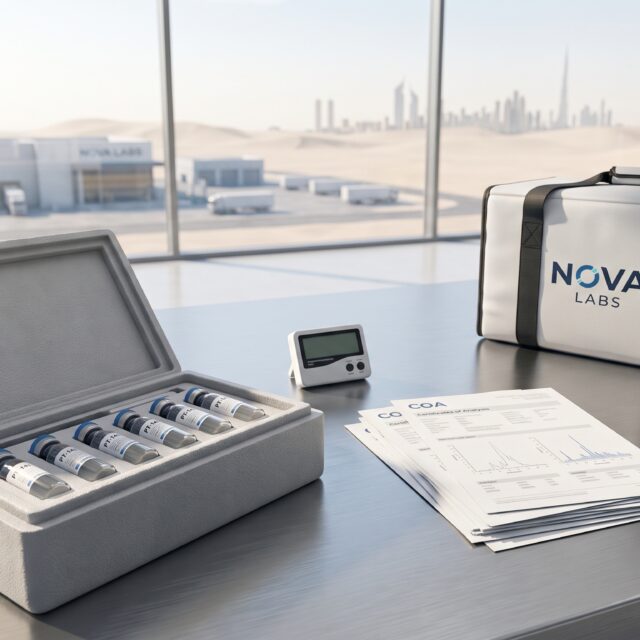
NOVA Labs addresses these exact regional challenges, providing secure UAE-based regional dispatch that incorporates robust thermal packaging and deeply understands GCC customs requirements, significantly reducing the friction faced by Gulf researchers.
Evaluating Payment, Support, and Documentation
For institutional buyers, the purchase process must be as transparent as the chemical analysis. A reliable supplier servicing Qatar must provide commercial support tailored to regional business practices. This includes offering seamless communication channels, such as direct WhatsApp support, to resolve logistical queries in real time.
Furthermore, accurate commercial invoices, detailed packing slips matching the exact nomenclature of the compounds, and accessible testing keys are non-negotiable for swift procurement approvals. Vendors who offer secure, locally compliant payment gateways demonstrate a commitment to the region that fly-by-night international vendors lack. Without precise commercial documentation, packages risk indefinite holds by Qatari authorities.
Bottom Line for Qatar Procurement
Strict MoPH regulations have effectively filtered out low-quality, non-compliant vendors from the Qatari market. While this increases the initial scrutiny required by procurement staff, it ultimately protects the integrity of regional research. By demanding verifiable third-party testing, strictly adhering to in vitro applications, and utilising insulated regional cold-chain logistics, laboratories can successfully source high-purity MOTS-c without customs friction or compound degradation.
When preparing for your next in vitro cellular assay, prioritise vendors that combine rigorous analytical testing with specialised Middle Eastern logistical expertise. Doing so ensures your research is powered by pure, intact, and fully documented compounds.
Ready to equip your laboratory? Review our verifiable documentation and procure MOTS-c for in vitro laboratory study directly from a trusted GCC source.
Disclaimer: The products mentioned in this article are strictly for laboratory and research purposes only. They are not intended for human consumption, animal testing, or therapeutic use. Buyers must comply with all regional regulations.
References
- Qatar Ministry of Public Health (MoPH). Pharmacy and Drug Control Department Guidelines on Unlicensed Medicines and Peptides.
- General Authority of Customs, State of Qatar. Importation Guidelines for Biological and Chemical Research Materials.
- Lee, C., et al. (2015). “The mitochondrial-derived peptide MOTS-c promotes metabolic homeostasis and reduces diet-induced obesity.” Cell Metabolism (In vitro data standardizations).
- World Health Organization (WHO). Good Distribution Practices for Pharmaceutical and Biological Products (Cold Chain Guidelines).
- Qatar: MOPH Prohibits Handling of Unlicensed Peptides (PDC/2026/31)
- MoPH bans sale and use of unlicensed peptide products
- Sourcing HPLC Tested Peptides in Qatar: COA Verification & Customs
- Buy MOTS-c in Qatar: Purity, COA, and Delivery Guide
- Shipping Policy – Pure Peptides
- MOTS-c vs SS-31: Research Differences & UAE Buyer Guide
Frequently asked questions
Is it legal to buy MOTS-c in Qatar for research?
Yes, provided the MOTS-c is procured strictly for in vitro laboratory research, is not promoted or used for human consumption, and the supplier fully adheres to the documentation and marketing regulations set forth by the Qatar MoPH.
How can I verify the purity of MOTS-c before ordering?
Buyers should demand a third-party Certificate of Analysis (COA) from an independent laboratory like Janoshik. This COA must feature a verifiable cryptographic key to confirm a purity of 99% or greater via HPLC and an exact theoretical mass of 2174.6 g/mol via Mass Spectrometry.
Why is cold-chain shipping important for delivering peptides to Qatar?
Peptides like MOTS-c are highly sensitive to thermal degradation. Because GCC temperatures frequently exceed 45 degrees Celsius, insulated cold-chain logistics from a regional hub are essential to protect the compound from spoiling during customs transit.
What happens to undocumented peptide shipments at Hamad International Airport?
Packages containing unlicensed peptides or those originating from suppliers making unapproved consumer or non-laboratory claims face immediate interception and scrutiny by the General Authority of Customs and the Qatar MoPH.
Nova Labs buyer tools
Ready to verify stock, testing and delivery?
Use the product page and lab report section to check availability, documentation, delivery timing and support before placing an order.
- COA / test-report checks
- Qatar delivery context
- Cold-chain handling
- COD and card payment options
- WhatsApp support