



Procuring premium research compounds in volume requires precision, compliance, and absolute logistical reliability. As the scientific and analytical sector in the UAE continues to expand, laboratories, academic institutions, and independent researchers are increasingly seeking dependable sources for wholesale peptides in Abu Dhabi.
However, the transition from purchasing individual vials to bulk procurement introduces significant complexities. High-volume buyers must navigate stringent local regulations, aggressive climate challenges that threaten compound stability, and customs friction that can delay critical research timelines. Choosing the right partner goes far beyond comparing unit prices; it requires a deep dive into third-party analytical testing, batch consistency, institutional payment structures, and local supply chain capabilities.
This guide breaks down exactly how to evaluate a B2B supplier, what documentation to demand, and how local logistics play a critical role in ensuring your wholesale order arrives fully viable and ready for advanced laboratory application.
The Core Challenge: Sourcing Wholesale Peptides in Abu Dhabi
Quick Answer: What should buyers look for when sourcing wholesale peptides in Abu Dhabi? B2B buyers must verify independent COA and HPLC testing, ensure GDP-compliant cold-chain delivery (2°C-8°C) to protect product stability, and confirm local stock availability to bypass UAE customs delays.
Unlike standard chemical supplies, lyophilised peptides are sensitive biological compounds that degrade rapidly if exposed to excessive heat, moisture, or light. In a climate like Abu Dhabi’s, standard international shipping methods frequently result in compromised products. Furthermore, relying on overseas suppliers often leaves bulk buyers vulnerable to seized shipments, opaque delivery windows, and inconsistent batch syntheses that can compromise multi-month research projects.
Securing bulk peptides in Abu Dhabi successfully means partnering with a supplier who understands the unique intersection of rigorous biochemical quality control and highly specialised local logistics. B2B purchasing requires more than a standard online checkout; it requires a dedicated procurement pipeline.
Navigating MoHAP Regulations and B2B Compliance
The regulatory landscape for pharmaceuticals and medical devices in the UAE is robust and carefully monitored. Understanding these frameworks is essential for any institution or independent researcher importing or purchasing peptides in volume.
Under recent updates to UAE federal health legislation and the formal activation of the Emirates Drug Establishment (EDE) in 2024, the distribution of pharmaceutical and medical products is heavily regulated. Furthermore, the Ministry of Health and Prevention (MoHAP), alongside the Department of Health (DOH) Abu Dhabi, enforce strict guidelines mandating that clinical peptide products can only be dispensed and administered by licensed healthcare professionals within certified facilities.
For B2B buyers, this reinforces a crucial distinction: research peptides must be explicitly sourced and clearly documented for in-vitro laboratory and analytical research purposes only. They fall outside the compounding guidelines of direct-to-consumer medical sales, but they still require transparent handling and correct operational licensing.
Top-tier suppliers cater to this by requiring direct inquiries regarding peptide sequences, purity thresholds, and institutional verification before issuing a wholesale quote. This professional friction is a positive signal; it demonstrates that the supplier is operating within compliant parameters and respects the high standards of the UAE market.
Quality Verification: What to Demand from a Peptide Wholesale Supplier
When evaluating a peptide wholesale supplier in Abu Dhabi, the presence of rigorous, verifiable testing documentation is non-negotiable. A premium B2B supplier will not just claim high purity; they will prove it through independent, third-party analytics.
Essential Analytical Documentation
Before committing to a bulk order, procurement staff must request and review the following documentation:
- Certificate of Analysis (COA): This document serves as the fundamental ID of the batch. It should detail the physical appearance, molecular weight, and the precise purity percentage of the compound.
- HPLC (High-Performance Liquid Chromatography): HPLC reports separate and quantify the individual components within the vial, clearly identifying any impurities or truncated sequences that occurred during synthesis. For sensitive research, purity should consistently exceed 98%.
- Mass Spectrometry (MS): MS confirms the exact molecular mass of the peptide, verifying that the correct amino acid sequence was successfully synthesised without structural errors.
- Bioburden / Endotoxin Testing (LAL): Crucial for advanced research applications, this testing ensures the lyophilised powder is free from harmful bacterial endotoxins that could skew cellular assays or in-vitro study results.
- TFA Removal Verification: Trifluoroacetic acid (TFA) is frequently used during peptide synthesis. High levels of residual TFA can be highly toxic to cell cultures. Premium suppliers provide documentation showing successful TFA removal processes, ensuring safety for delicate cellular assays.
B2B Procurement: Lot Reservation, Payments, and Support
One of the most overlooked aspects of purchasing bulk peptides in Abu Dhabi is batch consistency. Peptides are synthesised in discrete lots. While a highly controlled manufacturing process minimises variance, slight differences between synthesis runs can introduce uncontrolled variables into long-term longitudinal studies.
Premium wholesale partners offer ‘lot reservation’ options. If your laboratory is conducting a six-month protocol, you can secure the requisite volume of vials from a single, specific synthesis batch. This ensures absolute chemical uniformity throughout the duration of your research, protecting the integrity of your data.
Additionally, professional B2B procurement demands flexible institutional workflows. A legitimate supplier will accommodate formal Purchase Orders (POs), secure bank wire transfers, and localized GCC payment gateways. Furthermore, having a dedicated account manager reachable via secure channels (like encrypted email or WhatsApp business lines) is vital for real-time stock checks, order adjustments, and resolving any logistical friction.
GDP-Compliant Logistics and Cold-Chain Delivery in the UAE
The most meticulously synthesised peptide is ultimately useless if it degrades during transit. Standard international shipments of research chemicals are highly vulnerable in the UAE. Using standard express carriers without proper medical warehouse licensing or clear Incoterms often results in customs seizures or weeks spent in non-temperature-controlled holding areas.
Abu Dhabi’s pharmaceutical and research logistics landscape relies heavily on GDP-compliant (Good Distribution Practice) cold-chain transport. Facilities around the Musaffah Industrial Area and the Etihad Cargo cool chain hub are designed to maintain strict temperature controls.
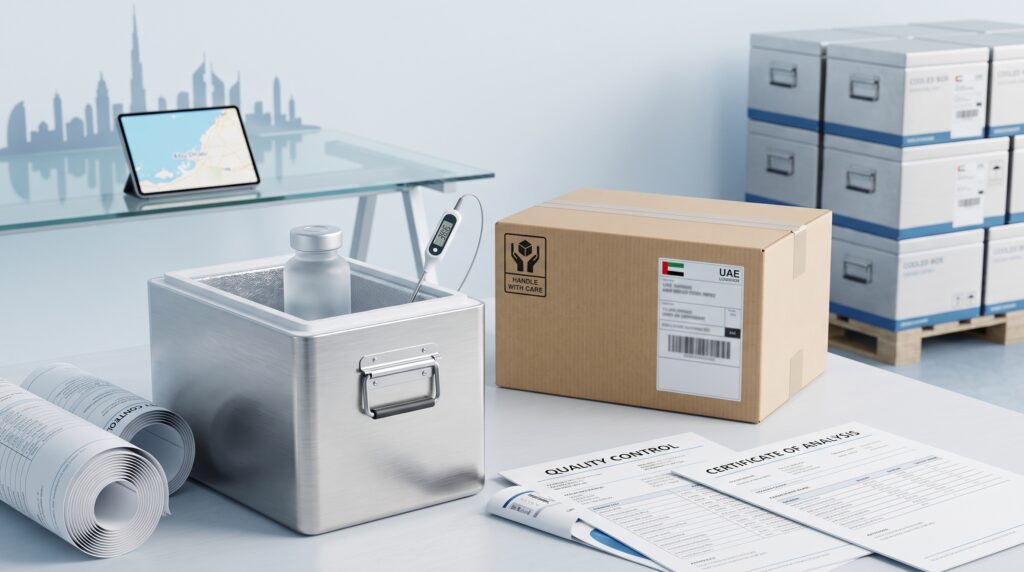
For peptide viability, this means maintaining a consistent 2°C to 8°C environment during transit. When evaluating a supplier, inquire specifically about their domestic fulfillment capabilities. A supplier with local stock already cleared through UAE customs provides a massive strategic advantage. They can facilitate rapid domestic dispatch using specialised local couriers equipped with active cooling or validated insulated packaging, ensuring the compounds arrive at your laboratory fully intact and ready for reconstitution.
Furthermore, clear shipping terms (such as DDP – Delivered Duty Paid – over EXW – Ex Works) protect the buyer from sudden import duties and the administrative headache of clearing scientific materials at the border.
Buyer Checklist: Evaluating Your Bulk Supply Partner
Transitioning to a new wholesale provider requires due diligence. Use this checklist to ensure your chosen supplier meets the operational and scientific standards required in the UAE:
- Verifiable Testing: Do they provide batch-specific, independent COAs and HPLC/MS chromatograms prior to purchase?
- Local Availability: Do they hold stock within the UAE to guarantee rapid, secure delivery, or are they drop-shipping from overseas with high customs risks?
- Volume Flexibility: Can they accommodate tiered volume pricing, OEM requests, and specific lot reservations for extended research protocols?
- Logistics & Packaging: Do they utilise thermal packaging, GDP-compliant cold-chain logistics, and trusted local couriers to protect against the GCC heat?
- Responsive Support: Is there a dedicated account manager or secure WhatsApp channel for immediate B2B coordination, stock checks, and logistical troubleshooting?
- Payment Confidence: Do they offer secure, transparent payment structures (e.g., bank transfers, institutional PO handling) suitable for B2B procurement?
Partnering with NOVA Labs for Wholesale Needs
For laboratories, procurement managers, and independent researchers operating in the UAE, finding a supplier that bridges the gap between scientific rigor and local operational excellence is critical.
At NOVA Labs, we understand the specific challenges of the local market. We provide comprehensive third-party testing documentation, ensuring you always know the exact purity and identity of your compounds. By maintaining local fulfillment capabilities, we bypass international shipping delays and mitigate the risks of compound degradation, offering fast, secure, and temperature-conscious delivery directly to your facility in Abu Dhabi.
Whether you are scaling up a new analytical protocol or securing a consistent supply chain for an ongoing project, our dedicated B2B team is ready to assist with tiered pricing, lot reservations, institutional payment options, and tailored logistical solutions.
To discuss volume requirements, batch availability, and specialised shipping coordination, explore our dedicated wholesale procurement page. If you wish to review our current synthesis quality and available compounds before placing a bulk order, you can view our full catalogue in our research shop.
Disclaimer: All products mentioned in this article are strictly for in-vitro laboratory research and analytical purposes only. They are not intended for human consumption, diagnostic, therapeutic, or clinical use. NOVA Labs policies require compliance with all local health and laboratory regulations.
References
- Ministry of Health and Prevention (MoHAP) UAE. “Guidelines for the Importation and Distribution of Medical and Research Products.” mohap.gov.ae
- Department of Health (DOH) Abu Dhabi. “Healthcare Professional Licensing and Scope of Practice.” doh.gov.ae
- World Health Organization (WHO). “Good Distribution Practices for Pharmaceutical Products.” who.int
- Emirates Drug Establishment (EDE). “Federal Law on Medical Products and Pharmaceutical Facilities, 2024.” mohap.gov.ae
- Peptide Supplier UAE | B2B Research Peptide Supply, COA & OEM – BT BioLabs
- Wholesale Research Supply | UAE Core Peptides
- Importing Pharmaceuticals and Medical Devices to the UAE: A Comprehensive Guide
- New UAE Peptide Regulations: What You Need to Know
- Incoterms for Research Peptide Imports into the UAE – Peak Labs
- Cold Chain Logistics – Amjad Khan Transport
- UAE Cold Chain Logistics 2024: Trends, Compliance & 3PL Growth | Ken Research
Frequently asked questions
What is the most important document to check when buying wholesale peptides in Abu Dhabi?
Buyers must verify batch-specific Certificates of Analysis (COAs) accompanied by third-party HPLC and Mass Spectrometry reports. These documents confirm the exact purity percentage and molecular identity of the specific batch you are purchasing.
Why is cold-chain delivery critical for bulk peptides in the UAE?
Lyophilised peptides can degrade rapidly if exposed to the extreme heat common in the UAE. GDP-compliant cold-chain logistics (maintaining 2°C-8°C) ensure the compounds remain stable and fully viable upon arrival at your laboratory.
What is lot reservation in peptide procurement?
Lot reservation allows B2B buyers to secure their entire volume order from a single synthesis batch. This eliminates slight batch-to-batch chemical variations, ensuring absolute consistency for long-term research protocols.
Are wholesale peptides in Abu Dhabi subject to MoHAP regulations?
Clinical administration of peptides requires licensed healthcare professionals under MoHAP guidelines. However, research peptides formulated and sold strictly for in-vitro laboratory research follow separate B2B procurement and compliance pathways.
How can B2B buyers avoid customs delays when importing peptides?
The most effective way to avoid customs seizures and delays is to partner with a supplier that holds local stock within the UAE or operates using precise DDP (Delivered Duty Paid) Incoterms and medical-grade freight forwarding.
Nova Labs buyer tools
Ready to verify stock, testing and delivery?
Use the product page and lab report section to check availability, documentation, delivery timing and support before placing an order.
- COA / test-report checks
- Abu Dhabi delivery context
- Cold-chain handling
- COD and card payment options
- WhatsApp support