

Procuring high-quality research compounds in the Gulf Cooperation Council (GCC) requires more than just finding a supplier with an active website. For research laboratories and informed buyers in Bahrain, the purchasing process is complicated by extreme environmental factors and stringent national import regulations. Understanding exactly what you are ordering, verifying its purity, and ensuring it arrives intact is paramount to successful research.
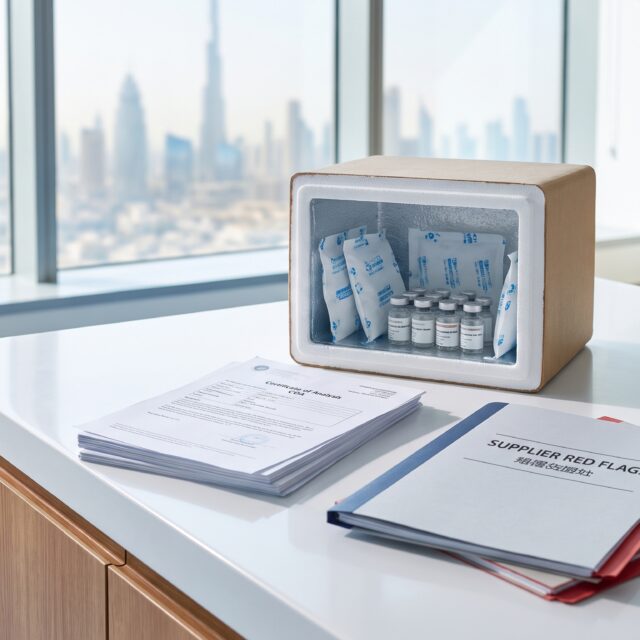
The single most important document in this process is the Certificate of Analysis (CoA). However, a CoA is only valuable if you know how to interpret the data it presents and verify its authenticity. This comprehensive guide will explain the complete how to read peptide coa bahrain requirements, decode complex analytical charts, and ensure that the compounds you source are fully protected against the region’s intense thermal and logistical challenges.
Core Verification: How to Read Peptide CoA Bahrain Guidelines
Quick Answer: When learning how to read a peptide CoA in Bahrain, you must verify three critical elements: an HPLC chromatogram showing ≥98% purity (indicated by a single sharp peak), a Mass Spectrometry (MS) report confirming exact molecular weight, and a batch number that perfectly matches your physical vial.
Failing to verify even one of these elements leaves your laboratory vulnerable to degraded compounds, substituted materials, or completely falsified products. When conducting research, the integrity of your input material directly dictates the validity of your outcomes. Therefore, reading a CoA is not just a formality; it is a critical step in your laboratory’s standard operating procedures.
Decoding HPLC Purity: The 98% Benchmark
The most prominent feature on any legitimate Certificate of Analysis is the High-Performance Liquid Chromatography (HPLC) report. This analytical technique separates, identifies, and quantifies each component within a given sample. When evaluating a supplier’s documentation, the HPLC chromatogram is your primary tool for determining quantitative purity.
In the research peptide industry, the widely accepted standard for high-quality compounds is a minimum purity of 98%. But how do you verify this number visually on the report?
When examining the HPLC chromatogram, look for a single, sharp, distinct peak that dominates the graph. This primary peak represents your target peptide. The baseline of the graph should be relatively flat and clean. If you see numerous smaller peaks scattered around the primary peak, these represent impurities. Common impurities include truncated peptide sequences (where the solid-phase synthesis process failed to attach all amino acids), residual solvents, or excess trifluoroacetic acid (TFA) salts used during the manufacturing phase.
It is highly recommended that researchers scrutinize the axes of the chromatogram. The y-axis typically represents the intensity of the signal (often measured in milli-Absorbance Units or mAU), while the x-axis represents retention time (the time it takes for the compound to pass through the chromatography column).
A legitimate CoA will clearly list the integration table below the graph, detailing the precise area percentage of the main peak. If a supplier simply types ‘Purity: 99%’ without providing the corresponding integration table and a clear, readable chromatogram, the document should be treated with extreme suspicion.
Mass Spectrometry (MS) and Identity Verification
While HPLC confirms how pure a substance is, it does not actually prove what the substance is. To confirm the chemical identity of the compound, any comprehensive how to read peptide coa guide bahrain laboratories rely on must include a detailed analysis of Mass Spectrometry (MS) data.
Mass Spectrometry measures the mass-to-charge ratio (m/z) of ions. Every peptide has a specific theoretical molecular weight based on its unique chain of amino acids. The MS report will display a graph with a prominent peak corresponding to the detected molecular weight of the sample.
To verify this, you must compare the theoretical molecular weight of your specific peptide against the ‘observed’ or ‘found’ molecular weight listed on the MS report. Small variations (often within 1 to 2 Daltons, frequently due to the addition or subtraction of a proton during the ionization process, seen as M+H or M-H peaks) are normal and expected in mass spectrometry. However, if the observed molecular weight is significantly different from the theoretical weight, the vial contains the wrong compound entirely or is severely degraded.
Why Lot Numbers and Third-Party Validation Matter
The digital age has made it incredibly easy for disreputable suppliers to forge or manipulate PDF documents. Consequently, learning how to read a peptide coa in bahrain also means knowing how to spot a counterfeit document.
The most crucial cross-reference check is the lot number or batch number. The lot number printed on the physical vial you receive must exactly match the lot number listed on the Certificate of Analysis. If a supplier provides a ‘generic’ CoA without a lot number, or if the numbers do not match, you have absolutely no proof that the document actually corresponds to the lyophilized powder in your vial.
Furthermore, the most reliable CoAs are generated by independent, third-party analytical laboratories, not by the supplier’s in-house team. Trustworthy third-party labs will often include a QR code or a secure verification link directly on the CoA. Scanning this code should take you to the independent laboratory’s official domain, where the original, unaltered report is hosted. This closed-loop verification system prevents suppliers from photoshopping purity percentages or altering chromatogram images to hide synthesis errors.
The NHRA Shield and Customs Reality in Bahrain
Understanding the chemistry on a CoA is only half the battle for GCC researchers; navigating the logistics is the other. Bahrain’s National Health Regulatory Authority (NHRA) maintains rigorous oversight over the importation of chemical, pharmaceutical, and biological compounds. Recent regulatory updates have heavily emphasized strict serialization requirements, including the use of GS1 2D DataMatrix barcodes at ports of entry to ensure end-to-end traceability.
For independent laboratories and informed buyers, this means that importing compounds directly from overseas suppliers via standard international couriers (like DHL or FedEx from the US or China) carries an exceptionally high risk of customs seizure. Unregistered or poorly documented shipments are routinely flagged, delayed in hot warehouses, or destroyed at the border.
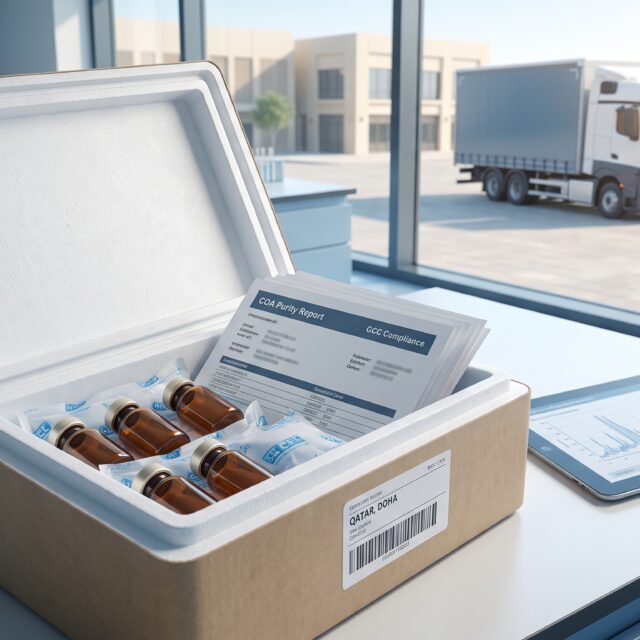
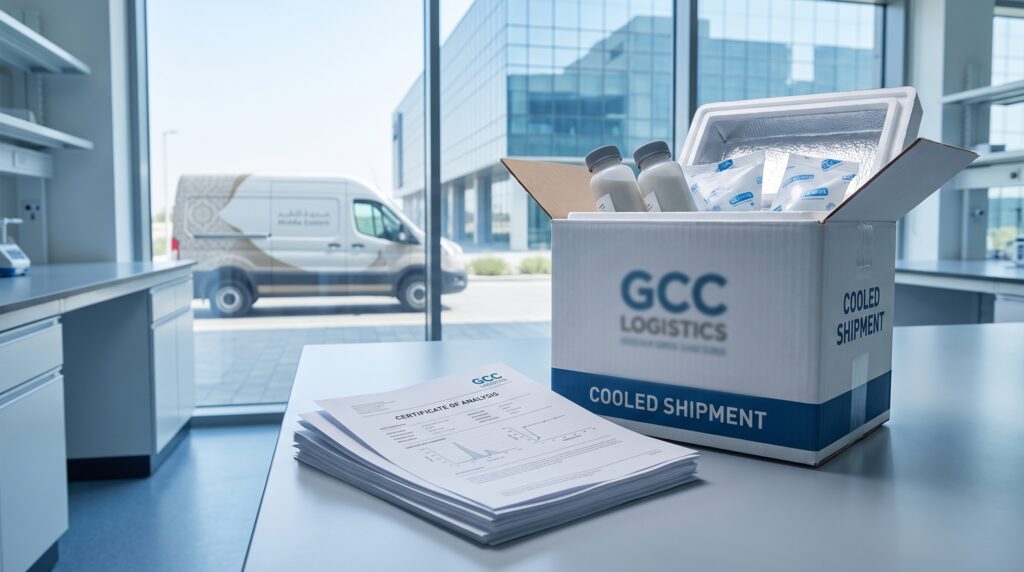
To mitigate this friction, leading suppliers do not rely on standard international post. Instead, premium providers utilize established regional networks. By leveraging a dedicated UAE-to-Bahrain cold-chain transport network, researchers can bypass the unpredictable delays of international airfreight and rely on localized logistics designed specifically for the GCC regulatory environment. This ensures your verified peptide actually reaches your lab bench.
Combating the Gulf Heat: Cold-Chain Logistics
The most pristine, 99% pure peptide verified by a flawless CoA is rendered completely useless if it is degraded during transit. Bahrain experiences extreme temperatures, with summer heat routinely exceeding 45°C. Peptides are highly sensitive organic molecules; prolonged exposure to intense heat accelerates degradation processes such as hydrolysis (cleavage of peptide bonds by water), oxidation, and aggregation.
Standard international shipping often involves packages sitting on scorching airport tarmacs or in un-airconditioned delivery vans for days. This environment rapidly destroys the molecular integrity of the compound, meaning the purity listed on the CoA no longer applies by the time the vial reaches your laboratory.
This is why local, temperature-controlled delivery is non-negotiable. Reputable regional suppliers ensure that compounds are handled under strict cold-chain protocols throughout the delivery process, utilizing insulated packaging to preserve the exact chemical structure detailed in the third-party analytical reports.
Storage Guidelines and the Condensation Trap
Once the compound arrives safely at your facility, proper handling is required to maintain its verified purity. Lyophilized (freeze-dried) peptides should be stored away from direct light. For medium-term storage (several months), refrigeration at 2°C to 8°C is adequate. For long-term preservation (up to two years), deep freezing at -20°C is highly recommended.
Researchers in coastal GCC areas like Manama must also be hyper-aware of the ‘condensation trap.’ Bahrain’s environment is not only hot but frequently highly humid. If you remove a cold vial of lyophilized powder directly from the freezer and immediately open it in a humid room, the ambient moisture will instantly condense inside the vial, ruining the powder before you even have a chance to reconstitute it. Always allow vials to acclimate to room temperature within a sealed desiccator for 30 to 60 minutes before breaking the seal.
Once you reconstitute the compound with bacteriostatic water, it becomes significantly more fragile. Reconstituted solutions must be kept refrigerated at all times, away from UV light, and should ideally be utilized within 28 days to ensure the absolute integrity of your research data.
Checking Supplier Support and GCC Payment Methods
Before placing an order based on a promising CoA, GCC researchers must also evaluate the supplier’s operational reliability. A supplier’s ability to provide a CoA is standard; their ability to answer technical questions about that CoA separates premium labs from drop-shippers.
Look for suppliers offering direct, responsive customer support—ideally via WhatsApp or a dedicated local email channel—where you can request current batch CoAs before checking out. Furthermore, secure, region-friendly payment gateways are essential. Suppliers that rely solely on obscure cryptocurrencies or unverified third-party wire transfers often lack the commercial infrastructure necessary to guarantee consistent product quality or honor refund policies in the event of transit damage.
Final Recommendations for GCC Buyers
Evaluating research compounds requires a critical, scientific eye. By mastering how to read a peptide CoA—specifically focusing on HPLC chromatogram sharpness, MS molecular weight alignment, and rigorous lot number verification—you protect your research investments from substandard materials.
However, in Bahrain, analytical purity must always be paired with logistical security. Demand full transparency from your suppliers. Look for third-party lab verification, matching batch numbers, and a clear operational understanding of the local climate. By combining rigorous CoA analysis with reliable regional cold-chain delivery, you ensure that the high-purity compounds you expect are exactly what arrives on your laboratory bench.
To source rigorously tested compounds backed by transparent, third-party analytics and secure regional logistics, explore our full catalog of research compounds at NOVA Labs.
Disclaimer: All products mentioned and supplied by NOVA Labs are strictly for in-vitro laboratory research purposes only. They are not intended for human consumption, therapeutic use, or medical treatment. Buyers must ensure compliance with all local laws and institutional safety guidelines.
References
- National Health Regulatory Authority (NHRA) Bahrain. (2023). Guidelines on the Importation of Medical and Chemical Products.
- Kaiser, R. (2018). High-Performance Liquid Chromatography in Peptide Analysis. Journal of Chromatographic Science.
- Smith, J. A., et al. (2021). Mass Spectrometry for the Verification of Synthesized Peptides. Analytical Biochemistry.
- Tracekey Solutions. (2022). Regulatory Update: Serialization Requirements in Bahrain and the GCC.
- NOVA Labs Quality Control. (2024). Standard Operating Procedures for Cold-Chain GCC Logistics.
- How to Read a Peptide Certificate of Analysis (COA) — Complete Guide – Pepspan
- Buy Tesamorelin Bahrain: Supplier Purity & GCC Delivery – NOVA Labs
- Regulatory Update: Serialization in Bahrain – tracekey solutions GmbH
- How to Read a Peptide Certificate of Analysis – Dissolv Labs
- Peptide Storage Temperature Kuwait | Stability & Delivery – NOVA Labs
Frequently asked questions
What is a peptide Certificate of Analysis (CoA)?
A Certificate of Analysis (CoA) is a formal quality control document issued by an analytical laboratory. It details the precise chemical purity (via HPLC), identity (via Mass Spectrometry), and molecular weight of a specific, lot-tracked batch of peptides.
How do I verify HPLC purity on a peptide CoA?
To verify HPLC purity, examine the provided chromatogram for a single, sharp primary peak with a flat baseline. You must also check the integration table below the graph, which should explicitly state that the main peak accounts for 98% or more of the sample's total area.
Why is mass spectrometry necessary for peptide testing?
While HPLC shows purity, Mass Spectrometry (MS) confirms the precise molecular weight of the sample. This verifies that the actual chemical compound in the vial perfectly matches the specific peptide sequence you intended to purchase.
How can I tell if a peptide CoA is faked or altered?
Faked CoAs often lack a specific batch or lot number that matches your physical vial. They may also have blurry chromatogram images, lack integration tables, or fail to provide a verifiable QR code that links directly back to an independent, third-party testing facility's official domain.
Are peptide shipments to Bahrain affected by customs?
Yes, Bahrain's NHRA strictly regulates the import of chemical and biological materials. Unregistered shipments from standard international couriers face high risks of seizure or prolonged heat exposure. This is why local researchers prefer secure, GCC-based cold-chain delivery networks.
Nova Labs buyer tools
Ready to verify stock, testing and delivery?
Use the product page and lab report section to check availability, documentation, delivery timing and support before placing an order.
- COA / test-report checks
- Bahrain delivery context
- Cold-chain handling
- COD and card payment options
- WhatsApp support