





How to Buy MOTS-c in Oman: Sourcing and Procurement
Quick Answer: To securely buy MOTS-c in Oman, researchers must select suppliers offering independent HPLC/MS Certificates of Analysis and localized UAE shipping. Regional fulfillment bypasses international tarmac delays, ensuring the peptide survives extreme GCC temperatures. All shipments must include Research Use Only (RUO) and MSDS documentation for smooth Bayan customs clearance.
Procuring high-purity research compounds in the Sultanate of Oman requires careful supplier evaluation. Whether you are a lab procurement officer or an independent researcher comparing regional vendors, assessing a supplier involves far more than simply looking at the lowest price per vial. The Mitochondrial Open Reading Frame of the 12S rRNA-c (MOTS-c) is a 16-amino acid peptide that is heavily studied for its unique role in cellular energy regulation, metabolic homeostasis, and AMP-activated protein kinase (AMPK) pathway activation.
Because of its complex molecular structure, verifying absolute chemical purity and ensuring stable delivery routes are the two most critical steps in the entire procurement process. Sourcing substandard materials not only invalidates costly experimental data but also poses severe regulatory delays at the border.
This guide breaks down exactly how to evaluate a MOTS-c supplier in Oman, what documentation is required to pass local customs smoothly, and how regional logistics provide a distinct structural advantage over international shipping.
Why Sourcing Matters: The Peptide Cold-Chain Challenge in the GCC
One of the most persistent and immediate challenges for researchers attempting to order sensitive peptides like MOTS-c in the Gulf region is the harsh climate. The extreme summer temperatures, which routinely exceed 45 degrees Celsius across Oman and the UAE, pose a severe degradation risk to delicate amino acid chains. Without strict logistics protocols, the peptide’s efficacy can be compromised before it ever reaches the laboratory.
The Risk of International Transit
Many international peptide suppliers ship directly from fulfillment centers in North America, Eastern Europe, or East Asia. These extended shipments often suffer from unpredictable transit times—sometimes taking anywhere from 5 to 14 business days. More critically, these international routes involve complex layovers where packages may sit in ambient, uncontrolled temperatures during airport tarmac holds.
Extended thermal exposure beyond standard room temperature can denature the MOTS-c peptide, breaking down its structural integrity and rendering the lyophilized powder useless for precise in-vitro research.
The UAE Regional Hub Advantage
By contrast, choosing a supplier with an established logistics footprint in the Middle East heavily mitigates these thermal and transit risks. Rapid shipping from nearby UAE fulfillment centers significantly shortens transit times to Muscat, Salalah, Sohar, and other Omani cities. Utilizing an expedited UAE regional delivery network ensures that the compound spends the absolute minimum time in transit.
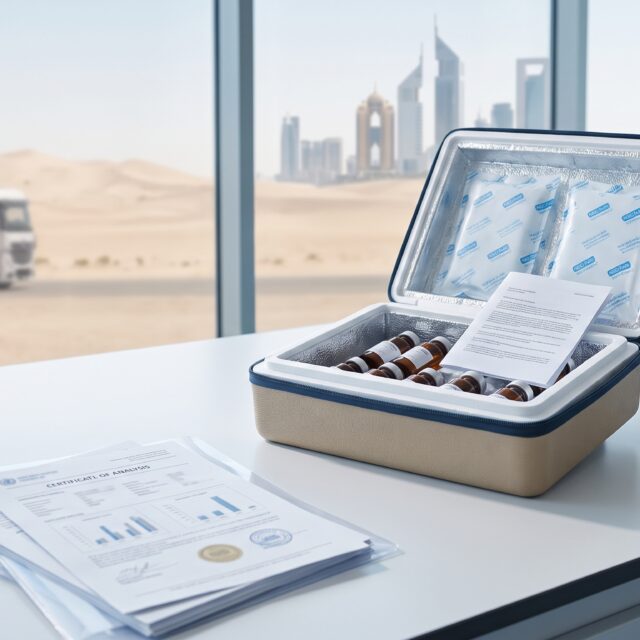
This regional proximity enables reliable temperature-controlled packaging solutions, safeguarding the lyophilized (freeze-dried) powder from environmental damage and eliminating the long layovers associated with cross-continental shipping routes.
Oman Customs and the Bayan Portal: Ensuring Compliance
Cross-border chemical procurement in the GCC requires strict adherence to local regulations. The Sultanate of Oman’s chemical import framework is highly regulated, governed by Royal Decree No. 46/95 (Handling and Use of Chemicals) and Ministerial Decision No. 248/97.
For researchers and buyers, this means that clearing customs without delays, fines, or holds requires proactive, accurate documentation. The Royal Oman Police (ROP) Directorate General of Customs utilizes the Bayan Single-Window Portal to digitally process all chemical and research imports into the country.
To ensure a smooth transition through the Bayan portal, your supplier must proactively align with the following documentation standards:
- RUO Labelling: The product and commercial invoice must be clearly labelled as a ‘Research Use Only’ (RUO) compound. This confirms compliance with local laws and clarifies the product’s non-commercial and non-human intent to customs inspectors.
- MSDS Documentation: A valid, up-to-date Material Safety Data Sheet (MSDS) must accompany the shipment. This is required by customs officials to verify the safety profile, chemical classification, and proper handling requirements of the substance.
- Accurate HS Codes: Using the correct Harmonized System (HS) code for laboratory reagents ensures the shipment is routed through the appropriate regulatory checks without unnecessary red tape.
Failing to provide compliant MSDS and RUO declarations can result in border friction, exposing the peptide to prolonged storage in non-refrigerated customs facilities while clearance is debated.
Evaluating Purity: Verifying Your MOTS-c Supplier
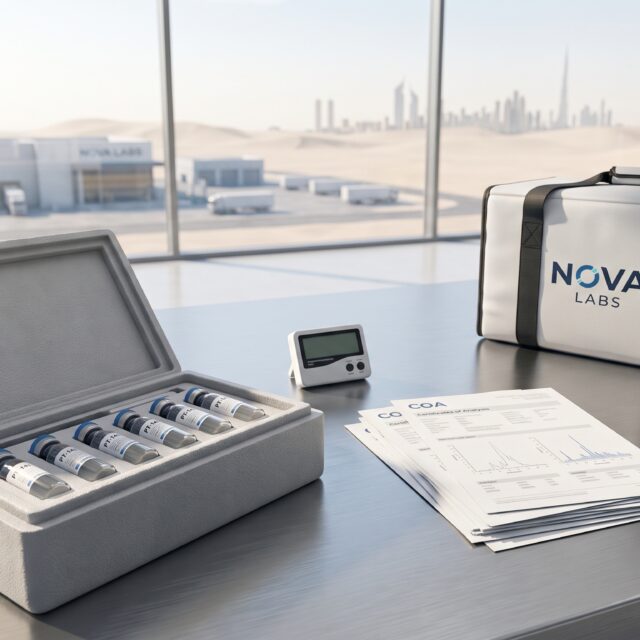
Not all peptides are manufactured equally, and visual inspection of a vial provides zero insight into the powder’s true composition. The absolute standard for verifiable purity claims in the GCC market is the presence of a batch-specific Certificate of Analysis (COA). If a supplier cannot produce independent lab testing, they should be immediately disqualified from your procurement list.
HPLC and MS Data
When reviewing a COA for MOTS-c, researchers must look for two highly specific analytical data points:
- High-Performance Liquid Chromatography (HPLC): This testing methodology evaluates the purity of the compound. Top-tier suppliers will demonstrate a purity level exceeding 99%. This ensures that the vial contains minimal synthesis byproducts, truncated sequences, or trace impurities that could skew experimental outcomes.
- Mass Spectrometry (MS): This verifies the exact molecular weight of the peptide. By matching the theoretical molecular weight of MOTS-c against the mass spec reading, buyers can confirm that the substance in the vial is indeed the correct amino acid sequence and that no sequence errors occurred during synthesis.
Independent Third-Party Testing
Internal, in-house testing is not sufficient for rigorous laboratory procurement. The COA must originate from a named, independent analytical laboratory. Informed buyers should be able to cross-reference the batch or lot number printed directly on their MOTS-c vial with the digital COA provided by the supplier.
Practical Lab Handling: Reconstitution and Storage
Beyond sourcing and logistics, researchers must be prepared to handle MOTS-c correctly upon arrival in Oman to maintain its structural viability.
Top-tier research suppliers provide MOTS-c in a sterile, lyophilized (freeze-dried) powder format, typically sealed in 10mg vials under inert gas. In this powdered state, the peptide is remarkably stable and can withstand short, expedited transit times at ambient temperatures.
However, once the researcher reconstitutes the peptide with bacteriostatic water or sterile saline in the lab, it immediately becomes highly fragile. Reconstituted MOTS-c requires strict refrigerated storage at 2 to 8 degrees Celsius. Researchers should also minimize mechanical shock (do not shake the vial forcefully) and protect the reconstituted solution from direct UV light to prevent premature degradation.
Payment Flexibility and Direct Support
Procurement friction is remarkably common with international chemical suppliers who only accept complex international wire transfers or volatile cryptocurrency. These methods often delay orders by several days as funds clear across international banking networks.
Omani researchers should actively look for regional vendors that offer localized GCC payment flexibility, including secure credit card processing and localized bank transfers.
Furthermore, having access to direct customer support—such as an active WhatsApp channel or localized phone support—provides a critical lifeline for stock checks, pre-purchase COA verification, and delivery troubleshooting before an order is even placed.
Where to Order MOTS-c in Oman
For buyers seeking absolute confidence in their research compounds, NOVA Labs provides a streamlined, secure solution tailored explicitly to the GCC research market.
By holding local stock in the UAE, NOVA Labs entirely eliminates the extended transit times and thermal degradation risks associated with overseas shipping. Omani buyers can easily access batch-specific, independent COAs to verify HPLC purity and Mass Spec results before placing an order. With secure payment gateways and direct local support, navigating the procurement process is straightforward, fully transparent, and built for researchers.
To explore current stock availability, review analytical testing reports, and evaluate vial specifications, you can securely order MOTS-c directly through the NOVA Labs platform.
Final Checklist Before You Buy MOTS-c in Oman
If you are preparing to source research peptides for your upcoming metabolic studies, keep this buyer’s checklist on hand to protect your budget and ensure the chemical integrity of your materials:
- Check the COA: Ensure the supplier provides batch-specific HPLC and MS reports from an independent, third-party testing laboratory, targeting >99% purity.
- Verify Regional Logistics: Confirm the supplier utilizes expedited shipping from a nearby GCC hub (like the UAE) to bypass extreme summer transit heat and international tarmac delays.
- Review Customs Readiness: Ensure the supplier utilizes proper Research Use Only (RUO) labelling and provides MSDS paperwork to comply with the ROP Bayan portal requirements.
- Confirm Support Channels: Test the supplier’s customer service responsiveness. A reliable vendor should readily answer questions about testing protocols, cold-chain logistics, and stock levels.
By demanding transparency, strictly verifying independent analytical data, and leveraging localized GCC logistics, Omani researchers can confidently secure the high-purity metabolic peptides required for their work. Ensure your lab is equipped for success by sourcing verified, RUO-compliant compounds today.
Disclaimer: The products mentioned in this article are strictly for in-vitro research and laboratory purposes only. They are not intended for human consumption, diagnostic, or therapeutic use.
References
- Lee, C., Zeng, J., Drew, B. G., et al. (2015). “The mitochondrial-derived peptide MOTS-c promotes metabolic homeostasis and reduces obesity and insulin resistance.” Cell Metabolism, 21(3), 443-454.
- Royal Oman Police (ROP) Directorate General of Customs. Bayan Customs Clearance System Guidelines and Permitted Chemical Protocols.
- Sultanate of Oman. (1997). Ministerial Decision No. 248/97 for the Regulation of the Handling and Use of Chemicals.
Disclaimer: The products mentioned in this article are for research purposes only and are not intended for human consumption.
- Buy MOTS-c in Oman: Supplier, COA & Cold-Chain Delivery – NOVA Labs
- Peptide Purity Guide Oman: Verifying COAs & Customs – NOVA Labs
- Peptide Supplier Checklist Oman: Buyer Guide & Import – NOVA Labs
- Directorate General of Customs – Permit to Export Chemicals
- Where to Buy MOTS-c in 2026: 9 Research Peptide Suppliers Compared
- Peptides Lab GCC – High-Purity Research Peptides | GCC Supply for Laboratories
Frequently asked questions
Is MOTS-c legally available for delivery to Oman?
Yes, MOTS-c can be legally imported into Oman when strictly labelled and declared as a Research Use Only (RUO) compound. The shipment must include an MSDS and comply with the chemical documentation requirements of the Royal Oman Police Bayan customs portal.
How should MOTS-c vials be stored upon arrival in Muscat?
Unreconstituted lyophilized MOTS-c powder is stable at ambient room temperature for short transit periods but should be stored in a freezer (-20°C) for long-term preservation. Once reconstituted with bacteriostatic water, it must be kept refrigerated at 2 to 8 degrees Celsius.
Why is third-party HPLC testing critical for research peptides?
HPLC (High-Performance Liquid Chromatography) testing scientifically verifies the purity of the peptide. It guarantees that researchers are working with a compound free of chemical synthesis byproducts or truncated sequences that could skew experimental data.
How long does peptide shipping take from the UAE to Oman?
When utilizing expedited regional logistics hubs in the UAE, shipments to major Omani cities typically arrive within 1 to 3 business days. This accelerated transit significantly minimizes the risk of thermal degradation in the GCC climate.
Nova Labs buyer tools
Ready to verify stock, testing and delivery?
Use the product page and lab report section to check availability, documentation, delivery timing and support before placing an order.
- COA / test-report checks
- Oman delivery context
- Cold-chain handling
- COD and card payment options
- WhatsApp support