



Researchers and procurement staff in Manama, Riffa, and across the Kingdom of Bahrain face a unique set of challenges when sourcing biological compounds. Securing reliable materials requires more than just reading an online label; it demands strict verification of analytical reports, a solid understanding of regional logistics, and a working knowledge of local import rules. If you are searching for a reliable peptide purity guide bahrain laboratories can trust, evaluating third-party testing protocols and cold-chain shipping practices is your fundamental first step.
Why a Reliable Peptide Purity Guide Bahrain Matters
Quick answer: To confidently verify peptide quality in Bahrain, buyers must request a batch-specific Certificate of Analysis (COA) displaying HPLC results of 98% or higher alongside Mass Spectrometry (MS) identity testing. Regional buyers must also navigate insulated GCC delivery requirements and the BHD 100 customs threshold to ensure safe, compliant procurement.
The global research supply chain varies wildly in quality, and the GCC region requires an extra layer of diligence due to stringent regulations and extreme climate conditions. A comprehensive peptide purity guide in bahrain goes beyond theoretical science—it must address how these delicate compounds survive transit from regional hubs, how they are cleared through local customs, and how laboratory staff must handle them upon arrival to prevent degradation.
The Science of Verification: HPLC and Mass Spectrometry
The foundation of any legitimate peptide procurement strategy is independent analytical testing. Without objective data, a supplier’s claim of high purity is essentially meaningless. Laboratories must insist on robust, transparent testing methodologies.
The Critical Role of HPLC
High-Performance Liquid Chromatography (HPLC) is the industry-standard method for determining a peptide’s target purity. This advanced process separates the components of a sample, allowing technicians to measure the exact proportion of the target peptide against synthesis impurities, such as truncated sequences or excess reagents left over from the manufacturing process. For standard biological research, cellular assays, and in vitro studies, an HPLC purity of 98% or higher (often expressed as ≥98%) is the universally accepted baseline. Using compounds with lower purity can introduce unwanted variables, leading to anomalous experimental data and compromising reproducibility.
The Necessity of Mass Spectrometry (MS)
While HPLC confirms the purity concentration of a substance, it does not confirm the precise chemical identity of the substance. This is where Mass Spectrometry (MS) is required. MS measures the exact molecular weight of the synthesized compound. Together, an HPLC chromatogram and an MS report provide a complete, verifiable picture, ensuring that you have a highly pure sample and the exact amino acid sequence required for your assay without mismatch errors.
Understanding TFA Removal
During standard solid-phase peptide synthesis, Trifluoroacetic acid (TFA) is frequently used to cleave the peptide from the resin. If not properly removed, residual TFA can cause cellular toxicity in certain sensitive biological assays. A definitive purity guide requires checking whether the supplier performs adequate TFA removal and purification steps, converting the peptide into a more stable and cell-friendly salt form, such as acetate, when required by specific research protocols.
Decoding Certificates of Analysis (COAs) for Your Lab
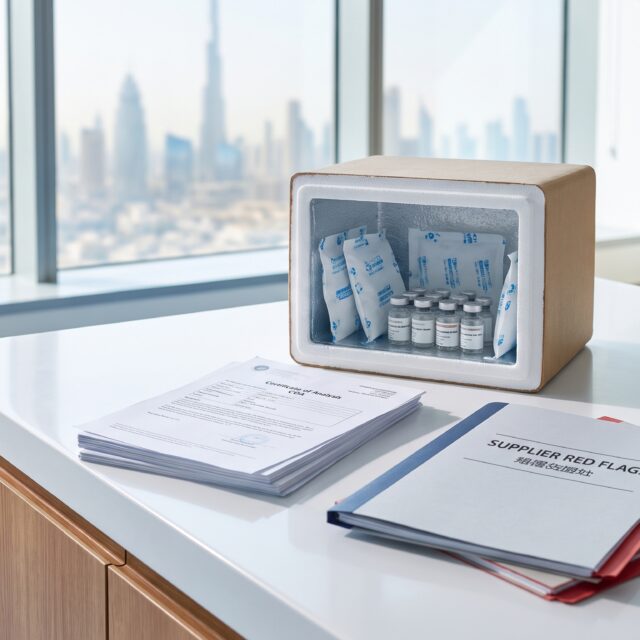
When evaluating a supplier, the Certificate of Analysis (COA) is your most vital document. However, not all COAs are created equal, and some international suppliers have been known to recycle outdated reports. Knowing how to scrutinize one is a crucial skill for any procurement officer in Bahrain.
When reviewing a COA, verify the following essential details:
- Batch matching: The batch or lot number printed on the COA must perfectly match the physical label on the lyophilized vial you receive. If they do not match, the test results are not representative of your compound.
- Testing dates: Look for recent testing dates to ensure you are not reviewing an outdated report for a long-depleted batch. Peptides have a long shelf life when freeze-dried, but testing should be relevant to current stock.
- Chromatogram visibility: A valid COA should display the actual visual graph (the chromatogram) showing the sharp primary peak and any minor, distinct impurity peaks, rather than just a typed “99%” text claim on a blank page.
- Net Peptide Content (NPC): Advanced guides distinguish between target purity and Net Peptide Content. While purity measures the absence of impurities, NPC accounts for the presence of non-peptide components like counter-ions (acetate/TFA) and residual moisture. A high-quality supplier can provide NPC data if your specific assay requires exact molar calculations.
Handling Gulf Temperatures: Shipping and Reconstitution Logistics
One of the most pressing concerns for researchers in the Middle East is extreme ambient heat. Understanding the thermal stability of your compounds is critical to ensuring they remain viable upon arrival at your facility in Bahrain.
Lyophilized Stability During GCC Transport
Research peptides are shipped in a lyophilized (freeze-dried) state. In this powder form, the structural integrity of the peptide is remarkably robust. Scientific data indicates that lyophilized peptides can tolerate room temperature and even transient spikes up to 40 degrees Celsius during transport without degrading. Suppliers shipping from Dubai to Bahrain via premium couriers typically complete the journey in 2 to 4 days.
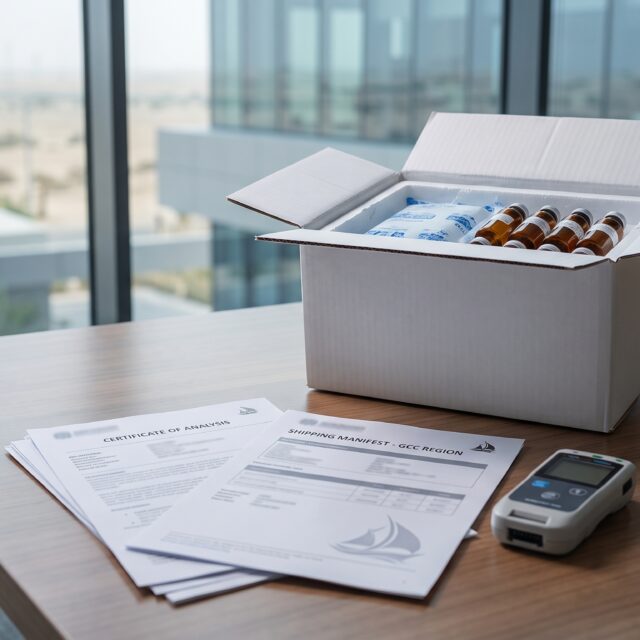
To mitigate the intense GCC heat, reputable suppliers utilize insulated thermal packaging, ensuring the internal temperature remains well within safe parameters during transit. For laboratories looking to understand regional cold-chain logistics in more detail, reviewing peptides UAE next-day delivery protocols provides valuable insight into how premium suppliers maintain compound integrity before dispatching orders across the GCC to Bahrain.
Reconstituted Fragility and Storage
The critical transition occurs during laboratory reconstitution. Once a peptide is mixed with a solvent—typically bacteriostatic water or sterile saline—for laboratory use, its molecular bonds become highly fragile. Reconstituted peptides must be immediately stored in a laboratory refrigerator at a strict 2-8 degrees Celsius. Exposure to room temperature, direct UV light, or physical agitation (such as dropping or aggressively shaking the vial) after reconstitution can rapidly degrade the compound, breaking down the amino acid chains and ruining the batch.
Bahrain Customs, VAT, and NHRA Import Regulations
Procurement in Bahrain requires strict adherence to local regulatory and tax frameworks. The National Health Regulatory Authority (NHRA) maintains rigorous oversight over imported chemical and medicinal products. To clear customs smoothly, research compounds must be explicitly and clearly labeled for ‘Research Use Only’ (RUO), accompanied by proper commercial invoices and batch documentation.
Furthermore, researchers must account for local tax policies. Recent updates to Bahrain Customs regulations regarding personal and postal shipments have established a lower tax-free threshold of BHD 100. Any shipment valued at BHD 100 or more is subject to standard customs duties and a mandatory 10% Value Added Tax (VAT). Researchers planning bulk orders or frequent, large-scale acquisitions must factor these duties into their project budgets. Ensuring that commercial invoices accurately reflect the paid value is essential to prevent customs clearance delays or unexpected holding fees.
Procurement Checklist: Selecting the Right GCC Supplier
Sourcing from an overseas international supplier often introduces long delivery delays, higher shipping costs, and increased customs friction. Regional suppliers operating within the GCC offer distinct logistical and operational advantages. Consider these factors when selecting a vendor for your laboratory:
- Regional dispatch speeds: Shipping from a centralized UAE hub to Manama, Riffa, or Muharraq bypasses intercontinental transit delays. Utilizing trusted regional couriers ensures a swift 2-4 day transit, minimizing the time compounds spend in transit.
- Payment flexibility: Modern GCC suppliers provide secure, encrypted online card payments alongside regional conveniences. Features like Cash on Delivery (COD) or localized installment payment gateways (like Tamara or Tabby) ease budget management for smaller independent laboratories and academic researchers.
- Direct, transparent support: Procurement is rarely a simple, one-click process. Suppliers who offer direct, responsive WhatsApp or email support can quickly resolve technical queries about specific batch numbers, COA availability, or real-time tracking updates.
Whether you are drafting a standard operating procedure for your facility or simply searching for a definitive peptide purity guide, direct your procurement teams towards suppliers who prioritize verifiable analytical documentation over marketing hype. Transparency in third-party testing and efficiency in regional logistics are the hallmarks of a trustworthy supply partner.
Conclusion: Secure Your Research Supply Chain
Ensuring accurate, reproducible research outcomes requires uncompromising standards at every stage of the supply chain. By demanding third-party HPLC and MS testing, understanding the nuances of lyophilized transport in harsh GCC climates, and proactively planning for Bahrain’s BHD 100 customs threshold, laboratories can secure high-grade materials without costly delays or degraded compounds.
For researchers who require absolute confidence in their reagents, choosing a supplier with deep regional expertise makes all the difference. To explore a comprehensive catalogue of RUO compounds backed by rigorous analytical reporting, secure cold-chain logistics, and dedicated GCC support, visit the NOVA Labs shop today.
Disclaimer: All products mentioned and supplied are strictly for in-vitro research and laboratory purposes only. They are not intended for human consumption, therapeutic use, or diagnostic applications. Always review local NHRA guidelines before importing biological compounds.
References
- National Health Regulatory Authority (NHRA) Bahrain – Medical and Chemical Import Guidelines.
- Bahrain Customs Authority – Duty and VAT Regulations for Postal Shipments.
- Journal of Peptide Science – Thermal Stability of Lyophilized Synthetic Peptides During Transit.
- Chromatography Today – Interpreting HPLC and Mass Spectrometry Data in Biological Compounds.
Disclaimer: The products mentioned in this article are for research purposes only and are not intended for human consumption.
- Peptide Purity Testing: How to Verify Quality and Safety (2026 Guide) | Peptidepedia
- Quality Control & Certificates of Analysis – Peptides.how
- Do Peptides Degrade During Shipping Without Refrigeration? Facts vs. Myths
- Bahrain: Customs duties and 10% VAT to apply on shipments valued over BHD 100
- Research Peptides Delivered to Bahrain | Wellness Labs – UAEPeptide.ai
Frequently asked questions
What is the acceptable HPLC purity for research peptides?
For standard biological research and laboratory assays, an HPLC purity of 98% or higher is the universally accepted baseline to ensure accurate, reproducible results without interference from synthesis byproducts.
Will peptides degrade during shipping to Bahrain in the summer?
Lyophilized (freeze-dried) peptides are highly stable and can withstand transient temperature spikes up to 40 degrees Celsius during short-term transport. Reputable GCC suppliers utilize insulated packaging to protect shipments during the rapid 2-4 day transit from regional hubs to Bahrain.
What is the Bahrain customs threshold for imported laboratory shipments?
Under current Bahrain Customs regulations, the tax-free limit for postal and courier shipments is BHD 100. Orders valued at or above this threshold are subject to standard customs duties and a 10% Value Added Tax (VAT).
Why is Mass Spectrometry (MS) required alongside HPLC?
While HPLC measures the concentration and purity level of a sample, Mass Spectrometry confirms the exact molecular weight and chemical identity. This ensures there are no critical amino acid sequence mismatches in the synthesized peptide.
How should research peptides be stored once reconstituted?
Once a lyophilized peptide is mixed with a solvent like bacteriostatic water, its molecular bonds become fragile. Reconstituted peptides must be kept strictly refrigerated at 2-8 degrees Celsius and protected from direct light, heat, and physical agitation.
Nova Labs buyer tools
Ready to verify stock, testing and delivery?
Use the product page and lab report section to check availability, documentation, delivery timing and support before placing an order.
- COA / test-report checks
- Bahrain delivery context
- Cold-chain handling
- COD and card payment options
- WhatsApp support