
Acquiring reliable laboratory supplies in the GCC often involves navigating complex regional logistics. For researchers attempting to source bacteriostatic water for peptides qatar, the local supply chain presents a very specific, recurring challenge. High-grade research peptides require exact reconstitution parameters. Substituting the correct solvent can introduce contamination, skew analytical results, and compromise an entire multi-week study.
Whether you are managing an institutional laboratory or conducting independent biochemical analysis in Doha, understanding the distinction between genuine bacteriostatic water and local pharmacy substitutes is critical. This guide breaks down local availability, the biochemistry of solvent preservation, logistics at customs, and how to verify high-quality GCC suppliers.
Quick Answer: Bacteriostatic Water for Peptides Qatar
For researchers sourcing bacteriostatic water for peptides in Qatar, local physical pharmacies only stock single-use sterile water. True bacteriostatic water contains 0.9% benzyl alcohol, which prevents bacterial growth for up to 28 days. Buyers must use specialized GCC suppliers to navigate customs seamlessly and ensure safe, multi-dose vial reconstitution.
The Qatar Pharmacy Gap: Sterile Water vs. Bacteriostatic Water
Many researchers new to the region assume they can walk into a local retail pharmacy in Doha—such as Kulud or Wellcare—and purchase the necessary solvents for peptide preparation. However, these retail environments do not stock genuine bacteriostatic water. Instead, they carry single-use Sterile Water (WFI), such as locally manufactured Qatar Pharma WFI.
While this sterile water is highly purified and functional for immediate, one-off chemical processes, it is strictly designed for single-use applications. It lacks any form of antimicrobial preservative. Once the rubber stopper of a standard WFI vial or ampoule is punctured, the liquid is exposed to the environment. If this unpreserved water is used to reconstitute a multi-dose research peptide vial, any microscopic contaminants introduced during the solvent transfer can multiply rapidly inside the vial. This renders the biochemical compound unfit for continued in vitro research and can actively degrade the peptide chains via bacterial proteases.
The Biochemistry of Reconstitution
True bacteriostatic water is specifically formulated with 0.9% benzyl alcohol. This precise concentration of benzyl alcohol acts as a bacteriostatic agent—meaning it actively inhibits bacterial reproduction without altering the fundamental chemistry of most peptide structures.
Why 0.9% Benzyl Alcohol Matters
In a laboratory setting, peptides are typically supplied as lyophilized (freeze-dried) powders to maximize shelf life. When these powders are rehydrated, they become highly susceptible to degradation. The 0.9% benzyl alcohol concentration is the globally recognized laboratory standard because it strikes the perfect balance: it is strong enough to inhibit the growth of common laboratory pathogens (like E. coli or S. aureus) while being dilute enough not to denature fragile peptide bonds.
This preservation allows a reconstituted vial to remain viable and sterile for up to 28 days when properly stored, making it an absolute necessity for any multi-dose analytical protocol.
Navigating Customs at Hamad International Airport (HIA)
Because bacteriostatic water is not readily available over the counter in Qatar, researchers are forced to look outward. Unfortunately, ordering sterile liquids from standard international e-commerce platforms often leads to procurement friction.
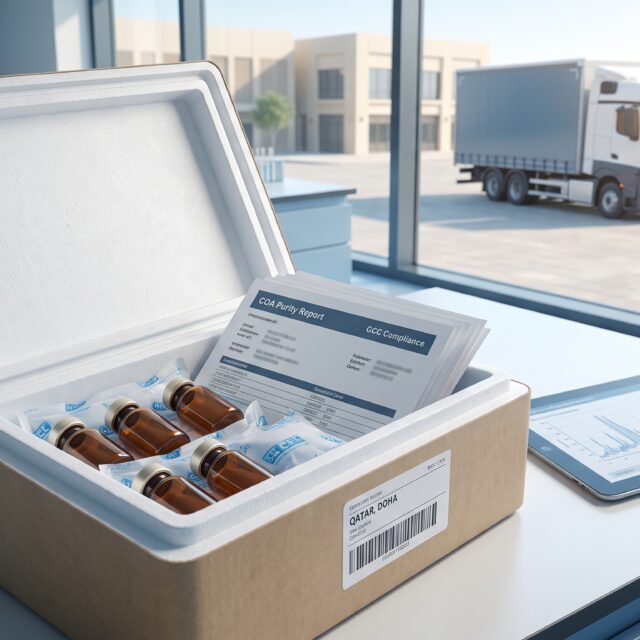
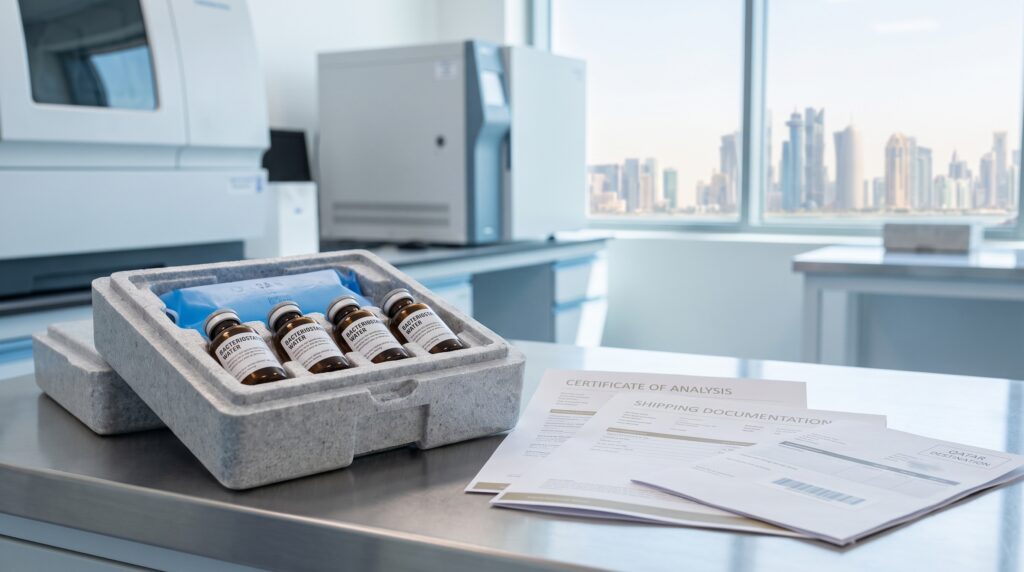
Broad-market international shipments of unlabelled or poorly documented sterile liquids are highly scrutinized by Qatari customs authorities at Hamad International Airport. Border control agents are trained to intercept unknown liquid shipments. Without the correct commercial documentation, Material Safety Data Sheets (MSDS), Certificates of Analysis (COA), and clear “Research Use Only” labeling, international shipments of bacteriostatic water are frequently delayed, turned away, or held indefinitely.
The GCC Logistics Advantage
Rather than risking international seizures and extended supply chain delays, informed buyers turn to specialized regional suppliers. Sourcing from a dedicated UAE-based laboratory supplier bridges the logistics gap perfectly.
A specialized provider understands regional customs protocols, provides the correct commercial invoices with accurate HS (Harmonized System) codes for laboratory reagents, and utilizes express shipping channels that routinely clear GCC borders. If you value fast GCC logistics and reliable UAE delivery, working with a supplier that intimately understands the Gulf’s specific regulatory and transit landscape is highly recommended.
Laboratory Handling and Storage: Managing the Doha Climate
Qatar’s extreme desert climate dictates strict handling procedures for all sensitive biochemicals. The ambient heat can rapidly degrade both lyophilized peptides and the benzyl alcohol within bacteriostatic water if left exposed during transit or on a lab bench.
Proper Refrigeration Logistics (2°C to 8°C)
Before reconstitution, intact vials of bacteriostatic water should be stored in a cool, dark place, ideally within a temperature-controlled environment away from direct sunlight. Once the bacteriostatic water is drawn and introduced into a lyophilized peptide vial, the resulting solution must be immediately placed in a controlled, refrigerated setting. The universal standard for storing reconstituted research peptides is between 2°C and 8°C (36°F to 46°F).
If a reconstituted multi-dose vial is left on a laboratory bench at standard Doha room temperatures, the compound’s structural integrity will degrade rapidly, heavily skewing any experimental data. Furthermore, while the 0.9% benzyl alcohol retards bacterial growth, its efficacy and stability are optimized when the solution is kept chilled.
Best Practices for Reconstitution
To maintain the integrity of the bacteriostatic water and the peptide, researchers should follow strict aseptic techniques:
- Sanitization: Always wipe the rubber septum of both the bacteriostatic water vial and the peptide vial with an isopropyl alcohol swab before puncturing.
- Gentle Transfer: When transferring the solvent, inject it slowly down the side of the peptide vial. Directing a harsh stream of liquid directly onto the lyophilized puck can damage delicate amino acid sequences.
- Dissolution: Do not shake the vial. Gently roll it between the fingers until the solution is completely clear.
- The 28-Day Rule: Regardless of the volume used or the storage conditions, the 28-day rule applies. 28 days after the initial puncture and mixing, the vial should be safely discarded, as the benzyl alcohol’s preservative properties begin to diminish past this window.
Buyer Checklist: How to Evaluate a GCC Supplier
When evaluating a regional supplier for bacteriostatic water and associated laboratory tools, knowing how to vet their operations is just as important as understanding the chemistry. Here are the core operational signals that indicate a trustworthy supplier in the GCC market:
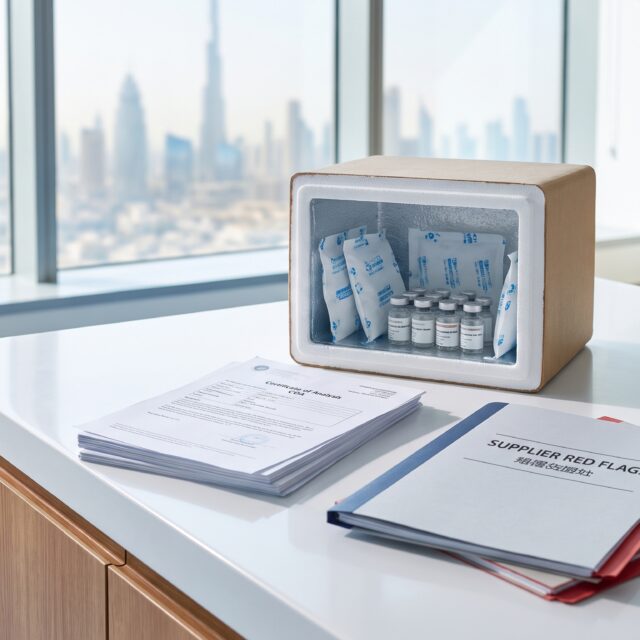
- Clear Documentation (COA): Does the supplier provide a Certificate of Analysis? A legitimate supplier will offer documentation proving the purity of their solvents and compounds. For peptides, look for independent High-Performance Liquid Chromatography (HPLC) and Mass Spectrometry (MS) testing.
- Appropriate Labeling: Products must be clearly marked for laboratory or research use. Suppliers that use consumer health claims attract customs friction and often operate outside of laboratory compliance.
- Climate-Controlled Handling: The supplier should utilize insulated packaging or rapid express logistics to ensure products do not sit in un-air-conditioned transit hubs during the height of the Gulf summer.
- Accessible Local Support: Can you reach a human? Suppliers that offer localized, immediate support channels—such as WhatsApp—demonstrate operational presence and accountability in the GCC market.
- Frictionless Payment: Look for suppliers that accommodate regional payment preferences, offering secure checkout via localized gateways (like Apple Pay or regional credit cards) and clear policies regarding Qatari shipping.
Expanding Your Research Repertoire
Once the logistics of acquiring bacteriostatic water are solved, researchers can focus entirely on the compounds themselves. High-purity solvents are only as effective as the lyophilized compounds they rehydrate. NOVA Labs provides rigorous, third-party-tested research materials tailored specifically for the GCC research community, ensuring that from solvent to compound, your laboratory data remains uncompromised.
To view compounds with transparent COA documentation and reliable regional availability, explore our premium research peptides today.
Conclusion
Procuring bacteriostatic water for peptides qatar requires bypassing the local retail pharmacy gap and looking beyond single-use sterile water. For any multi-dose research protocols, 0.9% benzyl alcohol is a non-negotiable requirement to prevent microbial contamination and maintain peptide integrity. By partnering with a specialized GCC supplier, researchers in Doha can avoid customs delays at HIA, ensure proper cold-chain handling, and maintain the precise conditions necessary for high-level biochemical analysis.
Disclaimer: The information provided in this guide is for educational purposes. All products and protocols mentioned are strictly for in vitro laboratory research purposes only and are not intended for human consumption, diagnostic, or therapeutic use.
*
References
- United States Pharmacopeia (USP). “Bacteriostatic Water for Injection, USP.” General Monographs for storage, packaging, and multiple-dose container limits.
- National Center for Biotechnology Information (NCBI). PubChem Compound Summary for CID 2345, Benzyl Alcohol.
- Local Pharmacy Inventory Checks. Doha, Qatar. Independent verification of sterile water (WFI) vs. bacteriostatic availability in retail settings.
- Bacteriostatic Water For Peptides Qatar: Practical Buyer Guide – NOVA Labs
- Qatar Pharma Water for Injection 5ml – Kulud Pharmacy
- Bacteriostatic Water (0.9% Benzyl Alcohol) | Canvax
- Bacteriostatic water (bac water) for peptides: what it is, how long it’s good for once opened, and whether it needs to be refrigerated : r/ScienceBioTechnology
Frequently asked questions
Can I buy bacteriostatic water in Qatar pharmacies?
No. Local retail pharmacies in Qatar only stock single-use Sterile Water (WFI). This water does not contain the necessary 0.9% benzyl alcohol preservative required for multi-dose peptide research.
What is the difference between sterile water and bacteriostatic water?
Sterile water is highly purified but preservative-free, meant strictly for immediate, single-use laboratory applications. Bacteriostatic water contains 0.9% benzyl alcohol, which actively inhibits bacterial growth and allows a reconstituted multi-dose vial to be used safely for up to 28 days.
Will my lab reagent shipment clear customs in Qatar?
Shipments from broad international markets are often delayed or seized at Hamad International Airport due to a lack of documentation. Using a specialized GCC supplier that provides correct commercial invoices, MSDS, and research-use documentation greatly improves customs clearance rates.
How should bacteriostatic water be stored in high-heat climates like Doha?
Before use, intact vials should be kept in a cool, dark place away from direct sunlight. Once mixed with a lyophilized peptide, the reconstituted multi-dose solution must be continuously refrigerated between 2°C and 8°C.
How long does reconstituted bacteriostatic water remain viable?
When properly refrigerated between 2°C and 8°C, bacteriostatic water maintains its antimicrobial effectiveness for 28 days after the initial puncture. After 28 days, the vial should be safely discarded to ensure strict research integrity.
Nova Labs buyer tools
Ready to verify stock, testing and delivery?
Use the product page and lab report section to check availability, documentation, delivery timing and support before placing an order.
- COA / test-report checks
- Qatar delivery context
- Cold-chain handling
- COD and card payment options
- WhatsApp support