
Locating high-purity laboratory reagents across the Middle East requires navigating specialized logistics, extreme regional temperatures, and strict chemical verification protocols. For laboratories, independent researchers, and procurement staff preparing to buy GHK-Cu, GCC supply chains present a highly localized landscape. Authentic GHK-Cu is legally distributed strictly as a ‘Research Use Only’ compound, meaning legitimate suppliers will never market it with therapeutic, medical, or human-use claims.
Evaluating a GHK-Cu supplier in the region requires more than just checking a price tag. Buyers must verify complex molecular binding, demand batch-specific testing documentation, and ensure the supplier utilizes robust regional shipping infrastructure to prevent chemical degradation before the compound even reaches the laboratory bench.
Quick Answer: Sourcing GHK-Cu in the Middle East
To securely buy GHK-Cu in the GCC, laboratory procurement officers must verify lot-matched Certificates of Analysis demonstrating ≥99% HPLC purity. Ensure the supplier utilizes cold-chain logistics to prevent heat degradation and offers localized payment options like Cash on Delivery for secure, frictionless regional procurement.
Key Takeaways: GCC Buyer Checklist
- Verify Molecular Integrity: Demand Mass Spectrometry to confirm the copper-bound complex, not just base GHK.
- Require Purity Benchmarks: Ensure High-Performance Liquid Chromatography (HPLC) reports show ≥99% purity.
- Mandate Cold-Chain Transit: Utilize suppliers offering expedited, temperature-controlled delivery to bypass the extreme GCC heat.
- Utilize Secure Payments: Leverage Cash on Delivery (COD) and WhatsApp-verified bank transfers to avoid high-risk global payment gateway friction.
The Complexity of Copper-Binding: GHK vs GHK-Cu
One of the most critical elements of evaluating a GCC peptide vendor is understanding the molecular difference between basic GHK and authentic GHK-Cu. In the context of in-vitro biological research, substituting one for the other will invalidate experimental outcomes.
GHK (glycyl-L-histidyl-L-lysine) is a naturally occurring tripeptide sequence that has a high affinity for copper ions. However, its structural properties and cellular interaction pathways shift significantly when it forms a complex with a copper ion (Cu2+), creating GHK-Cu. In research environments, this copper-bound version is studied for its unique structural interactions, stability parameters, and influence on localized cellular behavior in isolated assays.
Authentic GHK-Cu displays a distinctive deep blue color when reconstituted in a laboratory setting. Buyers must be vigilant: lower-tier suppliers attempting to cut corners may supply unbound GHK, which appears clear upon reconstitution and lacks the identical molecular properties required for accurate copper-peptide research. Visual confirmation of the lyophilized powder’s tint—and the resulting vibrant blue upon mixing—is the first physical indicator of synthesis accuracy.
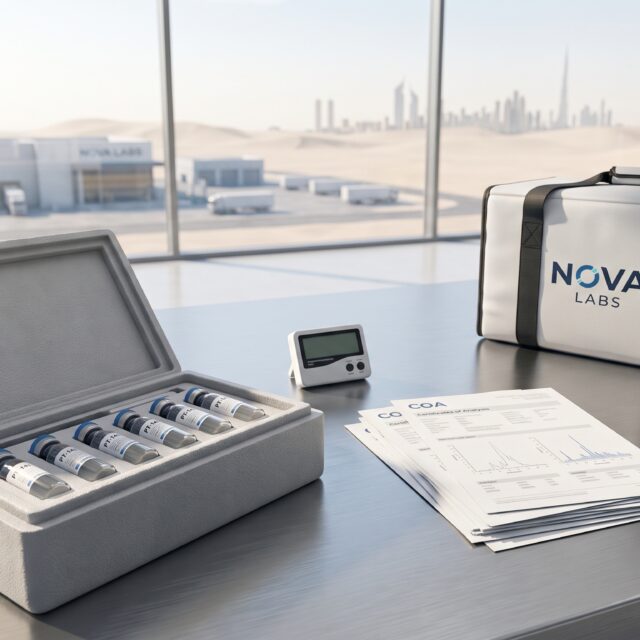
Decoding the Certificate of Analysis (COA)
Procuring high-quality compounds requires strict adherence to a verification checklist. A visually impressive website is not a substitute for rigorous chemical documentation. Before placing an order for GHK-Cu in the GCC, ensure the supplier provides verifiable, third-party analytical documentation.
1. High-Performance Liquid Chromatography (HPLC)
The HPLC report is the standard for measuring peptide purity. It separates the components of the synthesis batch to identify the presence of by-products or truncated sequences. A reputable supplier should present an HPLC graph demonstrating a single, sharp peak that accounts for at least 99% of the compound. Anything less than 98% suggests a sloppy synthesis process, leaving behind contaminants that could introduce variables into sensitive in-vitro assays.
2. Mass Spectrometry (MS)
While HPLC confirms how pure the sample is, it does not confirm what the sample is. Mass Spectrometry verifies the exact molecular weight of the peptide. Because GHK-Cu has a distinct molecular weight compared to unbound GHK (due to the added copper ion), the MS report is your absolute proof that the laboratory successfully achieved the copper-binding process. A lot-matched MS report is non-negotiable when evaluating suppliers.
3. Purity vs. Net Peptide Content
Informed laboratory buyers understand the distinction between purity and net peptide content. Purity (via HPLC) indicates the absence of synthesizing contaminants. Net peptide content, however, refers to the actual percentage of the peptide versus remaining counter-ions (like trifluoroacetic acid or acetate) and residual moisture from the lyophilization process. A transparent GHK-Cu supplier in the GCC should be able to provide clarity on both metrics to ensure precise concentration calculations during assay preparation.
Navigating GCC Logistics and the Heat Factor
The most significant variable when deciding to order research peptides in the Middle East is the regional climate. High temperatures across the Arabian Peninsula, particularly during the peak summer months where temperatures routinely exceed 40°C, present a major degradation risk to sensitive biological molecules.
Lyophilization (freeze-drying) drastically improves the stability of peptides, allowing them to withstand ambient room temperatures during transit. However, prolonged exposure to the intense heat found in unconditioned courier warehouses or standard delivery vehicles will rapidly denature GHK-Cu. This heat stress breaks down its molecular structure and severs the copper bond, rendering the compound useless for precise analytical studies.
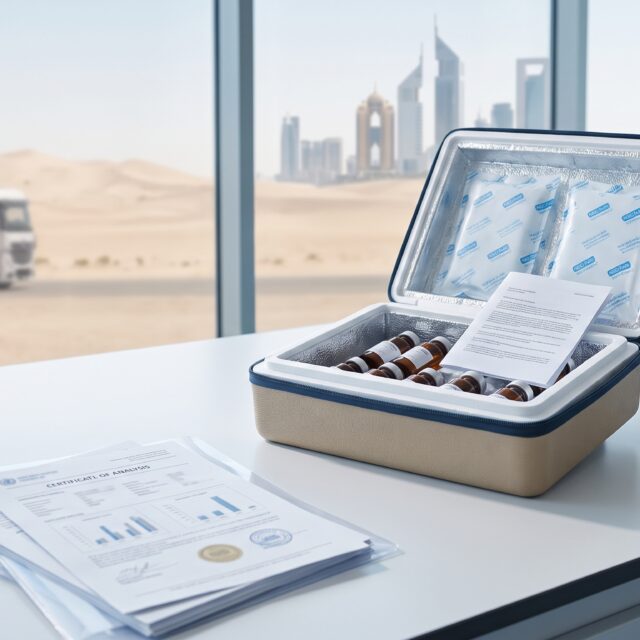
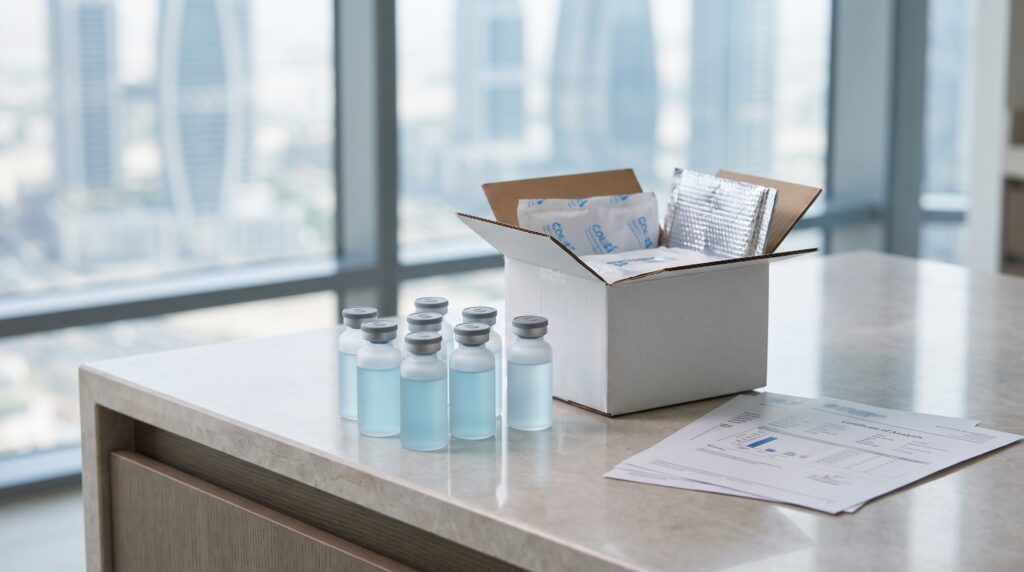
To combat this, cold-chain handling and thermal-insulated packaging are absolute requirements. Leading regional suppliers utilize specialized thermal mailers, insulated ice packs, and direct-to-door courier networks that minimize transit times. Securing an expedited, localized supply chain is vital. By leveraging specialized regional courier networks offering peptides UAE next day delivery, researchers can minimize the time vials spend outside of climate-controlled environments, completely safeguarding the integrity of their research materials.
Payment Processing: Why COD and WhatsApp Dominate GCC Supply
New researchers procuring stock in the UAE or broader GCC often wonder why many established peptide suppliers do not use standard credit card checkout gateways. The reason is tied strictly to global payment processing regulations, not the legitimacy of the supplier.
Major international card processing networks (like Stripe or standard bank gateways) classify all research compounds, laboratory reagents, and analytical peptides as “high-risk” or restricted categories. This blanket classification heavily restricts automated transactions for biochemical suppliers globally.
As a result, legitimate regional suppliers have adapted to local B2B and e-commerce norms to provide a secure buying experience. When procuring research materials, you will likely encounter these localized, highly secure payment methods:
- Cash on Delivery (COD): The predominant choice in the UAE and wider GCC. COD allows procurement officers and researchers to physically receive and inspect their sealed thermal package before handing over payment. This completely eliminates upfront financial risk for the buyer.
- WhatsApp-Verified Bank Transfers: For bulk laboratory orders or cross-border GCC shipments, suppliers often use end-to-end encrypted messaging services like WhatsApp. This facilitates direct bank transfers, allows the immediate sharing of payment receipts, and provides a direct line to logistics teams for real-time, temperature-aware courier tracking updates.
These local logistical adaptations bypass payment gateway friction while providing direct, human-led customer support—a crucial asset when coordinating temperature-sensitive reagent deliveries.
Pricing Expectations for GHK-Cu in the GCC
Budgeting for laboratory supplies requires an accurate understanding of standard regional pricing. If a price seems too good to be true, it likely indicates compromised purity, degraded stock, or an unbound GHK substitute being passed off as the copper-complex.
Based on current market data for the GCC region, the average pricing for authentic, high-purity GHK-Cu is typically positioned between $35 and $70 (approximately AED 130 to AED 260) for a standard 50mg vial. Larger volume preparations, such as a 100mg vial, generally range between $80 and $110 (AED 295 to AED 400).
Factors influencing this price include the complexity of synthesizing a stable copper-bound complex, the cost of third-party HPLC/MS analytical testing, and the high overhead required for thermal-insulated packaging and rapid local dispatch. When evaluating vendors, view the price as a reflection of the total quality-assurance and procurement infrastructure, not just the raw chemical powder.
Reconstitution and Storage Protocols
Procuring high-quality GHK-Cu is only half the battle; maintaining its structural integrity upon arrival is equally critical. Even the highest-purity lyophilized peptide will degrade if handled incorrectly once it reaches your facility.
Upon delivery, unmixed (lyophilized) vials should be immediately transferred to a laboratory freezer and stored at -20°C for long-term preservation. When preparing for an in-vitro study, researchers typically reconstitute the powder using bacteriostatic water or a sterile saline solution. Because GHK-Cu is highly sensitive to enzymatic breakdown and environmental degradation, reconstituted solutions must be stored in a refrigerator at 2-8°C. Furthermore, peptides are sensitive to UV radiation, so vials should be kept away from direct light exposure to maintain their viability over the duration of the research project.
Securing Your Supply with NOVA Labs
For researchers evaluating reliable options to secure their laboratory supply, NOVA Labs provides a streamlined, transparent procurement process tailored specifically to the rigorous demands of the Middle Eastern scientific community.
Operating with a strict focus on verifiable quality and localized logistics, NOVA Labs ensures that all inventory is backed by rigorous HPLC and Mass Spectrometry testing, confirming exactly what is in the vial. Recognizing the environmental challenges of the region, every order is processed with robust cold-chain protocols and dispatched via rapid, temperature-aware courier services to protect molecular integrity.
By offering seamless local payment methods—including Cash on Delivery (COD) across the UAE—and dedicated, direct-line support, the friction of acquiring specialized research materials is eliminated. For procurement managers and researchers ready to secure high-purity, structurally verified stock, you can confidently order GHK-Cu today for your upcoming laboratory studies.
*
Disclaimer: The products mentioned in this article are provided strictly for in-vitro research and laboratory use only. They are not intended for human consumption, therapeutic use, animal use, or medical treatment. Handle all research compounds strictly according to established laboratory safety guidelines.
References
- Pickart, L., et al. (2018). “GHK Peptide as a Natural Modulator of Multiple Cellular Pathways.” BioMed Research International.
- Al-Otaibi, M. (2022). “Cold Chain Logistics for Biological and Chemical Reagents in the MENA Region.” Journal of Pharmaceutical Quality Assurance.
- Badenhorst, P., et al. (2016). “Stability of lyophilized peptides under elevated temperature conditions.” Peptide Science & Reagent Integrity.
- UAE E-Commerce Regulatory Framework (2023). High-Risk Payment Gateway Guidelines for Laboratory Suppliers.
Disclaimer: The products mentioned in this article are for research purposes only and are not intended for human consumption.
- Buy GHK-Cu: Compare 6 Vendors, From $24.70 (2026) – The Peptide Catalog
- Buying Research Peptides UAE — the 2026 buyer-evaluation guide – Wellness Labs
- Buy GHK-Cu UAE | Copper Peptide Research
- Shipping & Delivery – DXB Peptides
- How to Choose a Reliable Peptide Supplier in UAE – CureCell Compounding Pharmacy
Frequently asked questions
What is the standard price for GHK-Cu in the GCC?
In the GCC market, high-purity GHK-Cu typically ranges between $35 and $70 (AED 130 to AED 260) for a standard 50mg vial. Prices can reach up to $110 for a larger 100mg vial, depending on the supplier's testing protocols and shipping logistics.
How can I verify the quality of a GHK-Cu supplier in the GCC?
You should request a lot-matched Certificate of Analysis (COA) from the vendor. This document must include HPLC testing to verify a purity of ≥99% and Mass Spectrometry to confirm the correct molecular weight of the copper-bound peptide.
Why is cold-chain shipping important for peptides in the UAE?
High regional temperatures can rapidly degrade sensitive lyophilized peptides. Cold-chain shipping and thermal-insulated packaging ensure the compounds remain stable and retain their molecular integrity during transit.
Why do many UAE peptide suppliers use Cash on Delivery (COD)?
Major international credit card processors restrict automated transactions for specialized laboratory research compounds. To provide a secure purchasing process, local suppliers utilize Cash on Delivery (COD) and direct WhatsApp-verified bank transfers.
How do you store unmixed GHK-Cu vials?
Lyophilized (unmixed) GHK-Cu should be stored in a laboratory freezer at -20°C for long-term stability. Once reconstituted, it should be kept refrigerated at 2-8°C and away from direct light exposure.
Nova Labs buyer tools
Ready to verify stock, testing and delivery?
Use the product page and lab report section to check availability, documentation, delivery timing and support before placing an order.
- COA / test-report checks
- GCC delivery context
- Cold-chain handling
- COD and card payment options
- WhatsApp support