



The Essentials of Cold Chain Peptide Delivery in Qatar
Quick Answer: Successful cold chain peptide delivery in Qatar requires strict temperature control to protect fragile research compounds from 45°C+ heat. Buyers must verify that suppliers utilize advanced thermal packaging, provide exact Ministry of Public Health (MoPH) documentation to prevent customs delays, and avoid accidental freezing during last-mile transit.
Securing research materials in the Gulf region involves navigating one of the most hostile supply-chain environments on the planet. For procurement staff, laboratory researchers, and informed buyers evaluating cold chain peptide delivery in Qatar, the margin for error is virtually nonexistent. Fragile amino acid chains are highly susceptible to thermal degradation, meaning a single logistics failure can render an entire batch of research materials structurally useless.
Evaluating a supplier requires looking past basic marketing claims to assess their operational logistics. Do they utilize phase-change materials rated for Middle Eastern climates? Do their regional courier partners operate multi-temperature refrigerated vehicles? Understanding the precise mechanics of cold chain peptide delivery for research peptides in Qatar is essential to ensuring your compounds arrive intact, fully potent, and ready for analytical application.
The Climate Challenge: Surviving Doha’s 45°C+ Heat
Qatar’s extreme summer climate poses a catastrophic threat to research shipments. Between May and September, ambient temperatures routinely exceed 45°C and can briefly touch 50°C.
Peptides are precisely sequenced chains of amino acids held together by peptide bonds. While lyophilized (freeze-dried) formats offer superior stability compared to liquid states, they are not immune to thermal stress. Prolonged exposure to ambient temperatures above 25°C accelerates degradation pathways such as deamidation, oxidation, and hydrolysis. If a shipment is left on a hot tarmac or sits in an un-airconditioned delivery van in Doha, the molecular structure can degrade in a matter of hours.
Standard clinical cold chain logistics classify pharmaceutical and biological products into specific temperature ranges:
- Controlled Ambient (+15°C to +25°C)
- Chilled/Refrigerated (+2°C to +8°C)
- Frozen (-15°C to -25°C or below)
High-quality peptide preservation typically requires continuous chilled or frozen environments. When sourcing these compounds, buyers must ensure that the logistics corridor maintaining this +2°C to +8°C window remains unbroken from the supplier’s warehouse directly to the final laboratory or consumer destination.
The Hidden Logistics Threat: Over-Cooling and Accidental Freezing
While extreme heat is the obvious danger, cold chain failure in desert climates is frequently caused by the opposite problem: over-cooling. In an effort to combat the blistering outdoor temperatures, inexperienced logistics operators often over-correct by packing shipments with excessive dry ice or setting transport refrigeration units too low without calibrated handovers.
Accidental freezing is exceptionally damaging. If a liquid-state peptide, or a lyophilized peptide that has not been properly buffered for deep freezing, drops below 0°C during transit, ice crystals can form. The expansion and mechanical shear forces generated by these ice crystals can permanently fracture the delicate molecular bonds of the compound.
Reliable cold chain peptide delivery in Qatar relies on sophisticated phase-change materials (PCMs) rather than simple raw ice. High-grade PCMs are engineered to absorb external heat while maintaining a strict, localized internal environment of exactly 2°C to 8°C, ensuring the payload never crosses the freezing threshold regardless of external thermal shock.
Navigating MoPH Customs Clearances at Hamad International Airport
One of the most frequent points of failure for international research shipments entering Qatar is the customs checkpoint at Hamad International Airport. The Ministry of Public Health (MoPH) and the Department of Pharmacy and Drug Control tightly oversee all biological and chemical imports.
Shipments that lack precise documentation are immediately flagged for inspection and placed in holding facilities. While major hubs like Hamad International possess advanced multi-zone warehousing (ambient, chilled, and frozen storage managed by specialized cargo handlers), packages detained due to missing paperwork often sit in preliminary clearance zones. If a shipment is held up for 48 to 72 hours, the internal passive cooling mechanisms will inevitably exhaust their capacity, exposing the peptides to ambient facility temperatures.
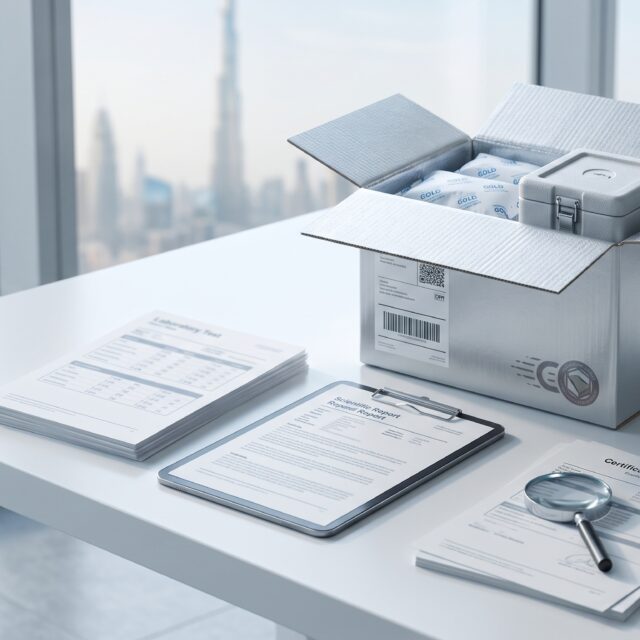
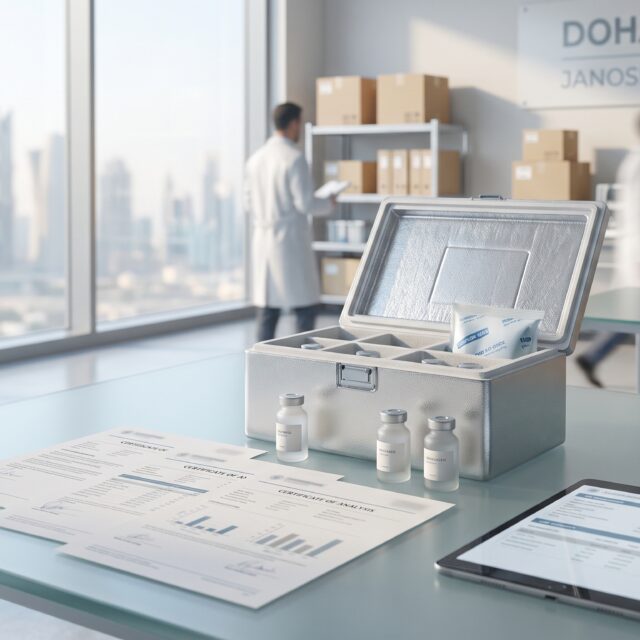
To prevent customs friction, professional suppliers provide meticulous documentation upfront. This includes accurate commercial invoices, detailed packing lists, clear origin certificates, and highly visible Certificates of Analysis (COAs) and HPLC/MS testing reports. Proving the chemical identity and purity of the research material is vital for swift clearance, minimizing the time the package spends outside a secure cold-chain environment.
Evaluating Thermal Packaging: Active vs. Passive Cooling
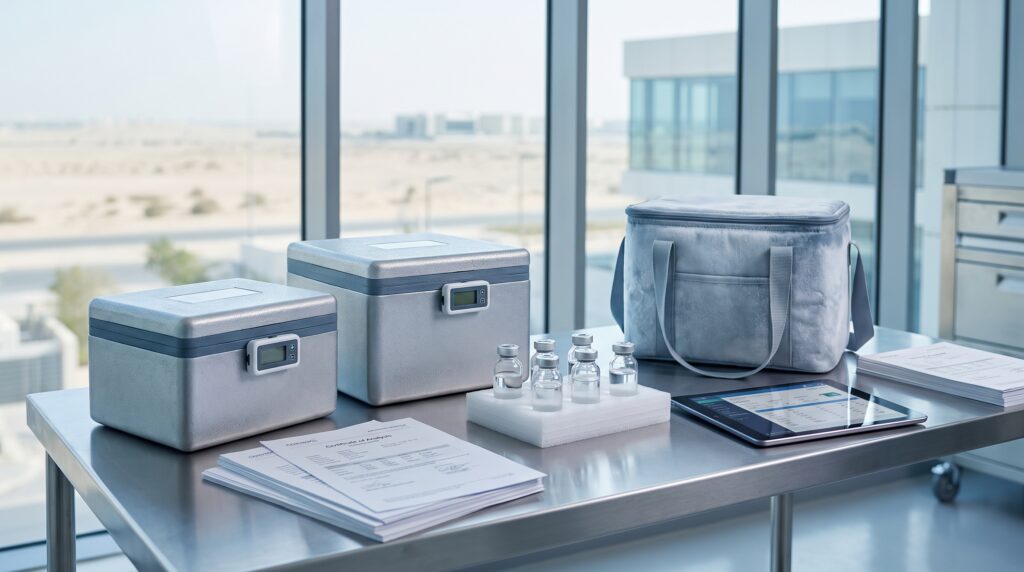
Understanding how your order is physically insulated is critical when comparing suppliers. The logistics industry utilizes two primary methods for temperature-controlled transit: active and passive cooling.
Active Cold Chain Systems
Active cooling involves self-powered refrigeration. These systems use battery-operated compressors or electrical hookups to continuously pump cold air throughout a container. Leading regional logistics providers (such as JSL Global or QAS Cargo) utilize multi-temperature reefers and specialized active containers for bulk freight. While active systems can maintain temperatures indefinitely, they are heavy, expensive, and typically reserved for large-scale laboratory procurement rather than individual research orders.
Passive Cold Chain Systems
Passive cooling is the industry standard for last-mile delivery and consumer-intent research orders. This method relies on heavy-duty insulation—such as Vacuum Insulated Panels (VIPs) or high-density EPS foam—combined with properly conditioned gel packs or PCMs. The limitation of passive packaging is time; depending on the insulation thickness and external temperatures, a passive cooler will only maintain its internal temperature for 48 to 72 hours.
Because of this strict time limit, rapid fulfillment is non-negotiable. If you are importing materials into Qatar, you must calculate whether the transit time—from dispatch to customs to your door—fits safely within the thermal lifespan of the supplier’s passive packaging.
The Advantage of Regional Suppliers and Local Fulfilment
Sourcing globally from North America or Europe significantly increases the risk of cold chain failure. A shipment crossing multiple time zones, navigating international flight transfers, and clearing strict GCC borders can easily exceed the 72-hour limit of passive cooling envelopes.
This is why regional GCC fulfillment is increasingly preferred by informed buyers. Operating from a regional hub drastically compresses transit times and limits the number of handover points where temperature spikes typically occur. By utilizing a supplier with established Middle Eastern logistics corridors, researchers can ensure their products spend minimal time in transit.
At NOVA Labs, we prioritize rapid, secure fulfillment across the region. Our localized operations set a high standard for delivery speed and temperature integrity. For researchers seeking to evaluate our analytical standards and compound availability, you can confidently browse our complete shop. Furthermore, the logistics framework that powers our regional dispatch is modeled on the efficiency of our peptides UAE next day delivery network, ensuring that time-sensitive compounds move through the supply chain with minimal thermal exposure.
What to Demand from Your Peptide Supplier
Before authorizing a purchase for research compounds in Qatar, buyers should verify several critical operational signals:
- Clear Documentation: Does the supplier provide accessible third-party Certificates of Analysis (COAs) and HPLC testing reports to ensure smooth customs clearance?
- Packaging Transparency: Can the supplier confirm the use of high-density EPS insulation and calibrated phase-change materials rated for Middle Eastern summers?
- Regional Logistics: Are the compounds shipping from a nearby GCC hub to minimize air-transit and customs holding times?
- Support and Accountability: Does the supplier offer responsive local support (such as direct WhatsApp communication) to address immediate tracking or clearance delays?
By prioritizing logistics infrastructure over simple product pricing, researchers ensure their chemical investments yield accurate, repeatable experimental data.
Conclusion: Securing Your Research Supply Chain in Doha
Successfully managing cold chain peptide delivery in Qatar is not just about placing an order; it is about evaluating a supplier’s logistical competence in one of the world’s most demanding climates. From the moment the compound leaves a chilled warehouse to the final delivery at your facility, every step must be optimized against the threat of 45°C heat, accidental freezing, and MoPH customs delays.
By insisting on verified thermal packaging, rapid regional fulfillment, and transparent COA documentation, buyers can completely mitigate these environmental risks. Do not let supply chain failures compromise the integrity of your research.
Ready to upgrade your research procurement? Explore our catalogue of rigorously tested, cold-chain-secured compounds today to experience the NOVA Labs standard of quality and logistics.
Disclaimer: The products mentioned in this article are for research purposes only and are not intended for human consumption.
References
- Ministry of Public Health (MoPH) Qatar, Department of Pharmacy and Drug Control Import Guidelines.
- Yes2Qatar & JSL Global: Cold Chain & Temp-Controlled Logistics in Qatar.
- Qatar Aviation Services (QAS) Cargo: Cool Chain Storage Capabilities at Hamad International Airport.
- Starlinks: Multi-Temperature Logistics and Cold Chain Complexity in the GCC.
- Cold Chain & Temp-Controlled Logistics Qatar | Yes2Qatar
- Cold Chain Logistics – JSL Global
- Cool Chain – Qatar Aviation Services
- Request for Inspection of Pharmaceutical or Medical Shipments | Sharek
- Medication Home Delivery Service – PHCC
- Cold Chain in a Tropical Climate: Where Logistics Failures Actually Happen, and What to Do About Them – TTMI Singapore
- Multi-Temperature Logistics: Simplifying Cold Chain Complexity – Starlinks
- From Manufacturer to End Customer: How AlGenome International Guarantees a Reliable Cold Chain for Your Critical Supplies
Frequently asked questions
How long can research peptides survive in Qatar's summer heat without cold chain packaging?
In ambient temperatures exceeding 45°C, uninsulated peptides can degrade rapidly, compromising their structural integrity within hours. Continuous chilled environments (2°C to 8°C) are strictly required for long-term stability.
Does Qatar Customs (MoPH) require special documentation for research peptides?
Yes, the Ministry of Public Health tightly oversees all pharmaceutical and research imports. Shipments require comprehensive documentation, including commercial invoices, packing lists, and verified Certificates of Analysis (COAs) to prevent customs holding.
What is the difference between active and passive cold chain packaging for peptides?
Active packaging uses powered refrigeration systems to maintain temperatures indefinitely, while passive packaging relies on insulated materials and frozen phase-change materials, which typically protect contents for a maximum of 48 to 72 hours during transit.
Can over-cooling or accidental freezing damage my peptide order?
Yes. Improperly calibrated phase-change materials or excessive dry ice can accidentally freeze fragile liquid-state or improperly buffered lyophilized peptides, which shears molecular bonds and permanently ruins the research sample.
Why is regional GCC fulfillment better for peptide delivery to Qatar?
Regional shipping compresses transit times from weeks to days, significantly reducing the risk that passive thermal packaging will exhaust its cooling capacity before clearing customs and reaching the final destination.
Nova Labs buyer tools
Ready to verify stock, testing and delivery?
Use the product page and lab report section to check availability, documentation, delivery timing and support before placing an order.
- COA / test-report checks
- Qatar delivery context
- Cold-chain handling
- COD and card payment options
- WhatsApp support