
Finding the Best Peptide Shop in Abu Dhabi
Quick Answer: When searching for the best peptide shop in Abu Dhabi, prioritize local suppliers offering independent Janoshik-verified COAs, active cold-chain logistics for lyophilized powders, and Cash on Delivery (COD). Avoid high-markup clinics by sourcing from trusted, direct-to-buyer platforms supplying strictly research-grade compounds.
The UAE capital is home to a rapidly expanding community of dedicated researchers, academic laboratories, and informed procurement specialists. However, finding a trusted supplier requires navigating a highly specific set of regional challenges. From the intense GCC summer heat that threatens molecular stability to strict global payment gateway protocols that flag research chemicals, sourcing high-purity synthetic amino acid chains is rarely as simple as adding an item to an online cart.
Whether you are managing a local research laboratory or evaluating materials as an independent scientific investigator, making the right decision means looking beyond polished marketing websites. This comprehensive guide breaks down the critical buyer trust signals, cold-chain delivery requirements, and verifiable documentation you must demand before finalizing any purchase in Abu Dhabi.
The Abu Dhabi Market: Clinical Centers vs. Direct RUO Suppliers
The local market for research compounds features a distinct divide between high-cost, clinically-supervised centers and independent, direct-to-buyer research-use-only (RUO) suppliers. Understanding this landscape is the first step in identifying the right vendor for your specific analytical needs.
Clinical centers located in premium districts like Yas Mall or Al Bateen operate on a supervised therapeutic model. While they provide full-service oversight, their pricing structures are widely discussed and frequently criticized by local buyers. Procurement cycles through these clinics can be outrageously expensive, often charging upwards of AED 1,700 to AED 2,150. For ongoing laboratory research, mass spectrometry benchmarking, or independent in-vitro study, these clinical markups are simply unsustainable.
This cost barrier drives high-intent buyers toward direct-to-buyer platforms. Independent suppliers offer direct access to research-grade compounds at a fraction of the clinical cost. However, not all direct suppliers are built equally. Some regional competitors operate strictly as gated B2B suppliers, requiring rigorous corporate verification and enforcing minimum order thresholds of AED 1,500 just to qualify for shipping. This leaves a significant gap in the market for accessible, high-purity open platforms that cater directly to independent researchers without compromising on verifiable quality.
Navigating UAE Customs and Local Sourcing
A major hurdle for researchers in Abu Dhabi is international customs. Attempting to import research compounds directly from overseas laboratories in the United States or China frequently results in indefinite customs delays or outright seizures. UAE customs officials require highly specific documentation for the importation of synthetic biological materials.
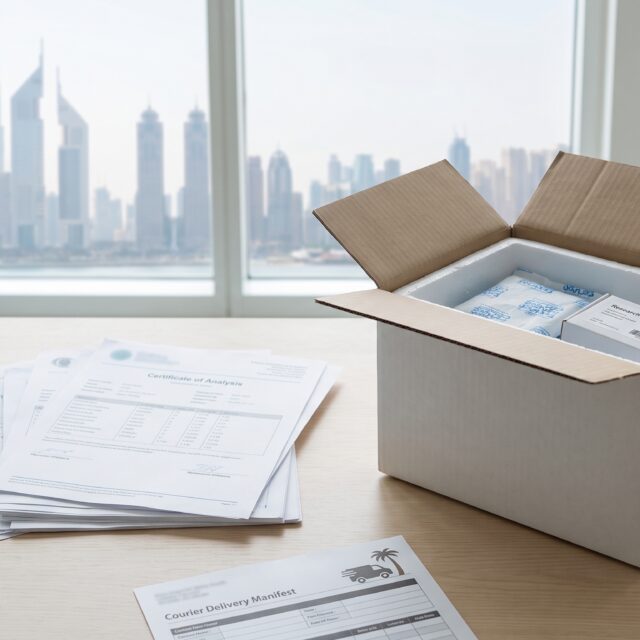
The best peptide shop in Abu Dhabi will have already absorbed this logistical burden. By sourcing from a specialized local vendor, researchers bypass international customs friction entirely. Local suppliers manage the bulk import compliance, ensuring that the materials are warehoused domestically and available for rapid, last-mile dispatch without the threat of unexpected border confiscation.
Beating the GCC Heat: Why Active Cold-Chain Logistics Matter
If you are searching for a trusted supplier in Abu Dhabi, climate-adapted logistics should be your primary concern. The extreme environment of the GCC, where summer temperatures regularly exceed 45 to 50 degrees Celsius, presents a severe hazard to delicate synthetic amino acid chains.
Peptides in their pre-reconstituted liquid form are highly unstable. When exposed to intense heat during transit, their molecular bonds can rapidly denature, rendering the compound completely useless for scientific study. Therefore, active cold-chain logistics are an absolute necessity for any local vendor.
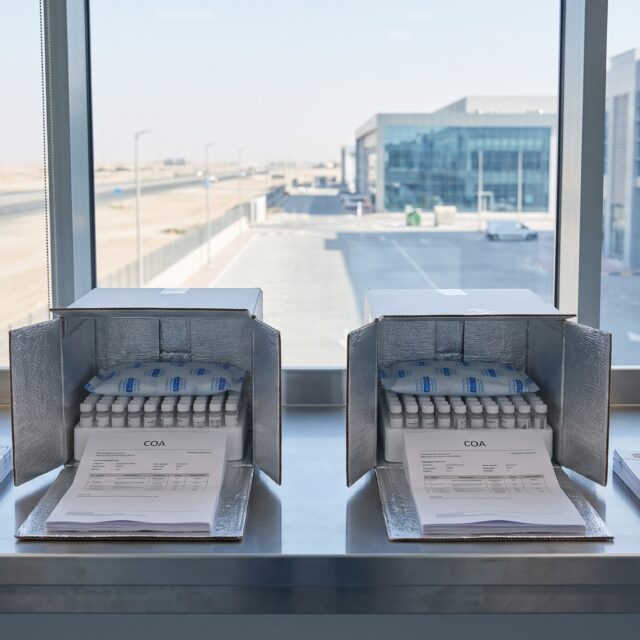
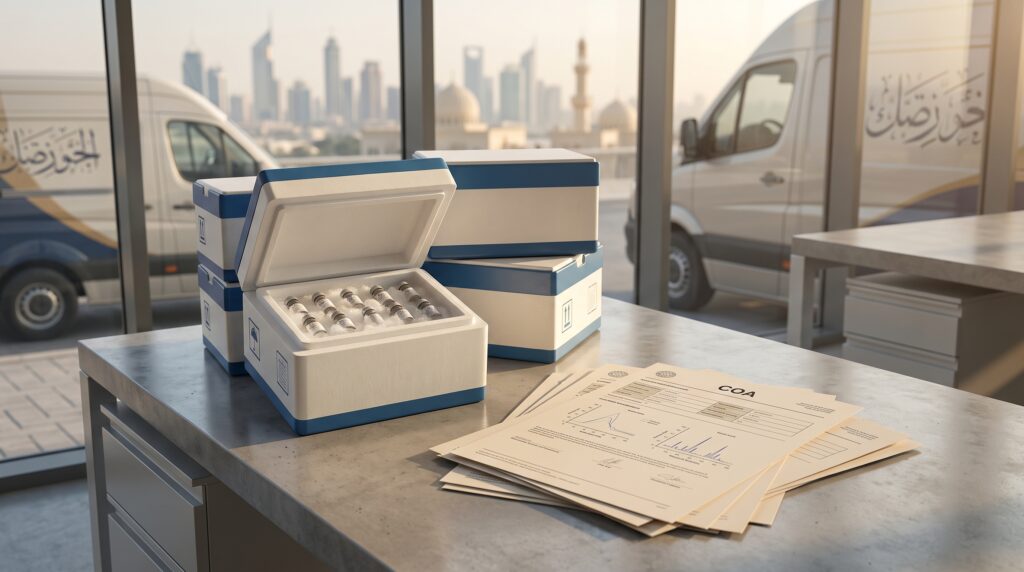
To maintain molecular integrity, research compounds must be shipped as lyophilized (freeze-dried) powder rather than liquid solutions. The lyophilization process extracts moisture from the compound via sublimation, vastly improving its thermal stability during transit. When evaluating an Abu Dhabi supplier, verify that they exclusively ship lyophilized powder in temperature-controlled, insulated packaging. If a vendor attempts to sell you pre-mixed liquid solutions through standard courier networks during the UAE summer, they are severely compromising the integrity of your research materials.
Verifying Purity: How to Read Third-Party COAs
The title of the “best peptide shop in Abu Dhabi” is ultimately earned through transparent, undeniable proof of purity. In the research compound industry, trust cannot be based on marketing claims; it must be cryptographically verifiable through analytical testing.
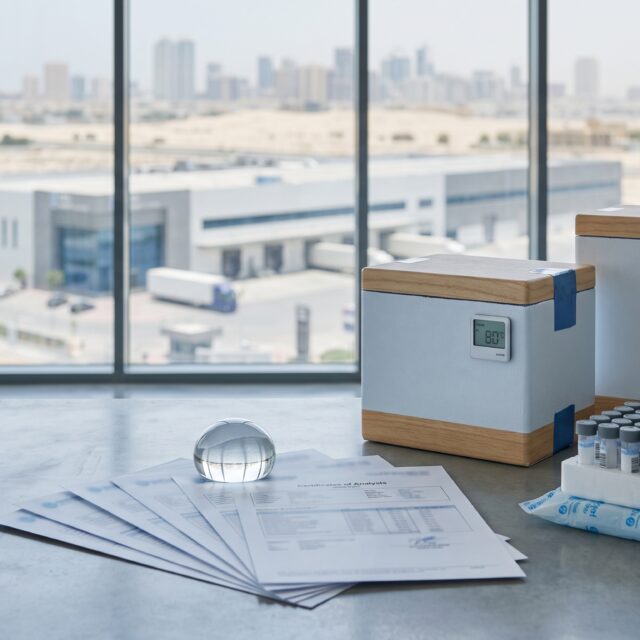
Before placing an order, buyers must request and review batch-specific third-party Certificates of Analysis (COAs). These documents should be generated by an independent, reputable analytical laboratory, such as Janoshik. A standard in-house test report is insufficient, as it carries an inherent conflict of interest.
When reviewing a COA, researchers must scrutinize two primary testing methodologies:
- High-Performance Liquid Chromatography (HPLC): This test determines the purity of the sample. For reliable research applications, the area under the curve on the HPLC graph should demonstrate a purity level of 99% or greater. Anything less risks introducing contaminants that could skew experimental data.
- Mass Spectrometry (MS): This verifies the molecular weight of the compound. The analytical report must show that the tested molecular weight perfectly matches the theoretical molecular weight of the specified peptide, ensuring that the substance in the vial is exactly what the label claims.
Always ensure that the COA features a verification key or QR code that can be cross-referenced directly on the testing laboratory’s official website. If a supplier cannot produce recent, verifiable COAs that match the batch numbers of their current inventory, they should be immediately disqualified from your procurement list.
Payment Friction: Why COD and Local Gateways Win
A unique hurdle in the UAE research market is the high rate of transaction failures on standard credit card gateways. Major global credit card processors (such as Stripe or PayPal) assign “High-Risk” Merchant Category Codes (MCC) to businesses trading in research chemicals and synthetic materials. This internal policy frequently flags and blocks legitimate transactions, resulting in immense frustration for buyers whose purchases are suddenly declined at checkout.
To circumvent these global gateway restrictions, successful regional suppliers have adopted localized, flexible payment infrastructure. Cash on Delivery (COD) has become the gold standard for secure, friction-free procurement in Abu Dhabi. By allowing researchers to pay only upon successful delivery, COD eliminates the risk of upfront payment failure and builds immediate trust between the buyer and the supplier.
Additionally, regional buy-now-pay-later (BNPL) platforms like Tamara offer secure, staggered payment options that are optimized for the GCC market and do not trigger the same automated flags as standard international credit card processors. When vetting a supplier, check their checkout page for these localized payment rails.
Local Support: The Importance of WhatsApp and Stock Checks
Modern laboratory procurement relies on fast, direct communication. When an experiment is pending, researchers cannot afford to wait 48 hours for an email support ticket to be resolved. The top suppliers in Abu Dhabi recognize this and offer direct, responsive communication channels.
Before making a purchase, test the supplier’s responsiveness via WhatsApp. Use this channel to verify current stock availability, ask for the most recent batch’s COA, and confirm expected delivery timelines. A vendor providing real-time, knowledgeable support demonstrates operational competence and a commitment to the local scientific community.
Why Buyers Trust NOVA Labs in the Capital
For researchers and informed buyers comparing options, NOVA Labs stands out as a highly reliable procurement partner tailored specifically to the realities of the UAE market. By focusing on verifiable documentation, climate-appropriate logistics, and localized customer support, NOVA Labs resolves the core frictions associated with sourcing in the capital.
All research materials are rigorously tested by independent facilities, with transparent COAs readily available for review. To combat the severe GCC climate, products are supplied as stable lyophilized powders and handled with dedicated care.
Logistically, NOVA Labs provides highly competitive delivery terms to the capital. Buyers in Abu Dhabi receive free standard shipping on eligible orders over AED 800, with a straightforward AED 60 standard fee for orders below that threshold. It is important to note that pre-filled injector pens and nasal sprays require highly specialized local cold-chain logistics; therefore, they never qualify for free shipping and do not ship cross-border outside the UAE. You can review the full details of our UAE next-day delivery protocols to understand exactly how your materials are handled.
Furthermore, NOVA Labs recognizes that modern procurement relies on fast communication. Buyers can utilize responsive WhatsApp-based customer support to check stock availability, verify batch quality, and confirm shipping timelines prior to checking out. If you are ready to explore a transparent, high-purity catalog, you can Shop Research Peptides directly through our secured platform.
Summary and Conclusion
Identifying the best peptide shop in Abu Dhabi requires moving past marketing rhetoric and focusing on verifiable trust signals. The high costs of clinical centers often push researchers toward direct-to-buyer platforms, but this transition demands strict buyer diligence.
Always ensure your chosen supplier provides independent, batch-specific COAs verifying 99%+ purity via HPLC and MS testing. Protect your investment by insisting on lyophilized powders shipped via active cold-chain logistics to prevent heat degradation in the harsh UAE climate. Finally, look for vendors that offer localized payment options like Cash on Delivery (COD) and responsive local support channels.
By demanding transparency, robust logistics, and responsive support, researchers in Abu Dhabi can secure the high-purity compounds necessary for their ongoing work without unnecessary risk or exorbitant markups.
Disclaimer: The products mentioned in this article are strictly for research and laboratory purposes only and are not intended for human consumption, diagnosis, or therapeutic use.
References
- Janoshik Analytical. Understanding HPLC and Mass Spectrometry in Peptide Testing.
- DNA Health and Wellness. Service Pricing Guides for UAE Clinics.
- Reddit UAE Communities. Cost analysis and supplier verification discussions for local research procurement.
- NOVA Labs. Cash On Delivery Peptides UAE | Order via COD & WhatsApp.
- NOVA Labs. Shipping Policy & UAE Cold-Chain Protocols.
Disclaimer: The products mentioned in this article are for research purposes only and are not intended for human consumption.
- Cash On Delivery Peptides UAE | Order via COD & WhatsApp – NOVA Labs
- Shipping Policy – NOVA Labs
- FAQ | Results, Delivery & Purity – NOVA Labs
- is UAE peptide research a legit and trust worthy source for petides? – Reddit
- Elysium Peptides: Premium Peptides In UAE For Research Use
- Peptide Therapy in Dubai & Abu Dhabi | DNA Health and Wellness
Frequently asked questions
How can I verify the purity of peptides bought in Abu Dhabi?
Purity must be verified through independent, third-party Certificates of Analysis (COAs) from reputable testing facilities like Janoshik. These reports should include High-Performance Liquid Chromatography (HPLC) to confirm 99%+ purity and Mass Spectrometry (MS) to verify molecular weight.
Why are standard credit card payments often declined for research compounds?
Major global credit card processors frequently flag and block transactions associated with research chemicals due to strict internal policies classifying them as high-risk. To avoid checkout failures, UAE buyers typically rely on Cash on Delivery (COD) or regional services like Tamara.
Is cold-chain delivery necessary for shipping within the UAE?
Yes, active cold-chain delivery is critical because the extreme GCC summer heat can rapidly degrade the delicate molecular bonds of synthetic compounds. Suppliers should always ship materials as stable lyophilized (freeze-dried) powder in temperature-controlled packaging.
What is the difference between clinic sourcing and direct-to-buyer shops?
Clinical centers provide supervised therapeutic protocols but often charge unsustainable markups (frequently exceeding AED 1,700 per cycle). Direct-to-buyer shops supply the same research-grade (RUO) compounds directly to independent laboratories and informed buyers at a fraction of the cost.
Are research peptides legal to buy in Abu Dhabi?
Yes, research peptides can be legally purchased in Abu Dhabi provided they are strictly labeled and utilized for Research Use Only (RUO) or laboratory analytical purposes, and are not intended for human consumption or therapeutic use.
Nova Labs buyer tools
Ready to verify stock, testing and delivery?
Use the product page and lab report section to check availability, documentation, delivery timing and support before placing an order.
- COA / test-report checks
- Abu Dhabi delivery context
- Cold-chain handling
- COD and card payment options
- WhatsApp support