

What Makes the Best Peptide Shop Qatar?
Quick Answer: The best peptide shop qatar will offer batch-specific third-party HPLC and Mass Spectrometry testing to prove absolute purity. For GCC researchers, a top-tier vendor must also utilize insulated cold-chain logistics to prevent thermal degradation during transit and maintain strict adherence to local research-use-only customs regulations.
Sourcing research compounds in the Gulf Cooperation Council (GCC) requires careful navigation. Extreme environmental heat, evolving regulatory frameworks, and a market divided between highly regulated local pharmacies and specialized online suppliers mean researchers cannot rely on simple web searches alone. Securing high-purity compounds requires a rigorous evaluation of a supplier’s documentation, logistical capabilities, and operational transparency.
This guide breaks down the critical trust signals every procurement specialist, researcher, and informed buyer in Qatar should evaluate before placing an order.
Navigating Qatar’s Evolving Regulatory Landscape
Understanding the local regulatory environment is the foundational step in evaluating any supplier. The market for clinical and research compounds in Qatar is distinctively bifurcated, and laboratory procurement specialists must understand these boundaries.
Traditional local pharmacy networks dominate the market for clinical-grade formulations. These institutions offer ultra-fast delivery and absolute authenticity, but they strictly cater to clinical applications and require mandatory, verified local medical prescriptions. They do not supply raw compounds or specialized peptides intended for laboratory or non-clinical research environments.
Conversely, specialized performance and research compounds are typically sourced through online laboratory suppliers. However, this sector operates under stringent oversight. Recently, Qatar’s Ministry of Public Health (MoPH) issued strict directives prohibiting the import, trade, and promotion of unlicensed peptide preparations for consumer use. The guidance explicitly notes that simply slapping a “for research purposes only” or “not for human use” label on a product does not automatically bypass local customs or trade laws if the supplier fails to meet actual compliance and laboratory documentation standards.
For researchers, this means that selecting a vendor requires evaluating how well they understand and respect these frameworks. A reliable vendor provides clear, accurate documentation reflecting the exact molecular nature of the compounds, ensuring they are strictly designated for in-vitro or laboratory research, without making unsupported, non-compliant, or medical claims.
Core Trust Signals: How to Read a COA
When comparing vendors, marketing claims of “99% purity” are meaningless without verifiable, scientific proof. A trusted best peptide shop qatar separates itself from generic resellers through rigorous, transparent documentation.
1. High-Performance Liquid Chromatography (HPLC)
HPLC is the gold standard for verifying compound integrity and measuring purity. The process separates the components of a sample to measure the exact concentration of the primary compound, identifying any leftover synthetic byproducts, solvents, or impurities.
When reviewing an HPLC report, researchers should look at the chromatogram (the visual graph). The primary peak should clearly represent the target peptide, and the total area under that peak should correlate with the advertised purity percentage (e.g., 99% or higher). Multiple large secondary peaks indicate poor synthesis and unrefined impurities, which can heavily skew experimental data.
2. Mass Spectrometry (MS)
While HPLC confirms how pure a substance is, Mass Spectrometry (MS) confirms what the substance is. MS determines the exact molecular weight of the compound. Researchers must cross-reference the observed mass on the MS report with the expected theoretical mass of the peptide sequence. If these numbers do not align precisely, the synthesized peptide does not match its intended molecular structure.
3. Third-Party Laboratory Verification
In-house testing is a starting point, but it is not sufficient for a premium supplier. The most reliable vendors utilize independent, accredited third-party analytical laboratories to conduct their HPLC and MS testing.
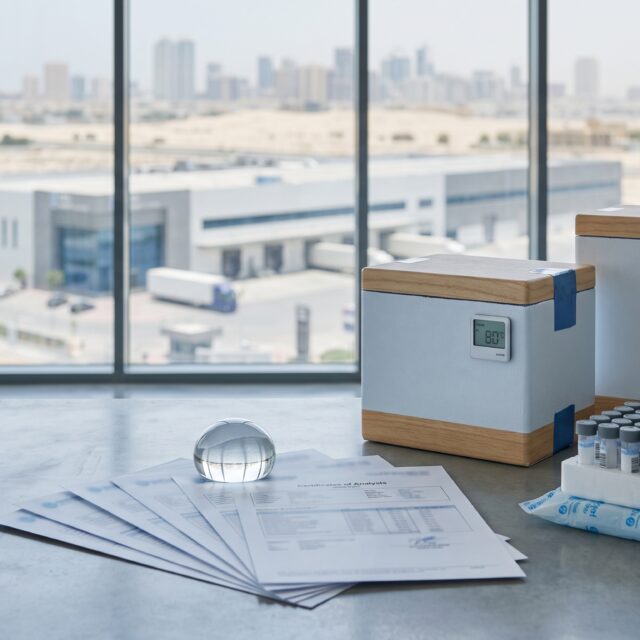
The Certificate of Analysis (COA) should clearly display:
- The testing facility’s credentials and logo.
- The exact date of the test.
- Verifiable contact information or a scannable QR code linking directly to the lab’s secure database.
- A batch number that perfectly matches the physical vial you receive.
If a shop uses the same static, low-resolution COA image for years across multiple batches, it is a massive red flag. External validation guarantees that purity metrics have not been manipulated to clear old inventory.
Beating the GCC Heat: Cold-Chain Logistics
One of the most critical factors when sourcing in the Middle East is the climate. If you are searching for the best peptide shop near me qatar, you must evaluate how that shop handles logistics in an environment where summer temperatures routinely exceed 45°C.
Peptide structures consist of delicate amino acid chains highly susceptible to thermal degradation. While lyophilised (freeze-dried) powders are significantly more stable than reconstituted liquids, prolonged exposure to high heat during transit can still compromise molecular integrity, leading to denatured compounds and failed experiments.
Regional Fulfillment vs. International Shipping
Ordering from overseas suppliers often involves lengthy customs delays. A package sitting in an unconditioned sorting facility or on a hot airport tarmac for a week is likely compromised by the time it reaches your laboratory.
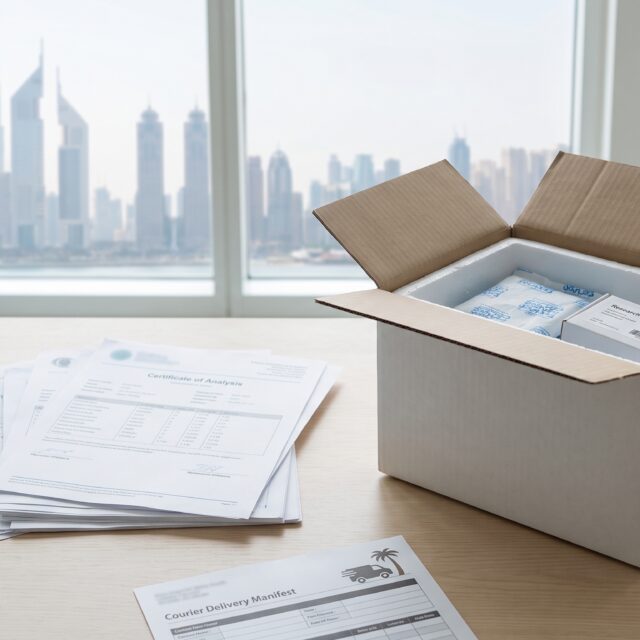
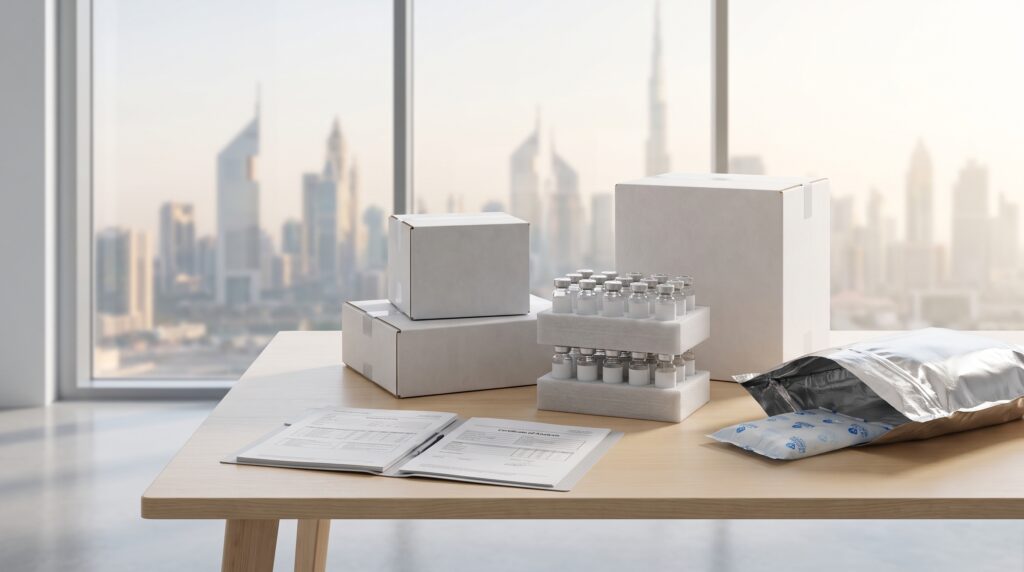
The most effective suppliers mitigate this risk by utilizing regional fulfillment hubs within the GCC and employing specialized thermal packaging. Insulated mailers, thermal bubble wrap, and expedited final-mile delivery are non-negotiable requirements for preserving compound efficacy in Qatar.
For researchers prioritizing speed and environmental control, sourcing from suppliers with established GCC networks is highly advantageous. Utilizing regional hubs ensures compounds spend minimal time in transit and are rarely subjected to extreme temperature fluctuations. Researchers can better understand how streamlined regional logistics function by reviewing our protocol for peptides UAE next-day delivery, which highlights the standard of speed, packaging, and temperature control required for the entire Gulf region.
Proper Handling and Storage for Research Integrity
Even if a supplier utilizes perfect cold-chain logistics, compound integrity can be lost the moment it arrives if not handled correctly by the researcher.
Premium suppliers provide clear guidelines on laboratory storage. Lyophilised powders should ideally be stored in a laboratory freezer at -20°C for long-term preservation, away from UV light and moisture.
Once a researcher reconstitutes the peptide using bacteriostatic water or sterile saline for an in-vitro assay, the compound becomes highly fragile. Reconstituted solutions must be refrigerated at 2°C to 8°C and should generally be utilized within 14 to 30 days, depending on the specific molecular structure, before natural degradation begins.
Secure Payments and Responsive Supplier Support
Navigating research procurement in the Middle East often requires direct communication regarding batch numbers, shipping schedules, and import documentation.
Direct Support Channels
The best suppliers offer direct, encrypted, and responsive communication channels. In the GCC, platforms like WhatsApp are heavily utilized for coordinating specialized deliveries. A supplier offering real-time support to answer questions about a specific batch’s COA, explain reconstitution volumes, or provide live tracking updates demonstrates a commitment to client service that fly-by-night operations lack.
Payment Flexibility and Security
Procurement flexibility is another hallmark of a mature supplier. Buyers should look for secure, diverse payment gateways. Many top-tier research suppliers offer alternative secure channels, such as direct bank transfers, encrypted crypto gateways, or localized Cash on Delivery (COD) options within specific networks, ensuring financial data remains protected while facilitating smooth B2B transactions.
Evaluating the Best Options: Why NOVA Labs Stands Out
While local pharmacies excel at providing prescription clinical formulations for patients, the need for specialized, high-purity research compounds requires a dedicated laboratory supplier. Researchers evaluating the market must balance the need for verifiable analytical quality against the realities of regional logistics and strict local compliance.
NOVA Labs has structured its operations to directly address the specific challenges of sourcing in the GCC. Rather than relying on generic marketing, NOVA Labs prioritizes objective scientific transparency:
- Public, Verifiable COAs: Every compound is backed by third-party HPLC and MS testing, with batch-specific reports accessible directly to the buyer prior to purchase.
- Climate-Aware Logistics: Packaging and transit protocols are designed specifically to protect lyophilised compounds from the extreme temperatures of the Middle East, utilizing insulated shipping materials.
- Streamlined Regional Sourcing: By maintaining efficient regional distribution networks, researchers receive their materials faster and in better condition, bypassing the extended transit times that plague standard international shipments.
Ready to evaluate a comprehensive range of analytically documented compounds? Explore our complete NOVA Labs shop to view batch reports and verify our commitment to research-grade purity.
Conclusion: Making an Informed Sourcing Decision
Finding the best peptide shop qatar requires moving past superficial marketing and focusing heavily on verifiable trust signals. In an environment shaped by strict MoPH regulations and extreme climate challenges, researchers cannot afford to compromise on quality or logistics.
Always demand batch-specific, third-party HPLC and MS testing to ensure molecular accuracy. Prioritize suppliers that utilize specialized cold-chain packaging and regional fulfillment networks to protect compounds from thermal degradation. By ensuring your supplier offers transparent documentation, safe shipping, and responsive support, you safeguard the integrity of your research and the accuracy of your resulting data.
Disclaimer: All products, compounds, and materials mentioned in this article and provided by NOVA Labs are intended strictly for in-vitro laboratory research purposes only. They are not intended for human consumption, clinical treatment, diagnostic purposes, or therapeutic use. Always strictly adhere to local regulations and laboratory safety protocols.
References
- State of Qatar Ministry of Public Health (MoPH). Circular regarding the prohibition of trade and promotion of unlicensed peptide products.
- Regional Trade Insights on Specialized Supplementation and Research Logistics in the GCC.
- Qatar Health Ministry Prohibits Trade and Promotion of Unlicensed Peptide Products
- MoPH bans sale and use of unlicensed peptide products – Qatar Living
- Buy PEPTIDES in Qatar – BPC-157, TB-500, GHRP, Ipamorelin – Doha Performance
- Ozempic 1mg Prefilled Pen 1’s – Kulud Pharmacy
- NovaLabs — 99% Purity, Research-Grade Peptides & Public COAs
Frequently asked questions
What is the best peptide shop in Qatar?
The best peptide shop for researchers in Qatar is one that provides verifiable, batch-specific HPLC and Mass Spectrometry testing, alongside specialized cold-chain logistics to protect compounds from the extreme GCC heat during transit.
Are research peptides legal to import into Qatar?
Qatar's Ministry of Public Health (MoPH) tightly regulates the import and trade of unlicensed peptide preparations. A generic 'research purposes only' label does not automatically exempt products from customs compliance; buyers must source legally through verifiable, compliant channels providing full analytical documentation.
Why is a COA important when buying peptides?
A Certificate of Analysis (COA) provides independent, analytical verification of a compound's purity and molecular weight. It ensures that the product is free from harmful synthetic byproducts and exactly matches the required molecular specifications for accurate laboratory research.
What is the difference between HPLC and MS testing?
HPLC (High-Performance Liquid Chromatography) measures the purity of the compound by identifying any leftover solvents or byproducts. Mass Spectrometry (MS) measures the molecular weight to confirm the synthesized peptide accurately matches the intended structural sequence.
How does extreme heat in Qatar affect shipped peptides?
Fragile peptide structures can undergo thermal degradation if exposed to the extreme heat of the Middle East, leading to denatured compounds. It is crucial to choose suppliers that use insulated thermal packaging and expedited regional delivery networks to maintain compound integrity.
Nova Labs buyer tools
Ready to verify stock, testing and delivery?
Use the product page and lab report section to check availability, documentation, delivery timing and support before placing an order.
- COA / test-report checks
- Qatar delivery context
- Cold-chain handling
- COD and card payment options
- WhatsApp support