
The Reality of Sourcing HPLC Tested Peptides in Qatar and the UAE
Sourcing HPLC tested peptides in Qatar and the UAE requires verifying third-party Certificates of Analysis (COAs) for both HPLC purity and Mass Spectrometry identity. Buyers must also ensure their supplier uses premium cold-chain logistics to clear GCC customs safely without degrading the compounds.
Securing high-quality research compounds in the Gulf Cooperation Council (GCC) is a complex logistical and analytical challenge. For laboratory professionals, clinical researchers, and procurement teams in Doha and Dubai, the market presents two distinct hurdles: a proliferation of unverified “99% purity” claims from low-trust vendors, and stringent customs enforcement at local borders.
Navigating this landscape safely requires an uncompromising approach to analytical documentation and a clear understanding of regional shipping constraints. Failing to verify these data points can lead to compromised in-vitro research outcomes, while ignoring local shipping realities often results in seized packages at Hamad International Airport or Dubai Customs. This guide outlines exactly how informed buyers evaluate suppliers, verify lab data, and ensure seamless delivery into the wider Middle East region.
Quick Answer: Buyer Checklist for GCC Sourcing
Before engaging with any supplier, researchers should run the vendor through a strict verification checklist. An impressive website does not guarantee compound integrity. Evaluate your procurement source against these mandatory requirements:
- Verifiable Third-Party COAs: The supplier must provide batch-specific reports from independent, accredited testing laboratories (such as Janoshik Analytical or MZ Biolabs).
- Dual Analytical Methods: Documentation must include both High-Performance Liquid Chromatography (HPLC) for purity and Mass Spectrometry (MS) for chemical identity.
- Direct Portal Verification: Legitimate lab reports include a unique alphanumeric key that allows you to verify the document directly on the testing facility’s database.
- GCC-Optimized Logistics: Vendors must utilize discreet packaging and premium couriers (like DHL Express) capable of navigating UAE and Qatar customs without thermal degradation.
- Endotoxin Testing: For sterile research environments, the supplier should offer LAL (Limulus Amebocyte Lysate) testing data.
The Logistical Hurdle: Navigating UAE and Qatar Customs
Even the most rigorously tested compounds are useless if they cannot clear local borders. Strict customs enforcement at Hamad International Airport in Qatar and Dubai International Airport in the UAE means that injectable-format and lyophilized research compounds are heavily scrutinized. High seizure rates are common for shipments that fail to comply with local regulations or utilize inadequate shipping methods.
Standard postal services, such as Qatar Post or Emirates Post, are notoriously unreliable for bringing research materials into the GCC. Reputable suppliers understand that standard generic mail often leads to weeks of delays, severe thermal degradation of sensitive peptide bonds, or outright confiscation by authorities who cannot readily identify the unlabelled white powders.
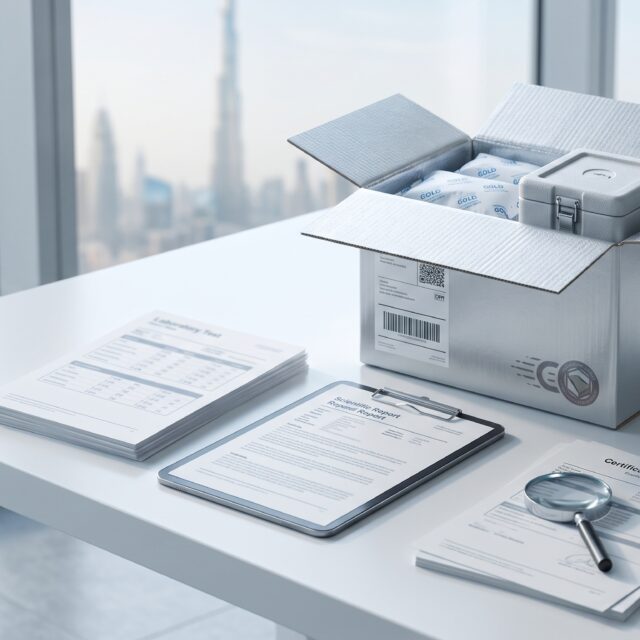
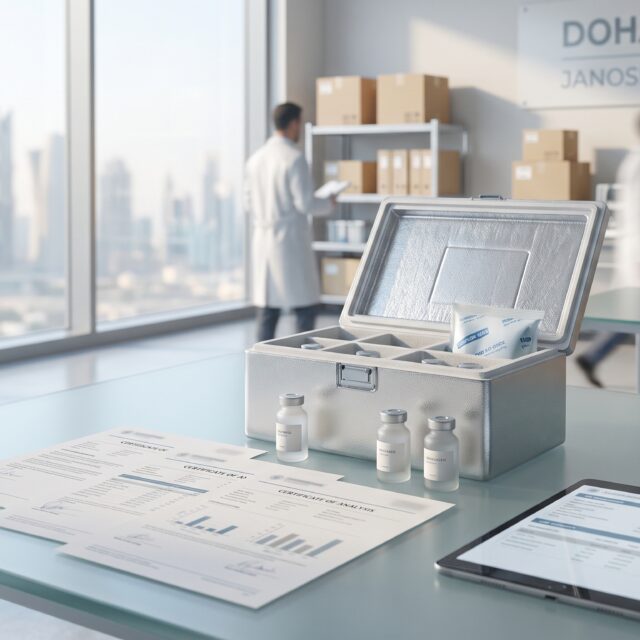
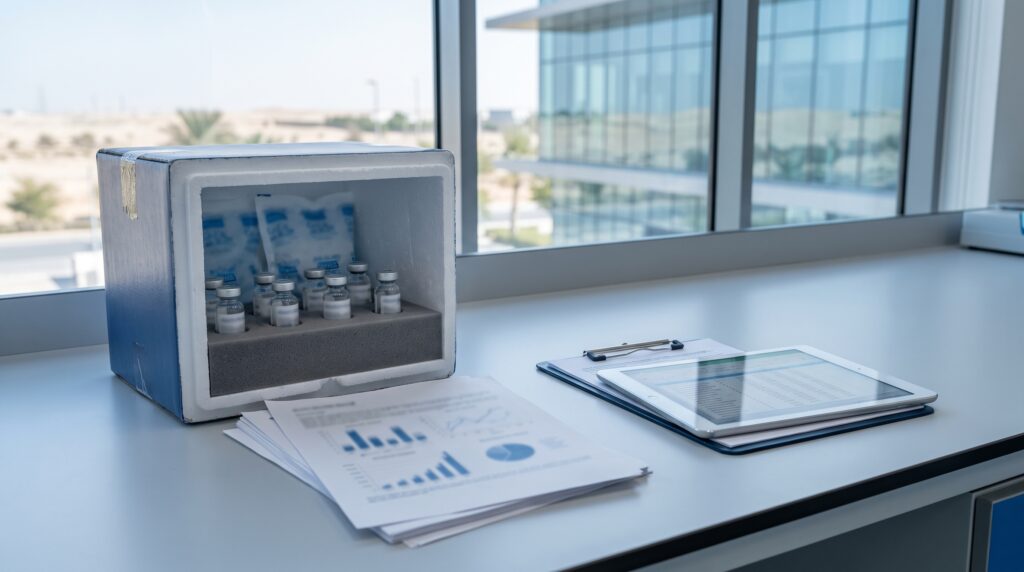
To mitigate these risks, specialized logistics are strictly required. Premium carriers like DHL Express are essential for navigating GCC customs rapidly, often clearing packages within 24 to 48 hours. Furthermore, discreet packaging has become the industry standard for research-grade materials. This practice protects the structural integrity of the lyophilized powder from harsh Middle Eastern transit temperatures while minimizing friction during border clearance. When evaluating a supplier, always confirm their exact shipping protocols for the GCC, including their policies on delivery windows, cold-chain support, and reshipment guarantees in the event of customs seizure.
Decoding the Chemistry: HPLC vs. Mass Spectrometry
Understanding how to accurately read a Certificate of Analysis is the most critical skill for anyone seeking HPLC tested peptides in Qatar or the UAE.
The industry gold standard for assessing purity is High-Performance Liquid Chromatography (HPLC). This analytical technique separates compounds based on their chemical affinity. As the sample passes through a pressurized column, a UV detector measures the absorbance of the molecules. Technicians then calculate the peak area of the target molecule relative to any impurities (represented as smaller peaks on the chromatogram graph).
However, a 99% purity claim on an HPLC report simply means that 99% of the UV-absorbing material in the sample is the target compound. It leaves a 1% margin for synthesis failure byproducts, truncated amino acid sequences, or residual solvents.
More importantly, HPLC alone is vastly insufficient. Quantitative purity is entirely useless if the vial contains the wrong chemical sequence altogether. This is where Mass Spectrometry (MS) becomes indispensable.
Mass Spectrometry measures the exact mass-to-charge ratio (m/z) of the molecules in the sample, confirming its exact molecular weight and, consequently, its chemical identity. If a vendor provides a beautiful HPLC graph but fails to provide accompanying MS data, the compound cannot be definitively verified. You might have a vial that is 99% pure, but it could be 99% pure mannitol or the wrong peptide entirely.
The Trap of “99% Purity”: TFA Salts and Net Weight
Beyond purity and identity, buyers in the GCC must understand the difference between a vial’s total lyophilized weight and its net active peptide content.
During solid-phase peptide synthesis, counter-ions (most commonly Trifluoroacetic acid, or TFA salts) are used to cleave the peptide from the resin and improve its solubility. During the freeze-drying (lyophilization) process, ambient moisture is also trapped in the powder.
As a result, even if an HPLC report shows 99% purity, moisture and TFA salts can comprise 10% to 30% of the total powder weight in the vial. If a researcher purchases a “10mg” vial, they may only be receiving 7mg to 9mg of net active peptide. Analytical standards require buyers to differentiate between these weights to ensure highly precise in-vitro dosing. Premium suppliers will often overfill vials slightly to account for this mass discrepancy, ensuring the researcher gets the exact net active amount advertised.
Spotting Forged COAs and Fake Lab Reports
As demand for research compounds has surged in Dubai, Abu Dhabi, and Doha, so has the prevalence of doctored analytical reports. Many online vendors reuse outdated COAs, aggressively edit PDFs to change batch dates, or simply forge documents to appear legitimate. For buyers evaluating an HPLC tested peptides shop in Qatar, forensic document verification is non-negotiable.
Legitimate sellers invest heavily in third-party, accredited testing. Laboratories like Janoshik Analytical provide a unique, cryptographic report ID for every batch tested. To verify a COA, buyers should never trust the PDF hosted on the supplier’s website alone. Instead, locate the report ID and enter it directly into the independent laboratory’s verification portal.
If the data does not match, if the date is over a year old, or if the report cannot be found, the supplier is likely compromising on quality.
At NOVA Labs, analytical transparency is foundational to our operations. We encourage researchers to meticulously review our verifiable independent lab results for every batch, ensuring complete confidence before any compound enters your facility.
The Overlooked Metric: Endotoxin (LAL) Testing
While HPLC and MS verify purity and identity, they do not assess biological contamination. For advanced research environments requiring sterile cell culture handling, bacterial endotoxins present a severe risk to experimental integrity.
Sterile filtration (such as passing the compound through a 0.22-micron filter) removes live bacteria, but it does not eliminate endotoxins. When bacteria are destroyed during synthesis or sterilization, their cell walls break down and release lipopolysaccharides (endotoxins) into the compound.
To detect this, premium suppliers conduct LAL (Limulus Amebocyte Lysate) testing. This separate analytical metric ensures that the compound meets stringent limits for in-vitro research applications, preventing cellular toxicity and adding an essential layer of confidence for exacting laboratory professionals.
Payment and Local Support for GCC Buyers
Procurement friction doesn’t stop at customs. For buyers in Qatar and the UAE, standard international credit card processors often flag cross-border purchases of research chemicals.
Reliable GCC suppliers offer diversified, secure payment gateways, including cryptocurrency options (which offer immediate, borderless settlement) and specialized credit card processing that minimizes false fraud flags. Additionally, navigating time zones and rapid shipping updates requires responsive support. Access to regional customer service—such as direct WhatsApp support operating in Gulf Standard Time (GST)—is essential for addressing real-time delivery modifications, payment queries, or customs clearance paperwork.
Conclusion and Final Verification Steps
Securing research materials in the GCC demands a rigorous approach to quality control. The search for true HPLC tested peptides in Qatar and the UAE should always end with concrete, verifiable proof. Do not accept purity claims at face value or rely solely on a vendor’s word.
Demand dual-method testing (HPLC and MS), verify unique COA report IDs through independent portals, ensure your supplier conducts LAL endotoxin testing, and mandate that they utilize discreet, premium logistics capable of clearing local customs safely.
For researchers ready to source highly documented compounds tailored to GCC logistical demands, we invite you to explore our comprehensive research peptide shop and experience the NOVA Labs standard of transparency.
Disclaimer: The products and compounds mentioned in this article are intended strictly for in-vitro laboratory research purposes only. They are not approved for human consumption, therapeutic use, or medical treatment of any kind.
References
- Qatar General Authority of Customs. (2023). Clearance Procedures for Restricted and Chemical Substances.
- UAE Federal Customs Authority (FCA). (2023). Unified Customs Tariff and Import Regulations for Chemical Compounds.
- Journal of Chromatography A. (2021). “Advancements in High-Performance Liquid Chromatography for Peptide Analysis.”
- American Society for Mass Spectrometry (ASMS). (2022). “Guidelines for Peptide Identification and Quality Control.”
- United States Pharmacopeia (USP). USP <85> Bacterial Endotoxins Test (LAL).
- Janoshik Analytical. (2024). Analytical Testing Standards for Synthetic Peptides and Verification Portal Guidelines.
- Certificate of Analysis (CoA): How to Read HPLC Purity Reports – Amino Peptides Ltd
- Peptide Certificates of Analysis: How to Read and Verify a COA (2026 Guide) | Peptidepedia
- How to Read a Peptide COA + Verify a Janoshik Report – CertaPeptides
- Peptide Purity: Proven Guide to Reading a COA 2026 – PSPeptides
- Certificates of Analysis: Third-Party Lab Tested Peptides – Peptara Labs
- Shipping Policy – Pure Peptides
- International Shipping — Countries, Customs, and What to Expect – Everychem
- Anyone tried bringing to Qatar? : r/PeptideGuidesPH – Reddit
Frequently asked questions
How do I verify a peptide COA in Qatar and the UAE?
To verify a Certificate of Analysis, locate the unique alphanumeric report ID on the document and enter it directly into the independent testing laboratory's secure verification portal (such as Janoshik Analytical). This ensures the document has not been forged or altered by the vendor.
What is the difference between HPLC and Mass Spectrometry?
HPLC (High-Performance Liquid Chromatography) determines the purity percentage of a sample by separating its compounds and measuring UV absorbance. Mass Spectrometry (MS) measures the exact mass-to-charge ratio, verifying the exact molecular weight and chemical identity of the target peptide.
Can standard couriers ship research peptides to Dubai or Doha?
Due to strict customs enforcement at Hamad International Airport and Dubai Customs, standard mail like Emirates Post often results in lengthy delays, thermal degradation, or seizures. Reliable suppliers utilize premium carriers like DHL Express and discreet packaging to ensure safe clearance.
Why do peptide vials contain less active compound than the total powder weight?
Lyophilized peptide powders contain residual moisture and counter-ions, such as TFA salts, left over from the solid-phase synthesis process. Even at 99% purity, these non-peptide components can make up 10% to 30% of the total vial weight.
What does LAL testing measure in research compounds?
LAL (Limulus Amebocyte Lysate) testing detects bacterial endotoxins (lipopolysaccharides) that remain even after sterile filtration. This testing is crucial for ensuring the compound is free from biological contaminants that could cause cellular toxicity and skew in-vitro research data.
Nova Labs buyer tools
Ready to verify stock, testing and delivery?
Use the product page and lab report section to check availability, documentation, delivery timing and support before placing an order.
- COA / test-report checks
- Qatar delivery context
- Cold-chain handling
- COD and card payment options
- WhatsApp support