




Procuring high-quality research materials in the Gulf region presents a unique set of challenges for procurement staff, laboratory managers, and informed buyers. Between intense regional temperatures that threaten chemical stability, complex cross-border customs regulations, and evolving local compliance frameworks, selecting a reliable partner is critical. For laboratory managers looking to buy CJC-1295 No DAC GCC, simply finding a vendor with an active website is no longer sufficient.
Today’s procurement standards demand strict verifiable testing, transparent batch documentation, and specialized logistics that can survive the climate of the Middle East. CJC-1295 No DAC, a synthetic 30-amino acid peptide, requires meticulous synthesis and handling. Because of its structural complexity, evaluating vendor legitimacy through hard analytical data and domestic supply chain infrastructure is non-negotiable. This guide explores the operational, analytical, and logistical factors buyers must evaluate to ensure their research compounds arrive intact and fully compliant with regional guidelines.
Where to Buy CJC-1295 No DAC GCC Safely
When looking to buy CJC-1295 No DAC GCC, researchers must source from UAE-based suppliers offering batch-specific certificates of analysis (COAs) showing ≥98% purity, dedicated cold-chain packaging, and localized dispatch. Domestic procurement bypasses strict cross-border customs delays, ensuring temperature-sensitive lyophilized peptides remain structurally intact.
Successfully navigating the regional market requires shifting focus away from direct overseas imports toward established domestic hubs. International shipments from North America or East Asia frequently face prolonged transit times. When a sensitive compound sits in a non-climate-controlled customs warehouse in Dubai, Riyadh, or Doha for several days, its molecular integrity can rapidly degrade. Domestic UAE suppliers mitigate this risk by holding inventory locally and utilizing courier networks that specialize in temperature-managed dispatch.
By leveraging localized warehousing, researchers operating within the Gulf Cooperation Council can drastically reduce procurement lead times. A domestic supplier can often facilitate same-day or next-day fulfillment within the UAE, and secure 48-to-72 hour transit times to neighboring nations like Saudi Arabia (KSA), Qatar, Bahrain, Kuwait, and Oman. This closed-loop logistical approach protects the peptide from unnecessary thermal exposure.
Quick Answer: The Regional Buyer Checklist
Before you finalize a procurement contract for research compounds, evaluate any prospective supplier against this operational checklist to ensure you are receiving a high-grade, verifiable product:
- Batch-Specific Testing: Does the supplier provide a Certificate of Analysis (COA) linked to the exact batch number on your vial, rather than a generic or outdated file?
- Analytical Rigor: Are purity levels confirmed via High-Performance Liquid Chromatography (HPLC) and Mass Spectrometry (LC-MS) showing a minimum of 98% purity?
- Climate Resilience: Does the vendor explicitly outline their cold-chain shipping protocols, such as insulated mailers and phase-change gel packs, to counter extreme GCC heat?
- Compliance Focus: Do they operate strictly within “Research Use Only” frameworks, avoiding prohibited physiological claims or human-use instructions?
- Logistical Control: Do they dispatch directly from within the UAE to avoid cross-border customs friction and transit delays?
Navigating Research Compliance and EDE Guidelines
Recently, the Emirates Drug Establishment (EDE) and regional health authorities have initiated stricter regulatory oversight on unauthorized pharmaceutical sales, enforcing actions against unapproved marketing channels. This pivotal shift was designed to curb unapproved consumer promotions and safeguard the integrity of the scientific sector.
For buyers evaluating a CJC-1295 No DAC supplier, this regulatory environment is a highly beneficial filter. It clearly separates reputable supply hubs from substandard vendors. Compliant laboratories operate strictly under a “Research Use Only” mandate. They will not provide human-use protocols, dosage guidelines, or market these compounds for unauthorized physiological applications.
When a vendor focuses exclusively on delivering chemical stability profiles, robust analytical data, and secure logistics rather than making unverified biological claims, it is a strong indicator of their operational legitimacy and long-term reliability. Researchers must ensure that their procurement channels reflect this professional standard to remain compliant with regional importation and laboratory handling guidelines.
Demystifying HPLC and LC-MS: Verifying Purity
The most critical asset any supplier can provide is transparent, verifiable documentation. Visual inspection of a lyophilized peptide cake offers no insight into its purity or synthesis quality. Because CJC-1295 No DAC is a moderately long sequence requiring Solid-Phase Peptide Synthesis (SPPS), the process inherently risks creating truncated sequences or deletion impurities. Therefore, informed buyers must rely on rigorous third-party analytical testing.
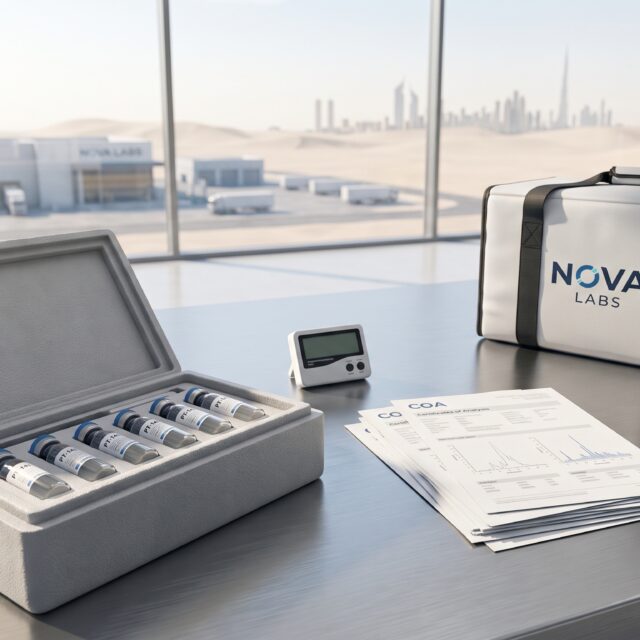
When evaluating a supplier, request their latest Certificate of Analysis (COA). A robust COA should include:
- HPLC (High-Performance Liquid Chromatography) Results: This technique separates the components in a mixture, identifying the exact percentage of the target peptide versus impurities. Premium research compounds should demonstrate a single, sharp chromatogram peak indicating ≥98% purity.
- LC-MS (Liquid Chromatography-Mass Spectrometry) Data: This confirms the molecular weight of the compound. The results must ensure that the synthesized peptide perfectly matches the exact molecular weight of CJC-1295 No DAC (approximately 3367 g/mol), confirming no missing amino acids in the chain.
- Batch Tracking Integrity: The documentation must feature a visible batch number or lot code that aligns perfectly with the labeling on the physical vial you receive. Generic, undated COAs are a major red flag in the industry.
Beating the Heat: Cold-Chain Logistics
The climate of the Gulf region—where ambient temperatures frequently exceed 40°C (104°F) during the summer months—poses a severe threat to peptide integrity. Understanding the stability profiles of these compounds is vital for any GCC procurement strategy.
In their lyophilized (freeze-dried) state, research peptides are remarkably resilient compared to their liquid counterparts. Un-reconstituted lyophilized peptides can typically withstand room-temperature transit for short periods without significant structural degradation. However, ambient temperature in a laboratory setting is vastly different from the interior of a standard delivery van parked under the midday GCC sun.
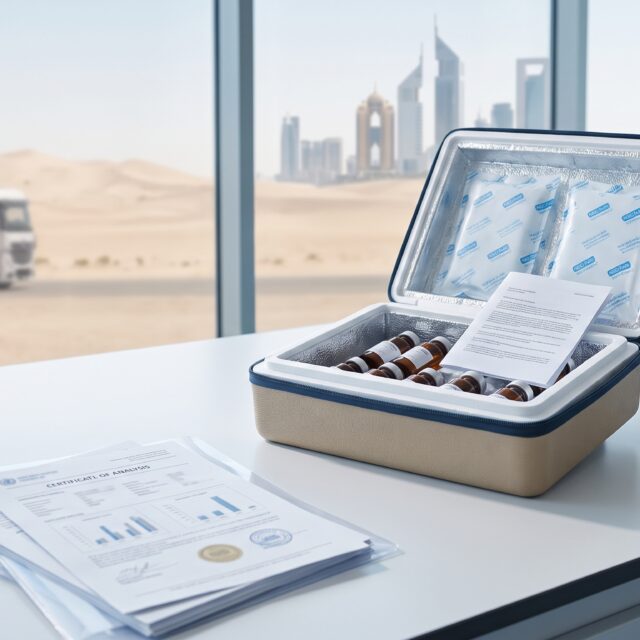
To safeguard delicate chemical bonds, top-tier regional suppliers employ specialized cold-chain logistics. This includes utilizing insulated thermocol packaging, commercial-grade gel cooling packs, and accelerated courier services to minimize the transit window. For more information on how specialized local dispatch protects your materials, review NOVA Labs’ next-day delivery protocols designed explicitly for temperature-sensitive research compounds in the Emirates.
Note: Once reconstituted with bacteriostatic water or laboratory solvent, peptide stability profiles change drastically. Reconstituted peptides must be immediately stored in a refrigerated environment between 2°C and 8°C (35°F to 46°F) and utilized promptly within the parameters of your experimental design.
Bypassing Customs: The Advantage of Domestic UAE Fulfillment
Historically, GCC researchers relied heavily on cross-border shipments from overseas laboratories. Today, importing biological research compounds directly into Saudi Arabia, Qatar, Bahrain, Kuwait, or Oman from outside the Middle East frequently triggers intense customs scrutiny. This can lead to prolonged holds, requests for additional laboratory declarations, or outright material seizures.
Domestic fulfillment within the GCC changes this dynamic entirely. By sourcing from a specialized hub operating within the UAE, buyers bypass international borders for their initial procurement. Suppliers holding physical stock in Dubai or Abu Dhabi can execute same-day dispatch. For buyers located outside the UAE but within the broader GCC, established regional land and air courier networks handle these shipments with significantly higher clearance success rates and shorter transit windows, maintaining the integrity of the cold chain from origin to destination.
Product Spotlight: Evaluating CJC-1295 No DAC for Your Lab
When integrating new compounds into a laboratory setting, it is important to understand the exact specifications of the material. CJC-1295 is a synthetic analogue of Growth Hormone Releasing Hormone (GHRH). The “No DAC” designation is crucial for researchers to note.
DAC stands for Drug Affinity Complex. Peptides synthesized with DAC are designed to bind to endogenous albumin, significantly extending their half-life during in-vitro and in-vivo assays. CJC-1295 No DAC (often referred to in scientific literature as modified GRF 1-29) lacks this complex, resulting in a much shorter half-life. Researchers must select the correct variant based on the specific pulsatile requirements and temporal parameters of their experimental model.
Securing high-grade materials requires a vendor that understands the intersection of chemical purity and regional operational hurdles. For laboratories seeking verifiable materials and seamless localized fulfillment, you can securely buy CJC-1295 No DAC directly through our regional portal.
Payment, Procurement, and Laboratory Support
The final hurdle in regional procurement is often financial logistics. Many overseas vendors lack the infrastructure to process payments smoothly from GCC-based institutions, leading to flagged credit cards or complex international wire transfers.
Modern domestic suppliers cater to regional B2B needs by offering secure processing in local currencies, seamless bank transfer capabilities, and dedicated WhatsApp concierge support for real-time stock checks. Within select UAE zones, some suppliers even provide Cash on Delivery (COD) options, further reducing the financial friction typically associated with acquiring sensitive research compounds.
Conclusion
The landscape for securing research compounds in the Middle East demands vigilance and strict quality control. When deciding where to buy CJC-1295 No DAC GCC, your decision should be driven by hard data: verifiable HPLC/LC-MS purity, batch traceability, resilient cold-chain logistics, and strict adherence to “Research Use Only” compliance. By prioritizing suppliers with a strong domestic footprint in the UAE, researchers can bypass cross-border customs friction, protect materials from extreme regional heat, and ensure the absolute integrity of their analytical work. For immediate regional sourcing backed by stringent quality testing, explore NOVA Labs’ complete catalog of research compounds to support your next project.
Disclaimer: The products mentioned in this article are for research purposes only and are not intended for human consumption, clinical application, or therapeutic use.
*
References
- Peptide Stability and Degradation Pathways. Journal of Pharmaceutical Sciences (2023).
- UAE Drug Establishment (EDE) Guidelines for Scientific and Research Procurement. UAE Ministry of Health and Prevention Updates (2024).
- Evaluating Cold-Chain Integrity in Middle Eastern Pharmaceutical Logistics. Regional Logistics Reporting (2024).
- Solid-Phase Peptide Synthesis and Truncation Impurities. Analytical Biochemistry Review (2022).
- Regulatory Oversight on Research Peptides in the GCC. UAE Medical and Scientific Journal (2023).
- CJC-1295 + Ipamorelin UAE – VaultLabs
- Shipping & Returns – Peptides DXB
- UAE Cracks Down on Unapproved Peptide Weight-Loss Drugs – Gulf News
- Is CJC-1295 Legal? Status in 158 Countries (2026) | peptide.law
- UAE customs? : r/PeptidePathways – Reddit
- Peptide Supplier for Saudi Arabia | B2B Research Peptide Supply – BT BioLabs
Frequently asked questions
How do I verify the purity of CJC-1295 No DAC in the GCC?
A reputable supplier must provide a batch-specific Certificate of Analysis (COA) featuring both HPLC and LC-MS testing to verify the correct molecular weight and ensure chemical purity levels exceed 98%.
How do suppliers protect peptides from UAE heat during shipping?
Premium domestic suppliers use specialized cold-chain logistics, shipping lyophilized vials in insulated packaging with commercial phase-change gel packs, and utilizing expedited local courier networks to minimize temperature exposure during transit.
Is it safe to import research peptides through GCC customs?
Direct overseas importation carries a high risk of customs delays and temperature degradation. It is significantly safer and faster to purchase from specialized domestic UAE suppliers who hold inventory locally, ensuring structural integrity is maintained.
What are the standard payment methods for buying research peptides in the UAE?
Established B2B suppliers offer secure local currency processing, domestic bank transfers, and often provide Cash on Delivery (COD) options within select UAE regions, along with dedicated local support for procurement.
What is the difference between CJC-1295 with DAC and without DAC for laboratory research?
The "No DAC" variant lacks the Drug Affinity Complex, resulting in a significantly shorter half-life during in-vitro testing because it does not bind to endogenous albumin, altering its temporal profile in experimental models.
Nova Labs buyer tools
Ready to verify stock, testing and delivery?
Use the product page and lab report section to check availability, documentation, delivery timing and support before placing an order.
- COA / test-report checks
- GCC delivery context
- Cold-chain handling
- COD and card payment options
- WhatsApp support