



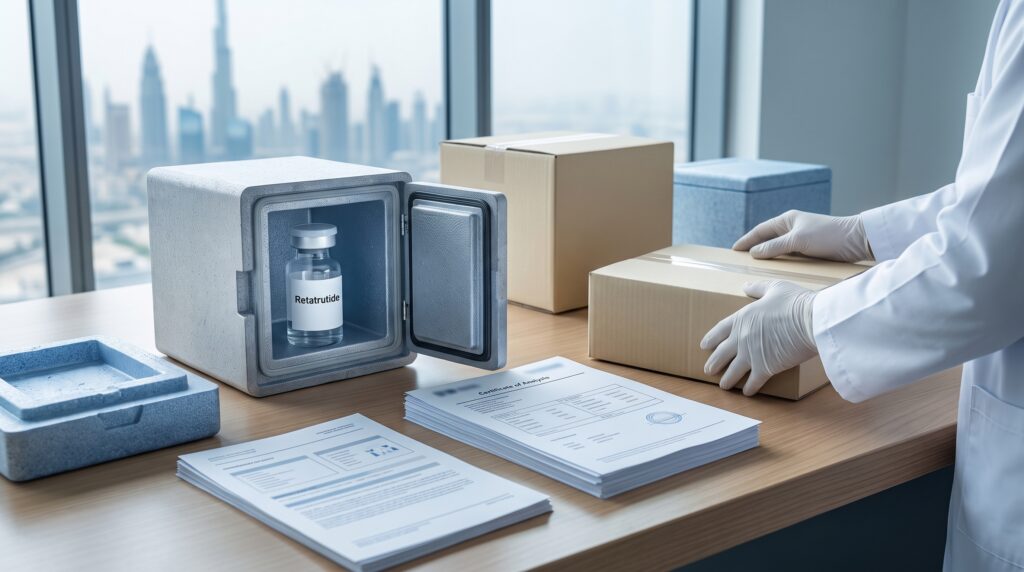
The Core Logistics When You Buy Retatrutide in Saudi Arabia
Quick answer: When looking to buy Retatrutide in Saudi Arabia, successful procurement depends on strict customs compliance and thermal protection. Researchers must ensure compounds are declared as ‘Research Use Only’ via FASEH portals, accompanied by lot-matched HPLC purity tests, and shipped using cold-chain logistics to survive GCC temperatures.
Sourcing high-purity biochemicals in the Middle East requires navigating a highly scrutinised regulatory and logistical landscape. For metabolic researchers evaluating investigational triple agonists (GIP, GLP-1, and glucagon receptor targets), securing a reliable Retatrutide supplier in Saudi Arabia involves far more than simply finding a product online. It requires verifying supply chain integrity, ensuring documentation aligns with local regulations, and protecting fragile compounds from the harsh regional climate.
Navigating KSA Regulatory Scrutiny and the Grey Market
Recent market shifts have fundamentally changed how institutions and independent researchers order Retatrutide in Saudi Arabia. Regulatory bodies like the Saudi Food and Drug Authority (SFDA) and Ministry of Health (MoH) have actively increased enforcement actions targeting unregulated sellers and entities promoting unregistered peptides to consumers.
This regulatory environment highlights a critical distinction for buyers: Retatrutide is not an approved medication for human consumption in Saudi Arabia or globally. It remains an investigational compound strictly restricted to laboratory and in-vitro research.
Procuring materials from illicit local grey-market channels poses severe risks to research integrity. These unregulated suppliers often lack temperature-controlled storage, provide zero documentation, and operate outside compliance frameworks. For serious research initiatives, engaging with scientific suppliers who explicitly decouple their products from therapeutic, clinical, or consumer claims is the only viable path to securing stable, high-quality reference materials.
Customs Compliance: FASEH and ‘Research Use Only’ Declarations
When importing biochemicals across Saudi borders, proper documentation is the difference between a seamless delivery and immediate customs seizure. KSA utilises advanced clearance portals like FASEH and SABER to monitor incoming scientific shipments.
To successfully clear Saudi customs, shipments containing Retatrutide peptide must be framed with absolute legal precision:
- Accurate HS Codes: Products must be categorised under appropriate Harmonised System codes denoting laboratory reference standards, completely separate from pharmaceutical or medical import categories.
- RUO Labelling: Every vial, invoice, and packing slip must clearly state ‘Research Use Only’ (RUO).
- Commercial Invoices: Suppliers must provide detailed, transparent commercial invoices that align with SFDA research-import exemptions, avoiding any language that implies dosage, human use, or therapeutic utility.
Suppliers experienced in Middle Eastern logistics understand these nuances. Before placing an order, buyers should confirm whether the supplier assists with accurate customs declarations or if they simply risk abandoning the shipment at the border.
Peptide Protection in the Desert: Thermal Stability
Even if a shipment clears customs rapidly, the extreme heat of the GCC poses a significant risk to peptide integrity. Retatrutide is a fragile 39-amino-acid chain. If exposed to sustained high temperatures, the molecular bonds degrade, rendering the compound practically useless for analytical study.
Local competitive listings in KSA sometimes offer pre-filled liquid pens. However, liquid-phase peptides are inherently less stable than their lyophilised (freeze-dried) counterparts.
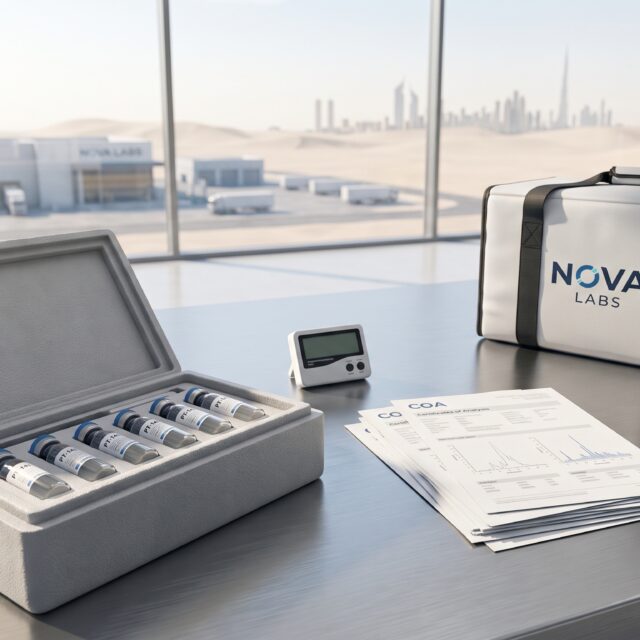
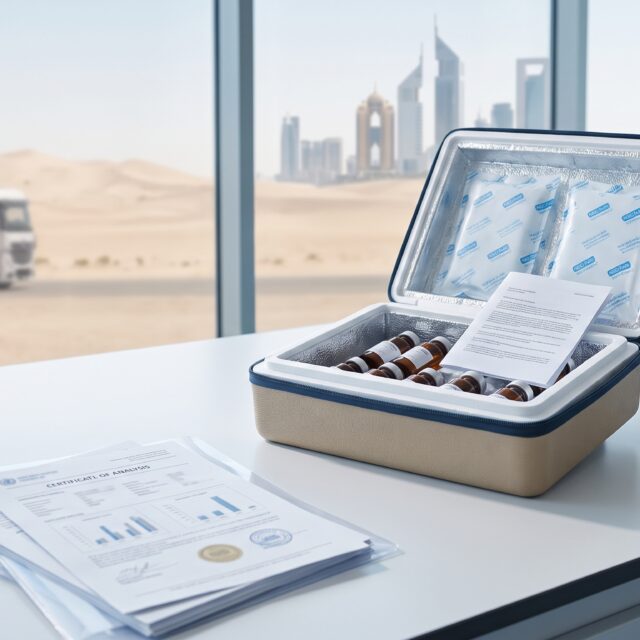
For cross-border transit or reliable local storage, informed researchers exclusively source lyophilised powder. The freeze-drying process removes moisture, significantly increasing the compound’s thermal resilience. Furthermore, professional suppliers utilise passive cold-chain protocols—such as insulated foil wrapping and gel packing—to stabilise the internal temperature during transit. Once received, researchers must reconstitute the lyophilised powder in a sterile environment and store it immediately under refrigeration.
Verifying Purity: The Role of COA, HPLC, and Mass Spec
Visual inspection of lyophilised powder provides zero information regarding its structural integrity, purity, or identity. A white powder could be 99% pure Retatrutide, heavily degraded fragments, or contaminated with manufacturing byproducts like heavy metals and residual solvents.
Before deciding to order Retatrutide in Saudi Arabia, procurement staff must demand verifiable documentation. The gold standard for verifying peptide quality is an independent, third-party Certificate of Analysis (COA).
A rigorous COA must include two specific testing methodologies:
- High-Performance Liquid Chromatography (HPLC): This technique separates the components of the synthesised batch. A valid HPLC report should display a clear, single dominant peak demonstrating a purity level exceeding 99%, confirming the absence of significant fragment impurities.
- Mass Spectrometry (MS): This verifies the exact molecular weight of the compound, confirming that the synthesised peptide is definitively Retatrutide and matches the expected sequence mass.
Crucially, these tests must be lot-matched. A generic COA from three years ago provides no assurance regarding the specific batch being shipped today. Suppliers who obscure their testing data or refuse to provide lot-specific documentation should be avoided.
Secure Payments and Procurement Logistics
The financial logistics of purchasing research biochemicals often present hidden friction. High-risk merchant categories—which frequently include scientific chemical suppliers—face constant payment processor instability. This can lead to sudden cancelled orders or non-functional checkout gateways.
When evaluating a Retatrutide supplier in Saudi Arabia, look for resilient, locally compatible payment infrastructure. Suppliers who integrate with reliable regional gateways or accept domestic network transfers demonstrate a commitment to serving the GCC market. Additionally, suppliers offering assisted manual procurement or secure wire transfers provide a necessary safety net when traditional e-commerce gateways experience downtime, ensuring research timelines are not delayed.
Why GCC Researchers Choose NOVA Labs
For researchers operating in the Gulf, balancing the need for rigorous purity, thermal stability, and customs compliance is complex. NOVA Labs addresses these challenges through a specialised regional operating model.
Located in Dubai, NOVA Labs bypasses the prolonged international transit times that plague overseas suppliers. We provide researchers across the GCC with seamless access to high-purity, extensively tested reference materials. Our team understands the nuances of regional customs portals and ensures all documentation explicitly reflects Research Use Only standards to facilitate smooth border clearance into Saudi Arabia.
By browsing the NOVA Labs product catalog, researchers can evaluate a wide range of verified compounds. Every batch is supported by accessible, lot-matched HPLC and Mass Spectrometry reporting, ensuring full transparency before a purchase is made.
Furthermore, our operational proximity allows us to execute robust cold-chain logistics tailored specifically to the Middle Eastern climate. To understand how we protect fragile compounds during transit, you can review our comprehensive GCC and UAE peptide delivery protocols.
Final Checks Before You Order Retatrutide in Saudi Arabia
Procuring sensitive investigational compounds requires diligence. As you evaluate your options, use this final checklist to ensure a secure and compliant acquisition:
- Regulatory Framing: Confirm the supplier explicitly sells under ‘Research Use Only’ terms and avoids all medical or dosage claims.
- Documentation: Demand a recent, lot-matched COA showing HPLC purity greater than 99% and proper Mass Spectrometry identification.
- Physical Format: Choose lyophilised powder over pre-mixed liquid solutions to guarantee thermal stability during transit.
- Logistics: Verify that the supplier utilises appropriate insulated packaging and understands how to declare scientific goods accurately for GCC customs.
- Support and Payment: Ensure the supplier provides accessible communication channels and secure payment methods that function reliably within the KSA banking system.
By prioritising transparency, analytical testing, and regional logistical expertise, researchers can confidently maintain the integrity of their laboratory studies and avoid the pitfalls of the unregulated grey market.
Disclaimer: The products mentioned in this article are strictly for laboratory and in-vitro research purposes only and are not intended for human consumption or therapeutic use.
*
References
- Saudi Food and Drug Authority (SFDA). Products Classification Guidance and Import Exemptions for Research Materials.
- Ministry of Health KSA. MoH Enforcement Reports: Warnings Against Unregistered Products.
- FASEH Logistics Portal KSA. Customs clearance guidelines for laboratory and reference standards in Saudi Arabia.
- NOVA Labs. Retatrutide Saudi Arabia: Buying, Purity, COA and Delivery Guide.
References
- Retatrutide Saudi Arabia: Buying, Purity, COA and Delivery Guide – NOVA Labs
- RETA – BioChain KSA
- MoH Warns Against Using Unregistered Drugs and Seizes Violators
- Saudi Health Ministry detains gym trainers over illegal drug sales
- Accept Mada – Saudi Arabia’s domestic payment network – Checkout.com
- SFDA Products Classification Guidance Version copy
Frequently asked questions
Is Retatrutide approved for human use in Saudi Arabia?
No. Retatrutide is an investigational compound and is not approved by the SFDA or any global regulatory body for human consumption. It is strictly limited to laboratory and in-vitro research use only.
How do I ensure Retatrutide survives shipping to KSA?
To prevent thermal degradation in the GCC climate, researchers should exclusively purchase lyophilised (freeze-dried) powder rather than liquid formulations, and ensure the supplier uses passive cold-chain packaging such as insulated wrapping and gel packs.
What documentation is required to clear Saudi customs for peptides?
Scientific shipments must be accurately declared using laboratory reference standard HS codes, clearly labelled for 'Research Use Only', and accompanied by transparent commercial invoices for portals like FASEH or SABER.
What is a Certificate of Analysis (COA) for peptides?
A COA is an independent testing report that verifies the quality of a peptide batch. A valid COA must include lot-matched HPLC testing to confirm purity levels (ideally over 99%) and Mass Spectrometry to verify the exact molecular weight.
Nova Labs buyer tools
Ready to verify stock, testing and delivery?
Use the product page and lab report section to check availability, documentation, delivery timing and support before placing an order.
- COA / test-report checks
- Saudi Arabia delivery context
- Cold-chain handling
- COD and card payment options
- WhatsApp support