
Quick Answer: Peptide Storage Temperature in Qatar
For laboratories in Qatar, lyophilized research peptides must be stored at -20°C in a manual-defrost freezer to maintain structural integrity. Once reconstituted, liquid peptides should be refrigerated strictly between 2°C and 8°C. Cold vials must acclimatize in a desiccator before opening to prevent condensation hydrolysis.
The Core Rules for Peptide Storage in the GCC
For research laboratories and procurement teams operating in the GCC, environmental extremes demand exact protocols. Whether you are sourcing complex amino acid sequences for in-vitro analysis or standard analytical reference materials, compromised storage invalidates experimental data. Ambient summer temperatures in Doha routinely exceed 45°C, accompanied by intense coastal humidity. If biological reagents are not packaged, shipped, and stored with absolute thermal precision, the structural integrity of the peptide bonds will rapidly degrade.
Maintaining the correct peptide storage temperature in Qatar is a multi-stage process. It begins the moment a vial leaves the manufacturing facility and continues through air transit, customs clearance, and final laboratory bench preparation. This guide outlines the critical storage requirements, handling procedures, and regulatory compliance checks necessary for successful peptide procurement and laboratory management in the region.
Navigating Qatar’s Extreme Climate and Cold-Chain Logistics
The journey of a research peptide from a supplier to a laboratory bench in Qatar introduces several thermal risks. The primary threat is tarmac heat during airport transit, followed by improper customs delays.
Surviving the Tarmac and Al-Nadeeb Customs
When shipments arrive at Hamad International Airport, cargo handlers generally transfer them to ‘Constant Climate’ zones, which maintain temperatures at either 2°C to 8°C or 15°C to 25°C. However, shipments lacking proper pre-clearance documentation run the risk of secondary inspections.
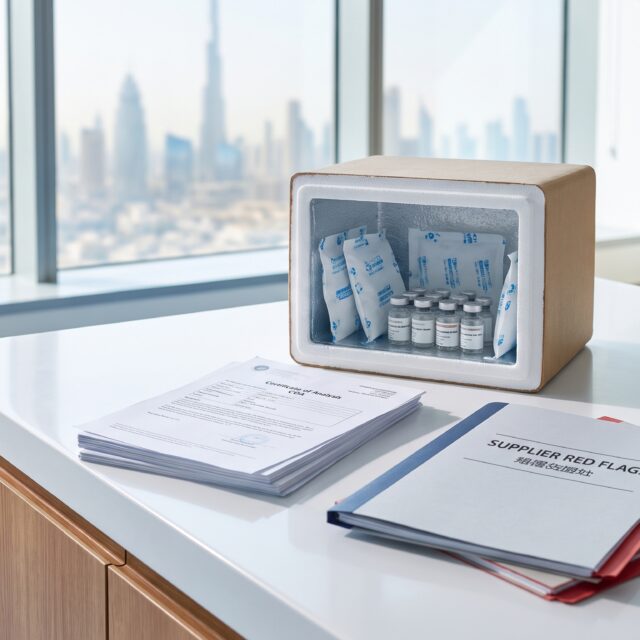
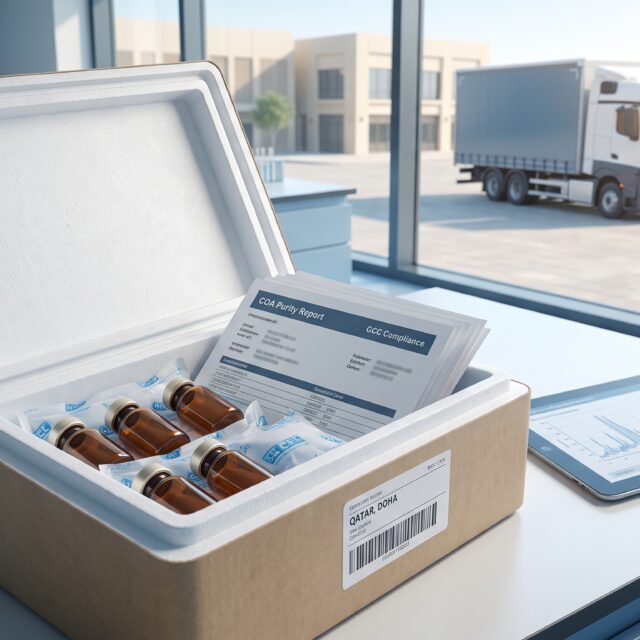
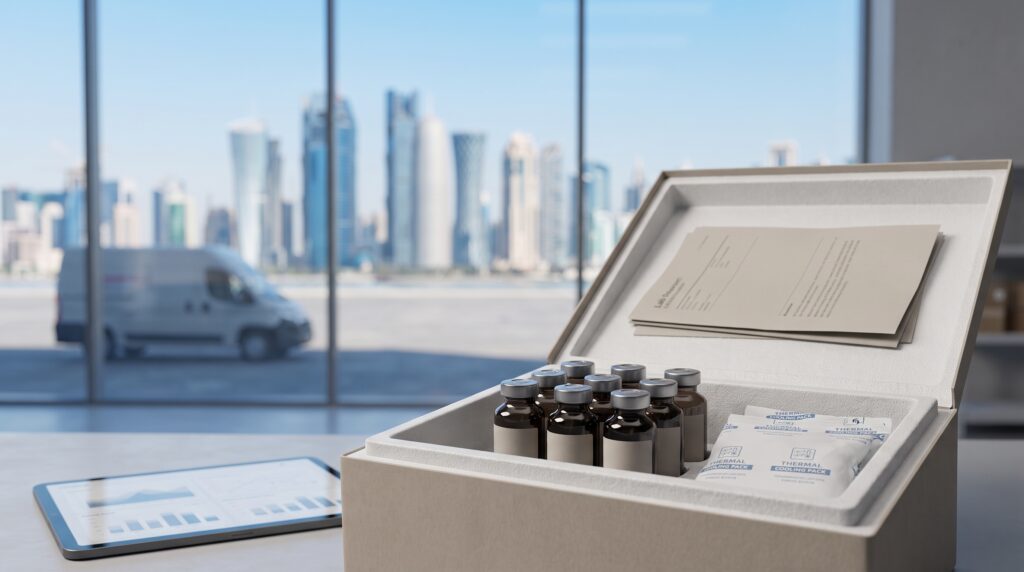
If a package sits in ambient heat during a 48-to-72-hour customs delay, standard ice packs will fail. High-quality suppliers mitigate this by shipping peptides in transit packaging equipped with active Phase Change Materials (PCMs). PCMs are engineered to absorb thermal energy and maintain a strict 2°C to 8°C internal environment for up to 120 hours, bridging the gap between customs clearance and laboratory delivery.
The Role of UAE Hubs in Rapid GCC Delivery
For regional researchers, leveraging a supplier with robust local infrastructure is vital. Vendors operating out of Dubai with proven infrastructure for UAE next-day peptide delivery can dispatch regional shipments to Qatar much faster than international suppliers. Sourcing locally from a GCC hub drastically reduces total transit time, minimizing thermal exposure and ensuring the cold chain remains intact from the warehouse to your Doha laboratory.
Laboratory Storage Protocols: Freezing vs. Refrigeration
Once safely delivered to the research facility, biological reagents must be rapidly logged and stored according to their physical state. Mishandling a peptide at this stage is the most common cause of premature degradation.
Storing Lyophilized (Powder) Peptides
Unopened, lyophilized peptides should be stored long-term at -20°C or colder. This deeply frozen state slows molecular kinetic energy, preserving the structural integrity of the peptide bonds for up to 24 months.
Crucially, these vials must be kept in a manual-defrost freezer. Standard commercial auto-defrost freezers cycle their temperatures up and down to prevent ice buildup. These microscopic, repeated temperature spikes introduce thermal stress and sublimation, which can slowly fracture sensitive amino acid chains and draw moisture into the vials.
Storing Reconstituted (Liquid) Peptides
Once a peptide is reconstituted—typically using bacteriostatic water containing 0.9% benzyl alcohol as an antimicrobial agent—its storage requirements shift immediately.
Reconstituted peptides must never be frozen, as ice crystal formation will permanently shear the delicate molecular structures. Instead, they must be refrigerated strictly between 2°C and 8°C. In this liquid state, the standard viability window for research application is up to 28 days.
Protecting Against UV Degradation
Furthermore, peptide sequences containing oxidation-prone residues such as Methionine (Met), Cysteine (Cys), or Tryptophan (Trp) are highly sensitive to UV exposure. These vials must be stored in light-proof containers or amber glass away from direct laboratory lighting and sunlight.
The Humidity Threat: Preventing Condensation Hydrolysis
One of the most frequently overlooked hazards when managing the peptide storage temperature guide qatar involves Doha’s high coastal humidity. Laboratory environments are often air-conditioned, but ambient moisture levels can still spike when doors open or ventilation shifts.
When a vial is removed from a -20°C freezer and instantly opened in an ambient, humid laboratory setting, the dramatic temperature differential causes rapid atmospheric condensation. Micro-droplets of water immediately form on the inside of the chilled glass and onto the lyophilized powder itself.
This premature introduction of unmeasured, unsterilized water triggers “condensation hydrolysis”—a chemical reaction that breaks peptide bonds and rapidly degrades the compound’s purity before the intended solvent is ever introduced.
The Solution:
Before opening any frozen or refrigerated peptide vial, place it inside a sealed laboratory desiccator for 30 to 60 minutes. This allows the vial to safely equilibrate to room temperature in a zero-humidity environment, ensuring the powder remains perfectly dry until proper reconstitution begins.
Interpreting COAs and Thermal Stress Degradation
If you suspect a shipment has been exposed to extreme heat during transit, examining the chemical properties is essential. Researchers should look for distinct signs of thermal degradation:
- Physical Appearance: Lyophilized powder that has melted and refrozen may appear as a dense, gummy puck rather than a loose, crystalline structure.
- Solubility Issues: Thermally degraded peptides often fail to dissolve completely in bacteriostatic water, leaving a cloudy or particulate-heavy solution.
- Analytical Verification: If the structural integrity is in question, running a new High-Performance Liquid Chromatography (HPLC) test and comparing it against the supplier’s original Certificate of Analysis (COA) is the only definitive way to verify purity.
MoPH Compliance and Qatar Customs Regulations
Procuring high-purity peptides in Qatar is not merely a logistical challenge; it is heavily governed by strict regulatory frameworks. Directives from the Qatar Ministry of Public Health (MoPH) explicitly prohibit the import, sale, and use of unlicensed peptide preparations for human clinical applications.
This regulation places the burden of proof entirely on the importer. To clear the Al-Nadeeb customs system quickly and legally, laboratory managers must ensure their shipments are explicitly documented for in-vitro research use.
Key documentation checks include:
- Precise HS Codes: Shipments must be correctly classified under laboratory reagent codes (e.g., HS Code 38229000).
- Verifiable COAs: Customs officials often require HPLC and Mass Spectrometry (MS) documentation proving the purity and identity of the chemical compound.
- Certificates of Origin: Matching commercial invoices and origin certificates must accompany the shipment to validate the source.
Procurement Checklist: Evaluating Peptide Suppliers in the GCC
When evaluating where to source analytical-grade compounds, price should never be the sole determining factor. Because biological reagents are highly vulnerable to poor handling, buyers must audit their suppliers on operational competence.
Before placing an order for your institution or independent laboratory, verify the following:
- Third-Party Testing Visibility: Does the supplier provide batch-specific COAs, HPLC traces, and Mass Spectrometry reports? If a vendor obscures their testing data, the purity of the compound cannot be trusted.
- Active Cold Chain Packaging: Will the shipment utilize Phase Change Materials (PCMs) capable of surviving a 120-hour transit window through regional hubs?
- Compliance Expertise: Does the supplier correctly label shipments “For Research Purposes Only” and provide the necessary customs documentation for MoPH guidelines?
- Support and Communication: Does the supplier offer direct communication (such as local WhatsApp support) to instantly verify stock availability or arrange specific GCC delivery windows?
Bottom Line
Preserving the integrity of your research materials requires a zero-tolerance policy for thermal stress. By ensuring lyophilized powders are kept at -20°C in manual-defrost units, acclimating vials in desiccators to prevent humidity-driven hydrolysis, and strictly adhering to MoPH research compliance, laboratories can guarantee the validity of their in-vitro experiments.
Always partner with transparent, compliance-focused suppliers that provide both rigorous third-party testing and secure regional logistics. Ready to source analytical-grade compounds for your facility? Explore our full catalog of independently tested reagents at the NOVA Labs Research Shop and ensure your next GCC shipment arrives with uncompromised integrity.
Disclaimer: The products and information mentioned in this article are strictly for in-vitro research purposes only and are not intended for human consumption, diagnostic, or therapeutic use.
References
- Handling and Storage Guidelines for Peptides and Proteins. Sigma-Aldrich.
- Impact of Humidity and Temperature on Lyophilized Proteins. International Journal of Pharmaceutics.
- Cold Chain Management for Biopharmaceuticals. Journal of Pharmaceutical Sciences.
- MoPH Regulations on Unlicensed Biological Products. Qatar Ministry of Public Health.
- GCC Cold Chain Logistics Guide. Regional Freight & Cargo Operations.
- Peptide Storage Temperature Qatar: Complete Handling & – NOVA Labs
- Qatar Cold Chain Peptide Delivery: Packaging & Logistics – NOVA Labs
- MoPH bans sale and use of unlicensed peptide products – Qatar Living
- Cold Chain Logistics in Qatar: A Complete Guide – WareOne
- Handling and Storage Guidelines for Peptides and Proteins – Sigma-Aldrich
- How to Store Peptides: Fridge, Freezer & Shelf Life Guide
Frequently asked questions
What is the correct peptide storage temperature in Qatar?
Lyophilized (powder) peptides should be stored at -20°C in a manual-defrost freezer. Reconstituted (liquid) peptides must be kept refrigerated strictly between 2°C and 8°C.
Why must I use a manual-defrost freezer for peptide storage?
Commercial auto-defrost freezers frequently cycle their internal temperatures up and down to prevent frost buildup. These microscopic temperature spikes cause thermal stress and sublimation that degrades delicate peptide structures over time.
How do I prevent condensation on frozen peptide vials?
Due to high coastal humidity in Qatar, transferring a cold vial into room air causes instant condensation, which degrades the powder via hydrolysis. Always place the cold vial in a laboratory desiccator for 30 to 60 minutes to reach room temperature safely before opening.
Can I freeze reconstituted liquid peptides?
No. Once a peptide is reconstituted with bacteriostatic water, freezing it will cause ice crystals to form, which physically shears and destroys the molecular amino acid sequences.
What documentation is required to clear research peptides through Qatar customs?
Under MoPH guidelines, laboratory research peptides must be shipped with correct HS codes (such as 38229000), a matching Certificate of Origin, and clear analytical documentation (COA/HPLC) explicitly stating the compounds are for research purposes only.
Nova Labs buyer tools
Ready to verify stock, testing and delivery?
Use the product page and lab report section to check availability, documentation, delivery timing and support before placing an order.
- COA / test-report checks
- Qatar delivery context
- Cold-chain handling
- COD and card payment options
- WhatsApp support