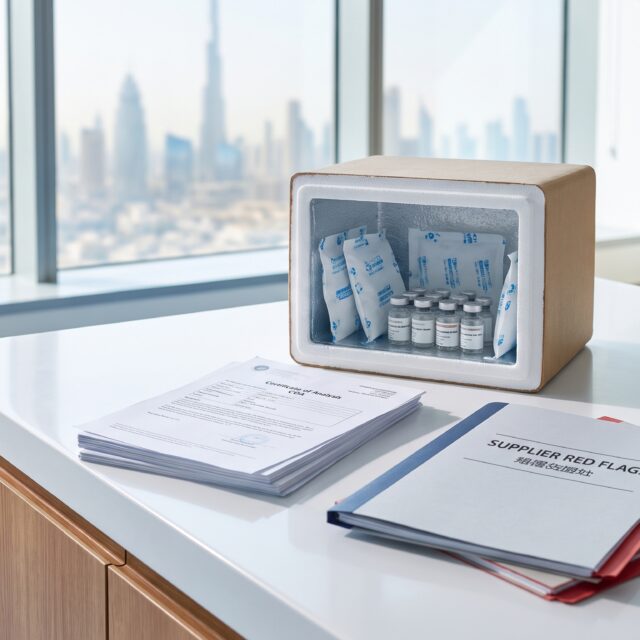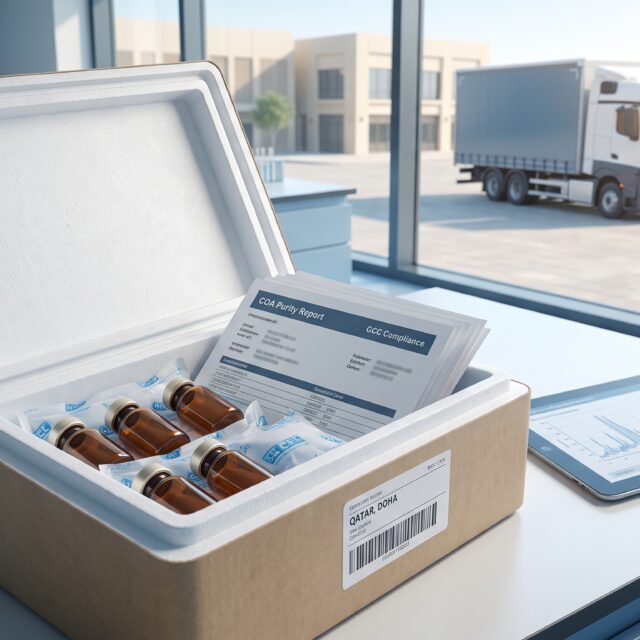



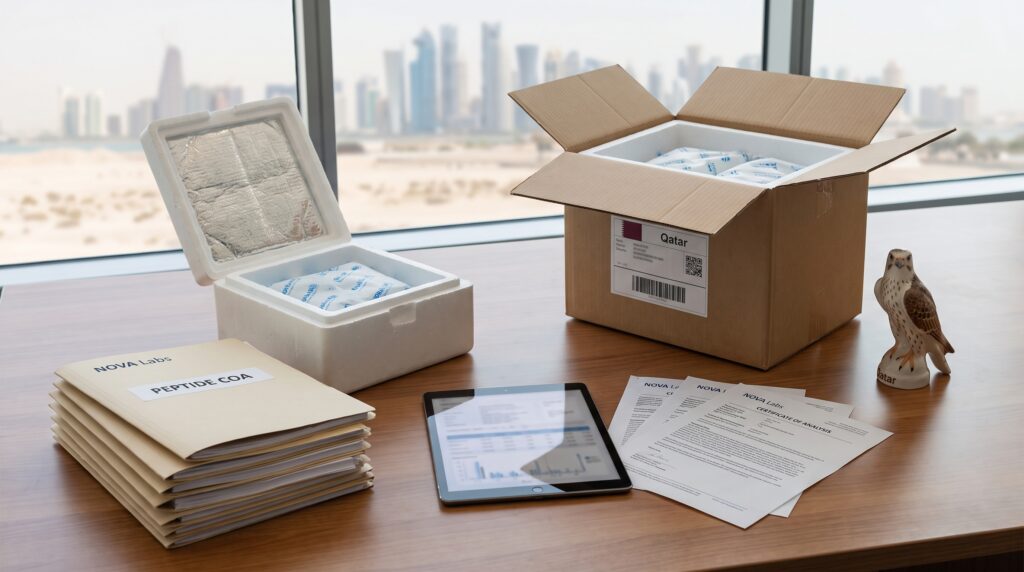
Procuring high-quality compounds for laboratory work requires meticulous vetting, especially when operating in the GCC. For researchers and procurement specialists in Doha, Dubai, and beyond, understanding how to read peptide coa qatar and UAE reports is the foundational step to ensuring your laboratory receives authentic, structurally verified materials. Sourcing research peptides involves navigating regional challenges—from extreme summer temperatures exceeding 45°C to strict import regulations managed by the Ministry of Public Health (MoPH) in Qatar and the Ministry of Health and Prevention (MoHAP) in the UAE. A comprehensive Certificate of Analysis (COA) is your primary defense against synthesis impurities, degraded compounds, and templated documentation fraud.
Quick Checklist: How to Read Peptide COA Qatar
To quickly audit a peptide COA in Qatar or the UAE, verify three distinct metrics: High-Performance Liquid Chromatography (HPLC) results showing at least 98% purity, Mass Spectrometry (MS) confirming the theoretical molecular weight matches the observed weight within 0.5 Daltons, and a lot number matching your physical vial perfectly.
The Anatomy of a Legitimate Peptide COA
A Certificate of Analysis is only as reliable as the data it presents. When sourcing from premium channels, the COA should not be a simple text document making broad claims; it must contain specific, detailed analytical charts. Navigating a ‘how to read peptide coa guide qatar’ search often yields generic results, but serious laboratory technicians must specifically break down the two main pillars of legitimate compound testing: High-Performance Liquid Chromatography (HPLC) and Mass Spectrometry (MS).
Without both of these tests clearly displayed on the documentation, a researcher cannot establish a reliable baseline for their in-vitro studies. Let us examine exactly what these charts mean and what thresholds are required for analytical-grade research.
Analyzing HPLC Purity Charts
High-Performance Liquid Chromatography (HPLC) acts as the primary ‘cleanliness’ metric. During the complex chemical process of peptide synthesis, incomplete or truncated amino acid chains frequently form. These are natural byproducts of the manufacturing process, but they must be rigorously filtered out before the compound is cleared for research use.
HPLC works by passing the sample through a column (the stationary phase) using a pressurized liquid solvent (the mobile phase). Different molecules in the sample interact differently with the column material, causing them to exit the column at different times (the retention time).
When reviewing an HPLC chart on a COA, you are looking for a dominant, sharp peak on the chromatogram graph. The area under this primary peak represents the target compound, while any smaller fluctuations along the baseline indicate residual impurities. For research-grade applications, the standard threshold is a minimum of 98% purity. Anything falling below this margin introduces unwanted variables into your experimental environment, potentially skewing data, causing unpredictable chemical reactions, or compromising the integrity of cellular assays.
Verifying Structural Identity with Mass Spectrometry
While an HPLC chart tells you how clean a sample is, it cannot confirm what the sample actually is. A batch could theoretically register as 99% pure on an HPLC chromatogram but contain an entirely wrong amino acid sequence due to a synthesis error or mislabeling. This is where Mass Spectrometry (MS) becomes a critical component of your documentation audit.
Mass Spectrometry measures the mass-to-charge ratio (m/z) of the molecules within the sample. Because every specific peptide sequence consists of a defined chain of amino acids, it possesses a precise, theoretical molecular weight. A legitimate COA should explicitly list both the theoretical mass (what the molecule should weigh) and the observed mass (what the testing equipment actually recorded).
When reading the MS chart, ensure the observed mass matches the theoretical mass within an acceptable variance of 0.5 Daltons (Da). If the variance exceeds 0.5 Da, the molecular structure is likely incorrect. It may be missing an amino acid, retaining a protective group from synthesis, or suffering from a critical manufacturing error. A mismatch here means the compound is useless for accurate research.
The Batch Traceability Audit: Spotting Forged Documents
Unfortunately, not all documentation provided by online vendors is legitimate. A critical skill in understanding how to read peptide coa in qatar and the wider GCC is the ability to spot forged, generic, or outdated certificates.
Many low-tier suppliers purchase a single batch of high-quality peptides, test it once, and then use that same COA for years across entirely different manufacturing runs. To safeguard your laboratory’s procurement, implement a strict batch traceability audit:
- Check the Lot Number: The lot or batch number printed on the COA must perfectly match the lot number printed on the physical vial you receive. If the supplier refuses to provide batch-specific documentation prior to purchase, consider it a major warning sign.
- Verify Testing Dates: Pay close attention to the date the analysis was performed. Peptides stored properly can last for years, but a COA dated five years ago suggests poor inventory rotation, reused documentation, or potentially degraded materials.
- Look for Third-Party Credentials: Reputable suppliers rely on independent, third-party analytical laboratories to perform HPLC and MS testing. Check if the testing facility is named and possesses standard laboratory accreditations (such as ISO certifications). An in-house COA without third-party verification requires a higher degree of scrutiny.
Overcoming GCC Logistics: Thermal Stress and Regional Delivery
Beyond documentation, the physical integrity of your research materials depends heavily on regional logistics. A perfectly pure peptide verified on a pristine COA can quickly degrade if improperly handled during shipping. The extreme summer climate in the GCC—where tarmac temperatures frequently exceed 50°C in Dubai, Abu Dhabi, and Doha—introduces significant thermal stress risks.
Fortunately, high-quality research peptides are formulated using lyophilization (freeze-drying). This process removes nearly all water content from the vial, halting the hydrolysis pathways that cause rapid degradation. While in their dry, lyophilized state, peptides are surprisingly resilient to short-term ambient heat exposure during transit.
However, prolonged exposure to extreme temperatures must still be avoided. This is why localizing your supply chain is highly advantageous. Utilizing a supplier with established regional infrastructure minimizes transit times drastically. For instance, prioritizing services like peptides UAE next day delivery ensures that temperature-sensitive shipments spend the absolute minimum amount of time in transit hubs, maintaining the chemical integrity proven on the COA.
Storage Protocols for GCC-Based Labs
Once a verified shipment clears customs and arrives at your facility, immediate and correct storage procedures are critical to maintaining the purity levels you just audited on the COA.
Managing Lyophilized Vials
For long-term storage of dry, lyophilized peptides, vials should be immediately placed in a laboratory freezer at -20°C (or up to -80°C for extended archival purposes). However, a common mistake researchers make is opening a cold vial immediately upon removing it from the freezer. In a humid, air-conditioned laboratory environment—common in Qatar and the UAE—opening a cold vial causes ambient moisture to instantly condense inside the glass. This introduces water to the lyophilized powder, ruining its freeze-dried stability.
Always allow the sealed vial to equilibrate to room temperature inside an airtight container or desiccator before removing the cap.
Handling Reconstituted Liquids
Once bacteriostatic water or sterile saline is introduced to the vial for laboratory assays, the peptide becomes liquid and its chemical stability window shortens drastically. Reconstituted peptides must never be frozen (as expanding ice crystals will shear and destroy the delicate molecular bonds) and must instead be stored securely in a dedicated laboratory refrigerator operating between 2°C and 8°C.
Sourcing Safely: Support, Payment, and Compliance
Procuring high-grade materials in Qatar and the UAE requires navigating local regulatory frameworks and ensuring reliable vendor communication. Attempting to source unknown compounds from overseas vendors lacking proper chemical documentation frequently results in customs seizures, delays, or the destruction of expensive research materials by border authorities.
Working with an established GCC-based supplier streamlines this process. Premium vendors provide dedicated support channels, such as direct WhatsApp communication, to facilitate instant COA verification before a purchase is even made. Furthermore, regional suppliers offer localized, secure payment gateways, removing the friction of international wire transfers while providing clear, batch-tracked documentation that satisfies local compliance requirements.
Bottom Line & Next Steps
Mastering how to read peptide coa qatar and UAE documentation is non-negotiable for serious researchers. Always demand batch-specific testing, verify that HPLC purity exceeds 98%, and confirm structural identity through Mass Spectrometry. Combine this rigorous documentation audit with optimized local logistics and strict cold-chain handling upon arrival, and your laboratory will secure the most accurate foundation for its ongoing studies.
If you are ready to source fully verified, analytically tested compounds backed by rapid GCC logistics and verifiable batch documentation, explore our full range of research-grade peptides today, or reach out to our technical support team for immediate COA verification.
*
Disclaimer: NOVA Labs products are strictly for laboratory research and analytical purposes only. They are not intended for human or animal consumption, diagnostics, or therapeutic use. Researchers must strictly adhere to all local safety and handling regulations during their studies.
References
- National Center for Biotechnology Information (NCBI). (2022). High-Performance Liquid Chromatography (HPLC) in Peptide Analysis.
- American Chemical Society (ACS). (2023). Mass Spectrometry Basics for Synthetic Peptides.
- Ministry of Public Health (MoPH) Qatar. (2024). Guidelines for the Importation of Laboratory Chemicals and Reagents.
- UAE Ministry of Health and Prevention (MoHAP). (2023). Cold Chain Management and Good Distribution Practice for Laboratory Supplies.
Disclaimer: The products mentioned in this article are for research purposes only and are not intended for human consumption.
- How to Read a Peptide COA (Real vs Fake)
- How to Read a Peptide COA (Certificate of Analysis): 2026 Guide
- Peptide Certificates of Analysis: How to Read and Verify a COA (2026 Guide)
- Peptide Storage Temperature Bahrain: Lab & Handling Guide – NOVA Labs
- My Peptides Arrived Warm With No Ice — Are They Ruined?
- Need MoPH Approval Before Importing to Qatar?
- Peptide Stability in Transit: The Evidence-Based Guide to Shipping Risks and Storage Realities
Frequently asked questions
What is the minimum acceptable purity on a peptide COA?
For accurate laboratory research, a high-quality peptide should demonstrate an HPLC purity level of 98% or higher. This strict standard minimizes the presence of synthesis byproducts that could negatively impact in-vitro data.
Why is Mass Spectrometry (MS) required on a COA?
Mass Spectrometry confirms the exact molecular weight of the compound. This ensures the correct amino acid sequence was synthesized, verifying the chemical's structural identity rather than just its overall cleanliness.
How can I tell if a peptide COA is fake or reused?
To spot a generic or fake COA, ensure the document includes detailed HPLC and MS charts rather than just text, verify the test date is recent, and confirm that the unique lot number printed on the document exactly matches the physical vial you received.
Will UAE or Qatar summer heat destroy shipped peptides?
Research peptides are lyophilized (freeze-dried), making them resilient to short-term ambient heat exposure during transit in the GCC. However, to preserve maximum chemical integrity, utilizing rapid local delivery and transferring them to a -20°C freezer upon arrival is highly recommended.
Can I request batch-specific COAs before purchasing in the GCC?
Yes, reputable suppliers operating in the UAE and Qatar will readily provide batch-specific, third-party tested COAs upon request, often facilitating these document checks via direct support channels like WhatsApp prior to procurement.
Nova Labs buyer tools
Ready to verify stock, testing and delivery?
Use the product page and lab report section to check availability, documentation, delivery timing and support before placing an order.
- COA / test-report checks
- Qatar delivery context
- Cold-chain handling
- COD and card payment options
- WhatsApp support